EAS4200 Aerospace Structures, Lecture 2, 2026 Fall
Overview
Ting Dong connects aircraft structural design to the failure modes engineers must prevent, explaining how spars, ribs, skins, and stringers carry bending and shear while fatigue, deformation, creep, and buckling threaten safety. Examples include Aloha Airlines fatigue damage, pressure and wing-load cycles on each flight, composite delamination, and turbine-blade creep; the lecture also outlines exam scheduling and the semester’s structural topics.
Key takeaways
- A flight is a fatigue cycle for a pressurized fuselage: cabin pressure creates hoop and longitudinal stress in the air, then those stresses relax after landing.
- Wing-root fatigue comes from load reversal: lift bends the wing upward in flight, while the wing, fuel, and engine weights bend it downward on the ground.
- Fastener holes can raise local stress to roughly three times nominal stress and may contain manufacturing or repair microcracks that become fatigue-crack initiation sites.
- Composite construction can reduce fastener-hole concerns, but internal delamination may be harder to detect than surface-visible cracking in metal structures.
- Excessive deformation is a structural failure concern even before rupture: accumulated plastic strain can remain after landing, and excessive wing deflection can threaten lift or ground clearance.
- Turbine-blade creep combines sustained centrifugal stress with high temperature, potentially stretching a blade until it rubs the engine casing.
Chapters
- Exam 2 is confirmed for Friday night because the only available classroom can accommodate the course’s 160 students.
- Ting Dong plans to request a different room or time for Exam 3 because many students have an EAS4510 Astrodynamics conflict.
- Students with a MAS3114 Computational Linear Algebra conflict can receive an accommodation for Exam 1; any exam-time change may also shift a quiz.
- Wing spars carry bending loads: in flight, the lower surface is in tension and the upper surface is in compression.
- Ribs maintain the airfoil shape and carry shear associated with torsion, including loads from nonuniform lift and deployed flaps.
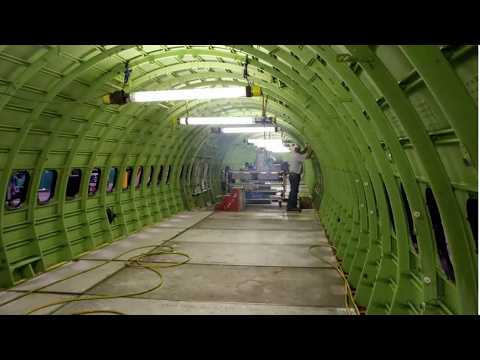
- Aluminum wings use fasteners to join stringers, frames, and skin, while integrated composite construction can avoid many fastener holes.
- Composites can conceal internal delamination, unlike many metal cracks that are visible at the surface; both materials therefore have distinct inspection challenges.
- The Aloha Airlines fuselage failure illustrates how a fatigue crack can pass from stable growth to rapid, unstable propagation.
- Nighttime manual inspection missed cracks, highlighting the importance of detecting damage before one more load cycle causes rupture.
- Cabin pressurization produces hoop and longitudinal stresses in the fuselage during flight, which relax on the ground and repeat with each flight.
- Wing-root stresses reverse between flight lift and ground loads; fastener-hole stress concentrations can reach roughly three times nominal stress, while engine vibration adds many more fatigue cycles.
- If fuselage stress exceeds yield strength, plastic deformation remains after landing and can accumulate over repeated flights.
- A Boeing 787 with an approximately 200-foot wingspan can have about 26 feet of upward wing-tip deflection in normal flight.
- Excessive wing deflection can reduce effective lifting area in flight or bring a wing tip dangerously close to the ground.
- Turbine blades face centrifugal stress and high temperature; creep can elongate a blade until it rubs the engine casing and breaks.
- Cabin pressure primarily creates tensile stress, so it does not explain the compressive stress that causes the illustrated fuselage-skin buckling.
- Yaw moments from aircraft control corrections can bend the fuselage, placing one side in compression and the opposite side in tension.
- The compressed skin can buckle locally, while the tensile side instead raises concern about stress exceeding yield strength.
- The course will begin with failures under static loading and then examine shear flow and shear stress in aircraft structures.
- Ting Dong expects to spend about one month on fatigue, reflecting its importance in aircraft maintenance and structural engineering.
- Additional planned topics include creep, deflection, and buckling, depending on the time available.
Transcript excerpt
0:00 So, uh I I got confirmation from UF about the exam uh reservation. So, um the second exam, they chose the third option, which is on Friday night. Uh if you have something scheduled that Friday night, if you have hope this early enough to where you can see now. Uh well, we can have exam party together. So, um and I also received email this morning, how many of you are taking EAS 45 10 astrodynamics and have the exam conflict um December 2nd. Seriously? Okay. Um how many of you are taking the MAS 3114 computational linear algebra, which is
0:50 the exam one is on December 21st. Oh, no, sorry. Sorry. Sorry. September 21st. September 21st. Okay. Uh I guess the third exam is the biggest problem. Um I will ask department to reserve a new um classroom for exam three. The second exam is the MAS 3114. What? The second exam? Yeah, the second exam. So, I I told you in the last class that I uh submitted request and option one, option two, option three, and I put the Friday night as option three because I know that most of you do not like to have any exam on Friday night, but uh somehow um the only classroom available for a class like this size, 160 students, is on
1:40 Friday night. So, we need to take on Friday night. I already put that one in syllabus, so that way exam two is confirmed. Uh and I think exam one should be fine because if it's like um I I will do accommodation for any of you who are taking the uh MAS 3114. Uh that's a similar exam, so it's higher priority than this class. Uh I will do a combination, but for yes, 4510, I will
This is the start of the transcript. Save this video free for the whole transcript, searchable and time-coded.
In this course
Related notes
Summary, takeaways, and chapters were generated by AI from the video's transcript and may contain errors. The video belongs to its creator, Ting Dong.