EAS4200 Aerospace Structures, Lecture 34, 2026 Fall
Overview
Ting Dong works through a thin-walled open-section shear-flow and shear-center problem, emphasizing how to determine each segment’s centroid coordinate, integrate varying shear flow for moment, and use symmetry to simplify calculations. The lecture also explains why the shear center can lie outside the material, clarifies sign conventions and moment-of-inertia approximations, and covers exam preparation and course logistics.
Key takeaways
- For a thin-walled open section, calculate shear flow segment by segment using the area and centroid coordinate associated with each local cut; an inclined wall requires projecting its centroid position onto the relevant axis.
- Choose the shear-center moment reference strategically: flows whose lines of action pass through that point create no moment, and symmetry can reduce the calculation to one side multiplied by two.
- Shear flow that varies with wall coordinate s must be integrated to obtain its resultant moment; treating a function of s as a constant produces an incorrect moment.
- The shear center is defined by zero twist under transverse loading, not by the cross-section’s geometric centroid, and it can lie outside the physical material.
- The coordinate direction for s is arbitrary, but the shear-flow sign convention is not interchangeable between Aerospace Structures and Mechanics of Materials; preserve the equation’s sign to infer flow direction.
- Small thickness-cubed terms in a thin-walled section’s inertia may be negligible compared with parallel-axis terms, while material removed near the neutral surface has little influence on bending inertia.
Chapters
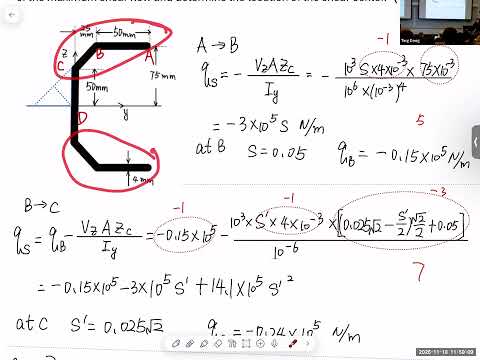
- The practice problem asks for maximum shear flow and shear-center location in a symmetric open cross-section under bending and transverse shear.
- Use the shear-flow relation based on VQ/I, calculating the area and centroid coordinate separately for each wall segment.
- For the inclined segment, project its midpoint distance onto the z direction; the example uses a 45-degree angle and 25 mm dimensions.
- Ting Dong uses point D as the moment reference, which makes shear flow on segments whose lines of action pass through D contribute no moment.
- Symmetry allows the moments from the upper and lower portions of the section to be calculated once and doubled.
- The shear-center location is a cross-section property, so changing the moment reference changes the reported distance from that point, not the physical location.
- For a downward transverse load on a C-channel, the internal shear flow produces a twisting tendency that the wall reaction must counterbalance.
- The shear center is the load application point where the transverse force causes bending without twisting the cross-section.
- Ting Dong recommends reasoning from the force and torque directions rather than relying on memorized positive and negative shear-flow conventions.
- The moment contribution from segment A to B is integrated over 0 to 50 mm, using the segment’s shear-flow expression and its 75 mm moment arm about D.
- For segment B to C, the moment arm is based on the perpendicular distance to D; the symmetric lower segments are included with a factor of two.
- A shear-flow expression containing terms in s or s squared is not constant, so its moment must be integrated rather than approximated as a constant flow times distance.
- The s coordinate along a wall is an arbitrary calculation reference and can be defined in either direction if used consistently.
- The applied shear force V determines the calculated flow magnitude and direction, but the shear-center location itself does not depend on the load magnitude or direction.
- Ting Dong explains positive internal shear using a beam free-body diagram, while noting that Aerospace Structures and Mechanics of Materials may use different sign conventions.
- A shear center may lie outside the material, as for an open channel, because its purpose is to eliminate torsion under transverse loading, not to mark the geometric centroid.
- When the cross-section has the relevant symmetry, the shear center lies on the symmetry axis; for the discussed section, only its distance from the z-axis needs to be found.
- For a rectangular section’s second moment of area, the example uses parallel-axis contributions for the flanges and neglects small thickness-cubed terms.
- A small opening near the neutral surface has little effect on bending inertia because bending stress is zero at the neutral surface.
- Ting Dong says the exam will contain four calculation problems and may combine fatigue with other course topics, including nonzero-mean fatigue.
- Completing the Gator evaluation and submitting a Canvas screenshot showing the course and completion status earns one point toward the final grade.
- The recommended textbook is by C. T. Sun, and Ting Dong directs students to the recorded class explanation for the exam problem solution.
- The negative sign in the shear-flow equation reflects a convention difference from Mechanics of Materials, where positive internal shear may be defined by its rotational effect.
- With the Aerospace Structures convention, positive shear stress integrates to positive internal shear force; the computed flow sign indicates whether it follows or opposes the chosen s direction.
- Ting Dong confirms that keeping the equation’s negative sign is useful when the problem requires determining shear-flow direction.
- Students may choose a different point, such as B instead of D, to calculate shear-flow moments; the resulting shear-center distance must be measured from that same reference.
- A student’s alternate solution to the extra-practice problem is acceptable if it reaches the same result through a consistent moment balance.
- Ting Dong invites students to email to schedule individual help and confirms that office-hour support is available.
Transcript excerpt
0:00 Let's start from the extra practice problem I uploaded. Hope you guys um already try to solve this problem yourself. Let's talk about the solution. Uh I I want to emphasize here again. It's completely different thing that you can understand my solution and you can solve the problem yourself. You know what I mean? You want to try to solve every problem yourself and see which part you didn't understand. You want to expose all your mistake. The place you may get stuck before the exam, not during the exam. Um so please don't try to like oh I see the solution. I understand it. I got it. Um you'll get stuck in exam. Um so so this was extra practice I I extra practice
0:49 problem I uploaded yesterday. And for this one, well, the basic idea is the same, right? Uh the basic idea is the same. So, we have this this this cross-section shape and we have a bending applied and a transverse force applied and this is a internal sheer force and we have the cross-section dimension of course. And now we need to determine the maximum shear flow and determine the location of the shear center. So very similar to what we did in class, the example problem and very similar to the third homework problem you did yesterday. And the only thing different here is that this part right. So for this part of course uh VQ of I V a Z about a Z is the
1:39 Q of V given I Z given and yeah for this for this one it's given. So the the key thing here of course a is still the same no matter it's like horizontal, vertical or this inclined. Um so a the same the thing is about the DC the coordinate of the cent
This is the start of the transcript. Save this video free for the whole transcript, searchable and time-coded.
In this course
Related notes
Summary, takeaways, and chapters were generated by AI from the video's transcript and may contain errors. The video belongs to its creator, Ting Dong.