CSCD 420 Nov 06 2026
Overview
Chris Cain designs a Turing machine for A^nB^n using X and Y tape markers, then extends the approach to A^nB^nC^n and explains how instantaneous descriptions record a machine's complete resumable configuration. The lecture also demonstrates unary addition with a compact tape rewrite, discusses input validation and edge cases, and introduces upcoming questions about whether Turing-machine augmentations change computational power.
Key takeaways
- Marking matched A's with X and B's with Y lets a Turing machine recognize A^nB^n by repeatedly pairing one symbol from each block and then checking for leftover B's.
- A Turing machine must use distinct states for rightward and leftward scans when their transitions differ; combining them can create infinite loops.
- Instantaneous descriptions capture the tape, head location, and current state, so a computation can be resumed without storing its execution history.
- Adding unary values can be done by erasing one 1 and converting the separator 0 into a 1, preserving the total count while joining the two runs.
- Turing machines can recognize A^nB^nC^n by marking matching A, B, and C symbols in each pass, demonstrating power beyond context-free languages.
- Undefined transitions provide rejection in these recognizers, while a transducer uses its tape to produce an output rather than only an accept-or-reject result.
Chapters
- The new assignment is expected next Thursday because Wednesday is a holiday; graded exams are expected back by the middle of next week.
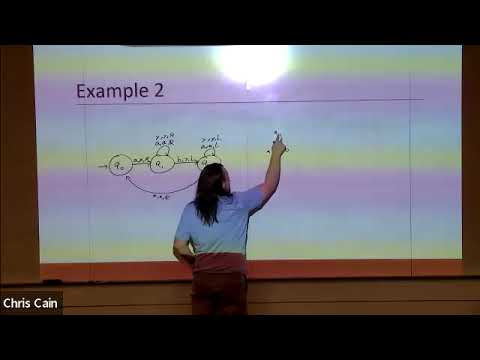
- The class returns to designing a Turing machine for A^nB^n, a language previously used to distinguish regular from context-free languages.
- The proposed strategy marks processed A's as X and matched B's as Y.
- The initial state Q0 expects an A, replaces it with X, and moves right into Q1.
- Q1 moves right over A's and previously marked Y's until it finds the next unmatched B.
- On that B, the machine writes Y and switches to a separate left-moving state, avoiding direction conflicts in one state.
- Q2 moves left over A's and Y's until it reaches an X, which marks the boundary of already processed A's.
- On X, the machine preserves the marker, moves right, and returns to Q0 to begin another matching pass.
- Separating right-moving and left-moving behavior prevents the machine from looping back and forth over the same symbols.
- A walkthrough on AABB shows the machine changing the first A and B to X and Y, then repeating the pairing process.
- After all A's are matched, Q0 scans past Y markers and accepts when it reaches a blank, ensuring no extra B remains.
- A separate initial state or an extra verification state prevents accidental acceptance of the empty string when the target requires n ≥ 1.
- Any undefined transition halts and rejects; the machine accepts the language rather than outputting a transformed string.
- Transition-list labels can group operations such as marking an A, finding a B, returning left, and validating the tape.
- An instantaneous description records the tape contents, current state, and read-write-head position around a turnstile.
- The final description is enough to restore the machine and continue, without needing its earlier execution history.
- To recognize A^nB^nC^n, the machine marks an A as X, the corresponding B as Y, and the corresponding C as Z during each pass.
- The machine needs additional right-moving states to distinguish searching for the first B from moving across the remaining B's toward a C.
- On the return trip, it crosses marked Z's, C's, Y's, B's, and A's until it reaches an X, then validates that only markers remain.
- This language is not context-free, showing that Turing machines recognize languages beyond those handled by context-free grammars and pushdown automata.
- Cain describes a Turing machine as capable of simulating algorithms written in any programming language, including computations such as video playback or an LLM.
- A Turing machine can act as a transducer by transforming input on its tape into output, rather than only accepting or rejecting.
- The model is a theoretical foundation for computation, though expressing ordinary programs in its low-level transitions would be verbose and error-prone.
- The exercise encodes positive integers X and Y as runs of 1s separated by a 0, then asks the machine to leave X + Y on the tape.
- For example, the input for 3 + 4 is 1110111, where the number of tally marks represents each value.
- Students can replace the input with the result; Cain gives time to design a machine before discussing a compact solution.
- The compact method erases the first 1, reducing the total count by one, then changes the separator 0 into a 1, restoring one mark.
- The machine scans to the separator, converts it, then moves across the remaining 1s to the ending blank and halts.
- For 1110111, the rewrite leaves seven 1s, representing 3 + 4 without moving the separator to the end.
- An extra state can verify that the input contains exactly one separator and no unexpected symbols; such validation should be included when the specification requires it.
- The basic addition machine assumes both unary inputs are positive; it needs an added transition from Q0 on 0 to handle a first operand of zero.
- The textbook alternative moves the separator to the end of the tape, which works but requires more transitions than changing the separator into a 1.
- The next class will examine modifications to the base Turing machine and determine whether they recognize new language classes or remain equivalent in power.
- The assignment is forthcoming, and Cain notes that the LaTeX homework document already contains questions students can begin.
Transcript excerpt
0:02 All right, time to get started. We are getting a new assignment today that, as mentioned a minute or so ago, we'll probably be due next Thursday, since Wednesday is technically a holiday and I don't like to make things due on a holiday, unless you're in my other class, which case that doesn't count. I have something for them due over the holiday. Sorry to those of whom I'm contradicting myself. So, last time I also handed off the exams to the grader. So, I'll be looking over those probably early next week to make sure that I agree with the gradings before I pass them back. But, I expect to have those back to you by the middle of next week.
0:52 Last time we were getting further examples of Turing machines, and we went from understanding their basic transitions to starting to solve some problems with them. And I left you with this problem to solve between yesterday and today, so I'd like to go over a solution. But, let's go ahead and take a look at the example one more time. We're looking at the first language that we covered when we started talking about context-free languages, which was A to the N B to the N. It was the first example we used for the regular pumping lemma that showed that the language wasn't regular, that it was context-free, but how easy is it to produce a context-free language with a Turing machine? So, I gave you the hint of we should use a couple of tape characters that are not in our language to represent the idea of
1:41 this character has been read and processed, because with this string we're trying to map or match A's with B's. And so, we would see an A and then move
This is the start of the transcript. Save this video free for the whole transcript, searchable and time-coded.
In this course
Related notes
Summary, takeaways, and chapters were generated by AI from the video's transcript and may contain errors. The video belongs to its creator, Chris Cain.