CSCD 420 Sep 28 2026
Overview
Chris Cain moves from formal grammars to automata in CSCD 420, explaining how equivalent grammars can use different production rules and how to justify that a grammar generates exactly its intended language. He then introduces automata as computational models and defines deterministic finite acceptors using five components, before demonstrating how a DFA processes binary strings through states and transitions.
Key takeaways
- A grammar is correct only if it is both complete, generating every string in the target language, and sound, generating no strings outside it.
- Equivalent grammars may use different numbers of nonterminals and production rules; logical equivalence and a clear explanation matter more than matching one example solution.
- A deterministic automaton's next move is determined by its current configuration and transition rules, while a nondeterministic automaton may have multiple possible next moves.
- A deterministic finite acceptor has five defining components: states, input alphabet, transition function, initial state, and final states.
- An acceptor classifies input with a yes-or-no result, while a transducer can produce outputs such as the sum generated by a binary adder.
- To simulate a DFA, consume one input symbol per transition and decide acceptance from the final state reached after the entire string is read.
Chapters
- Chris Cain offers time after class to help with the first assignment and verify solutions before submission.
- A question about Roman numeral limits raises how a grammar should handle repeated symbols such as M; Cain says he needs to check the assignment's intended upper bound.
- The assignment is due Wednesday, and Cain expects the next assignment to arrive around then.
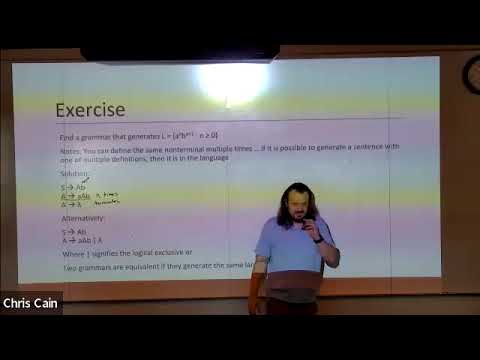
- The class reviews grammars for producing strings with matching numbers of a's and b's, including a rule that adds the final extra b.
- A vertical bar in a production means either destination is allowed, equivalent to writing two separate production rules.
- Different grammars can generate the same language, so a solution does not need to match Cain's exact notation if it is logically equivalent.
- A grammar may use any uniquely identifiable nonterminal symbols, provided the terminal and nonterminal sets do not create ambiguity.
- Additional nonterminals are acceptable when they help represent the language; minimizing them is a later concern, not a requirement for early solutions.
- Cain's explanation traces recursive productions that add an a and b while preserving their order, then uses the empty string as the recursion's base case.
- A grammar explanation should make the reasoning understandable and show why the rules generate the intended strings.
- A complete homework answer should give the production rules, state the grammar's quadruple, and explain why the grammar is correct.
- Correctness requires both directions: every string in the target language must be generatable, and no string outside that language may be generated.
- Cain compares a shorter grammar with one fewer nonterminal and production rule to show that different structures can express the same recursive process.
- An automaton is an abstract model of a digital computer, with an input mechanism, control states, and possible output or temporary storage.
- The input is read as a string from left to right, one character at a time, without moving backward to reread earlier characters.
- For language recognition, an automaton determines whether the completed input string belongs to the language it represents.
- Automata operate in discrete steps, generally consuming one input character and taking a transition at each step.
- A configuration records the current control state, the current position or symbol in the input, and any contents of temporary storage.
- A move or transition changes one configuration into another according to the automaton's transition rules.
- Knowing the complete configuration and the transition rules makes the next step predictable for a deterministic machine.
- A deterministic automaton has one uniquely determined next move for each applicable configuration; a nondeterministic automaton may allow multiple possible moves.
- An acceptor returns a yes-or-no result about whether an input string belongs to a language.
- A transducer produces an output string; Cain gives a binary adder that computes the sum of two binary inputs as an example.
- Automata support programming-language syntax, compiler token recognition, formal verification, language translation, and hardware such as binary adders.
- A deterministic finite acceptor is defined by five components: a state set Q, an input alphabet, a transition function, an initial state, and a set of final states.
- The transition function specifies a next state for every pair consisting of a current state and an input symbol.
- After the input ends, the machine accepts if its current state is final and rejects otherwise.
- Cain recommends meaningful state names, such as Q-even for a state representing an even number of zeros read, instead of relying only on labels like Q0 and Q1.
- A DFA transition consumes the current input symbol, changes state according to the transition function, and advances the input position.
- Transition graphs make the machine easier to simulate than an abstract table or formula alone.
- The initial state must be marked with an incoming start arrow; Cain notes that omitting this detail costs a point on a problem.
- The example DFA uses a binary input alphabet and marks Q1 as its accepting state.
- Students test possible interpretations of a three-state DFA, discovering that simple guesses such as counting ones or checking whether input is binary do not explain all outcomes.
- Cain demonstrates a trace on the binary string 0101101011, following its state changes and concluding that the machine accepts it.
- The class is asked to infer the full language recognized by the DFA as a follow-up challenge, with further practice planned for the next class.
Transcript excerpt
0:03 All right, since I have been in here before, somebody who is provoked, tell me you can hear me or do nothing and tell me that you can't hear me by doing that. >> Excellent. Sound is working. Video is I think we're good to go. We have an assignment up and running. How's that going? [clears throat] >> Like the homework? >> Yeah. Going all right. I'll have an hour after class between my classes and some time after that as well. If you are stuck and or would like some assistance getting started or you'd like to work through some of your answers with me,
0:50 I'd be happy to, especially on this first assignment, although it will remain true throughout the quarter, verify some of your work, even if you think you understand this, just getting that is this what you're looking for? Is this what those are common kinds of questions that I'm glad to take time to make sure that we're on the same page about before you just submit something and then get feedback. you weren't expecting. Nobody likes that. >> I had a question about the Roman numeral one. >> Yeah. >> Um so like for example like you only use like one M for like Roman numerals. >> Yeah. >> But like for C you use you can use up to is it one or two? Is that 50? >> You use one and what's the one I add after that? It's >> for C >> you can use what is it? Three L's
1:39 >> you can use a good few of them. So yeah, coming up with grammarss for for that. >> Okay. I just want to make sure that we're on the same page. Got it. >> But for that problem, we should account
This is the start of the transcript. Save this video free for the whole transcript, searchable and time-coded.
In this course
Related notes
Summary, takeaways, and chapters were generated by AI from the video's transcript and may contain errors. The video belongs to its creator, Chris Cain.