CSCD 420 Nov 03 2026
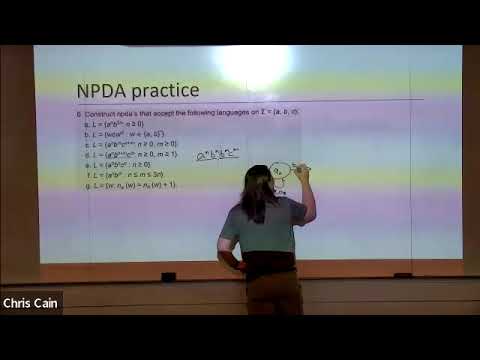 Watch on YouTube →
Overview
Chris Cain reviews formal-language topics for an upcoming exam, focusing on how transition choices distinguish deterministic pushdown automata (DPDAs) from nondeterministic ones and how stack designs recognize languages such as aⁿbⁿ⁺ᵐcᵐ. The session also practices proving grammar ambiguity, interpreting NPDA and context-free grammar rules, and designing grammars for prefix conditions and recursively nested patterns.
Key takeaways
- A DPDA is deterministic only when each state, input-symbol, and stack-top-symbol combination permits at most one transition.
- Grammar ambiguity is established by finding one string with two different parse trees, or equivalently two distinct derivations.
- For aⁿbⁿ⁺ᵐcᵐ, a stack can first match A characters against B characters, then use a different marker to match the remaining B characters against C characters.
- A pushdown automaton can recognize a required first-and-last-A pattern without counting middle B characters by keeping only a single stack marker.
- A language defined by a qualifying prefix followed by arbitrary text can be approached as the concatenation of a grammar for that prefix and a grammar for any suffix.
- Recursive productions that pair AA with BB can encode balanced nesting, a structure that ordinary regular expressions cannot generally count and match.
Chapters
- Chris Cain says assignment grades have stabilized and directs students to the newly published Assignment 5.
- He clarifies that a simple grammar is a specific grammar type, not merely a short or easy grammar.
- To test whether a pushdown automaton is deterministic, check for multiple moves from the same state using the same input symbol and stack-top symbol.
- The state, input character, and top-of-stack character identify the transition choice; multiple choices for that tuple create nondeterminism.
- Cain connects this constraint to simple grammars, where a nonterminal and terminal pair must determine a unique production.
- A grammar is ambiguous if one string has two distinct parse trees.
- The equivalent derivation test is to show two different production-application orders that generate the same string.
- Cain rewrites the target pattern as aⁿbⁿbᵐcᵐ to separate matching the A-count with initial B characters from matching additional B characters with C characters.
- The PDA pushes a stack marker for each A, then removes those markers as it reads the first matching B characters.
- When the stack returns to its bottom marker, further B characters push a second marker type that later C characters pop.
- The construction requires at least one B and one C for m ≥ 1; Cain notes that a correct solution need not use the fewest possible states.
- The transition diagram accepts a single A or strings that start with A, contain only B characters in the middle, and end with A.
- The stack holds at most one marker while B characters are read, so it records the need for a final A rather than counting the B characters.
- After the final A, the machine enters a state with no further input transitions, forcing that A to be the last character.
- The exercise asks whether some prefix of a string satisfies a balance condition involving the number of A and B characters.
- Cain restates the prefix test as checking successive initial segments, such as the first character, first two characters, and first three characters.
- He gives students time to attempt a context-free grammar before discussing construction strategies.
- One possible route is to build an NPDA that tracks the A/B balance on its stack, then convert the automaton to Greibach normal form; Cain warns this may take too long during an exam.
- A more direct route separates a qualifying prefix from an arbitrary suffix, then concatenates grammars for those two parts.
- The grammar must identify where the qualifying prefix ends, while allowing any remaining characters after that point.
- Cain recommends deriving the language's construction logic before writing productions, because starting too early can produce a tangled, error-prone grammar.
- Allowing a prefix component to derive the empty string can accidentally accept strings whose initial segment fails the required balance condition.
- The proposed repair separates a nonempty prefix derivation from a helper nonterminal that may derive λ, while preserving acceptance of the empty string where appropriate.
- The first grammar pairs each character added at the front with the opposite character at the back, such as A with B or B with A.
- Its language is an even-length opposite-mirror pattern, with the two halves related by reversal and character opposition.
- Cain says a precise English description is sufficient on an exam even when a compact mathematical notation is unavailable.
- The second grammar builds strings from paired AA and BB blocks with a recursive, balanced nesting structure, rather than merely producing arbitrary even runs.
- Each recursive choice matches an AA opening block with a BB closing block, allowing nested patterns analogous to balanced parentheses.
- Cain closes by offering office hours and access to additional practice questions.
Transcript excerpt
0:02 Hey, welcome to review part two for an exam we're taking tomorrow. Very exciting, I'm sure. At least get it over with. So, five was just turned around and published. So, feel free to take a look at that if you haven't already. The biggest issue that the greater let me know of from 045 is kind of a kind of a silly one. A simple grammar is a type of grammar and not just a really easy grammar or really short grammar. So I thought I would clarify that. What else? Other than that things seem to be reasonably good. We've kind of hit
0:50 a a stabilization point, I think, in terms of just looking at the class as a whole. In terms of terms of assignment grades, things are fairly stable. Not no wide variations. Any questions on schedule before we dive back into review? All right. I'm going to try to keep track of time well today because I want to make sure that I have some time to answer your questions, things that have come up over the last couple of days. But I wanted to address a couple of other topics that were brought up either in email after class in person. The first of those is the deterministic push down auto ina I had a request to go over DPDAS
1:40 and there's upon reflecting on this the type of question that you ask for a DPDA versus an NPDA is the same question the logic that you go through for that construction is the same logic the issue is in or the difference is in the actual construction and knowing and how to recognize when where the non-determinism is in your transitions. So I at least want to review that and go over that
This is the start of the transcript. Save this video free for the whole transcript, searchable and time-coded.
Related notes
Summary, takeaways, and chapters were generated by AI from the video's transcript and may contain errors. The video belongs to its creator, Chris Cain.