CSCD 420 Nov 05 2026
Overview
Chris Cain reviews deterministic Turing machines as tape-based computational models, explaining their read/write transitions, halting behavior, transducer outputs, and instantaneous descriptions. He then develops language-recognition examples, including an acceptor for 0⁺ and a tape-marking strategy for testing AⁿBⁿ by pairing symbols with X and Y markers.
Key takeaways
- A deterministic Turing machine transition is determined by the current state and scanned symbol, and specifies a new state, a written symbol, and a left or right head move.
- An undefined transition halts and rejects, while acceptance requires halting in a final state; an infinite loop is a distinct failure mode that may never produce a result.
- Instantaneous descriptions encode a configuration by inserting the current state immediately before the tape symbol under the head, as in ABQ1CD.
- The language 00* can be recognized with two scanning states: Q0 requires the first zero, and Q1 accepts when it reaches the blank after the remaining zeros.
- To recognize AⁿBⁿ, a Turing machine can mark matched A and B symbols as X and Y, then verify that no unmatched B remains.
- Blank tape cells should not be used as internal separators because the machine also relies on blanks to identify the end of the input.
Chapters
- Chris Cain frames a Turing machine as a deterministic state machine with finite control and an unbounded tape extending in both directions.
- At startup, the input is on the tape and the read/write head points to its leftmost character; the tape contents at halt represent the output.
- A transition reads the current state and tape symbol, then specifies a new state, a symbol to write, and a move left or right.
- Halting from a final state accepts, while halting from a non-final state rejects; an undefined transition also halts and rejects.
- The example starts in Q0 with the head on the first A of input AA.
- For each A, the machine writes B and moves right while remaining in Q0.
- On the blank after the input, the machine enters Q1, leaves the blank unchanged, and moves left.
- The next configuration has no defined transition, so the transducer halts with BB on the tape.
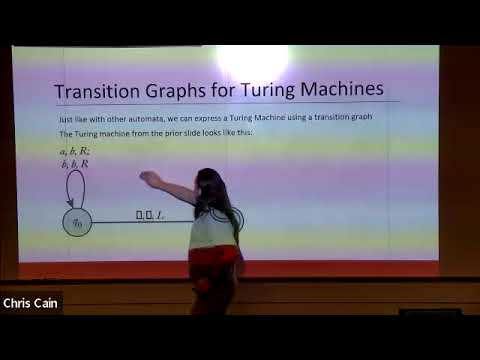
- Turing machine graph edges label three actions: the symbol read, the symbol written, and the direction of head movement.
- A machine that reads A in Q0 and moves right, then reads B in Q1 and moves left, loops forever on tape AB without changing either symbol.
- Unlike finite automata examples discussed in class, a Turing machine can repeat transitions indefinitely and fail to halt.
- Nondeterministic Turing machines can also be defined, although deterministic machines are used to model ordinary computers.
- A complete Turing machine configuration requires the control state, all relevant tape contents, and the read/write head position.
- Cain encodes all three in one string by placing the state symbol immediately before the tape character under the head.
- For tape ABCD with Q1 reading C, the instantaneous description is ABQ1CD.
- A transition that rewrites C as E and moves right to Q2 produces ABEQ2D, showing both the rewritten symbol and new head position.
- For language recognition, the query string starts on the tape with blanks on every other cell and the head positioned at the first input character.
- A string is accepted only when the machine halts in a final state after determining that the string belongs to the language.
- Failure can appear as a halt in a non-final state or as an infinite loop; a looping computation never returns a rejection result.
- Blank cells cannot safely serve as separators inside input because the machine would not know whether a blank marks the end or hides later tape content.
- The target language is 00*, meaning one required zero followed by any number of additional zeros.
- The machine uses Q0 to require the first zero, then Q1 to scan any remaining zeros by repeatedly moving right.
- When Q1 reads a blank, it moves left and halts in an accepting state.
- An input symbol such as 1 has no defined transition, so the machine halts and rejects without needing a separate reject state.
- The next target is AⁿBⁿ for n ≥ 1, which requires equal, nonzero counts of A symbols followed by B symbols.
- A pushdown automaton can count A symbols on a stack and match them against B symbols, but a Turing machine must implement a comparable procedure using its tape.
- Cain prompts the class to pair A and B symbols rather than trying to store the count in finite control or infer positions from an unknown input length.
- Writing blanks into the middle of the input is unsafe because blanks also indicate the tape's unfilled region.
- The proposed algorithm replaces each matched A with X and its corresponding B with Y, preserving the input's continuous nonblank region.
- After marking an A, the head moves right to find and mark the first available B, then returns left to continue matching.
- Repeated passes pair symbols until the A symbols have been processed; the machine must also check that no unmatched B remains after the Y markers.
- The exercise focuses on designing transitions for the marking and return steps, with roughly a dozen transitions considered plausible.
- Students work individually or together to turn the X/Y matching strategy into a transition list or state diagram.
- Cain confirms that a solution with about 12 transitions is a reasonable scale for the construction.
- The class runs short on time, so students are asked to finish the machine before the next day's review.
- Cain announces office hours starting immediately and another session from 1 to 3 for homework or project questions.
Transcript excerpt
0:02 All right. It's been almost a week since we talked about Turing machines. So, we're going to go back to talking about Turing machines. We have a project due on Sunday. TYK. We are working toward that second project, but it's a it's a ways out still. It's going to be the other parsing type that we're going to talk about after we talk about Turing machines, after we talk about the theory of computation, and talk about compilers in general. So, it's still it's still a ways out. I'm hoping to avoid a big crunch at the end of the quarter. So, we have to get to the content before I can assign it before it can be due. So, we'll see we'll see how that goes. So, we were talking about Turing
0:50 machines as a new class of state machine that has the same computational power as programs that we can write, which is wild and also cool. If we were looking at how a Turing machine defines its transitions, if we looked at its basic state, it is it has an internal state. So, it has the the same set of states that we've been working with as storage, both input storage and output storage. It has this infinite one-dimensional tape in both directions. We assume at the beginning of this run that the input is on the tape and the read write head is at the far left of that input. And the goal at the end of this program
1:38 is to have converted the input into the output. So, the output is going to be what is on the tape when the program halts, when this machine halts. And we defined what was kind of a a final state as before as then being able
This is the start of the transcript. Save this video free for the whole transcript, searchable and time-coded.
In this course
Related notes
Summary, takeaways, and chapters were generated by AI from the video's transcript and may contain errors. The video belongs to its creator, Chris Cain.