CSCD 420 Sep 23 2026
Overview
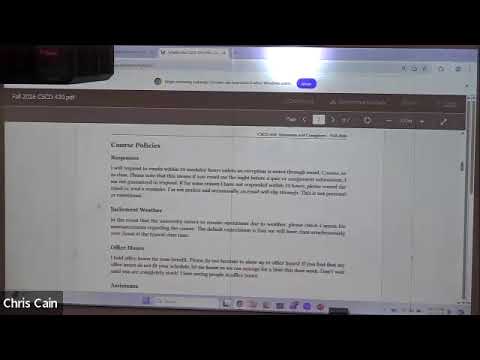
Chris Cain introduces CSCD 420 as a fast-paced course that spends about seven weeks on automata theory before connecting formal languages, computation, and complexity to compiler design. He outlines the course’s weekly assignments, coding projects, exam and grading rules, and documented, learning-focused AI policy, then begins reviewing automata, formal languages, and set operations.
Key takeaways
- CSCD 420 moves quickly from automata theory to compiler foundations, with Cain estimating about seven weeks for automata before the course turns toward compilers.
- The exam requirement is an average of at least 70%, and Cain bases exam questions heavily on the skills practiced in assignments.
- Assignments are expected most weeks, are generally due Wednesdays, and must be typed in LaTeX; Cain advises starting early because each problem may take around 30 minutes.
- AI use on submitted assignments requires a PDF record of every prompt and response plus a short learning reflection, while AI-generated project code is not permitted.
- Exams occur tentatively in weeks three, six, and nine plus a final, and allow one double-sided notes sheet but focus on problem solving.
- Set difference is order-dependent, unlike union and intersection, and a set complement is meaningful only after its universal set has been specified.
Chapters
- Chris Cain plans to spend about the first seven weeks on automata theory before reaching compilers, so missing a class can mean substantial catch-up.
- Class meetings combine lectures with individual, pair, and small-group problem solving; Cain recommends attending in person whenever possible.
- Cain is generally available weekdays, guarantees office hours from 11 a.m. to noon, and usually offers additional availability from 1 to 2 p.m. by arrangement.
- Canvas provides the Zoom link and recordings on Cain’s YouTube channel, including lectures from past course offerings.
- TA Akiva, grading the course for the third time, holds official office hours from 9 to 10 a.m. in office 145 and welcomes questions about homework.
- The textbook is optional but useful as a technical reference; assigned textbook problems and diagrams will also be available through Canvas materials.
- Cain guarantees an email response within 24 weekday hours and encourages students to follow up if a message was missed.
- For weather disruptions, students should check Canvas; the default backup is a synchronous class on Zoom.
- Assignments make up the largest share of the grade, while projects and exams carry roughly comparable weights.
- Students need an average of at least 70% on exams to pass the course; exam questions draw heavily on assignment outcomes.
- Cain uses semester-style grade cutoffs, including 93% for an A, 90% for an A-minus, 87% for a B-plus, and 83% for a B.
- Assignments are generally due Wednesdays, exams Fridays, and each homework problem may take about 30 minutes, with roughly a dozen problems per assignment.
- Assignments must be prepared in LaTeX using templates on Canvas; Cain and Akiva can help students establish a workflow.
- A course bounty board will offer challenging extra-credit problems, with recognition for students who solve the most.
- Two individual coding projects are planned, around weeks five and ten; Java is recommended, but students can discuss using another language with Cain or Akiva.
- Exams are closed-book and closed-notes, but students may bring one double-sided sheet of handwritten or typed notes; exams emphasize problem solving rather than memorized answers.
- Cain evaluates late work individually, considering circumstances beyond a student’s control, communication timing, and the effect on the rest of the course schedule.
- Students do not generally need to provide documentation such as a doctor’s note, but Cain asks them to communicate honestly as soon as they know there is a problem.
- Cain is most flexible when an extension can fit into the grading schedule without causing a backlog at the end of the quarter.
- The first one or two extension requests are unlikely to prompt questions, while repeated requests may require closer discussion.
- Cain permits AI when it helps students achieve course learning outcomes, but not when it bypasses learning or produces work beyond their current capabilities.
- For AI used in submitted assignments, students must attach a PDF addendum containing every prompt, every response, and a brief explanation of what they learned.
- Students can use AI privately as an exam study partner without submitting an addendum, but assignment-related AI interactions must be documented.
- AI cannot write code for the two coding projects; it may be used to understand concepts or support aspects other than the project’s actual coding.
- The tentative exam schedule is weeks three, six, and nine, plus a final; projects are planned for the ends of weeks five and ten.
- Cain aims to assign projects at least two weeks before they are due, once the relevant course material has been covered.
- Regular remote attendance should be arranged with Cain in advance because in-class teamwork is central and the course is officially synchronous and in person.
- Cain asks students to attend in person when reasonably possible so emergency recordings remain available without undermining the course’s in-person format.
- Course topics include automata theory, formal languages and grammars, computability, and advanced computational complexity.
- The material supplies the theoretical foundations for translating high-level programming languages into low-level languages that computers can execute.
- Cain frames the course around what computers can compute in principle and in practice, including the limits that remain as technology improves.
- An automaton is introduced as a simplified model of a computer or program, with input, output, decision-making, and, in some models, storage.
- A formal language uses an alphabet, such as the symbols 0 and 1 for binary, together with rules that determine which symbol combinations are meaningful.
- Sets are collections defined by membership, with order and repeated elements irrelevant; curly braces denote sets and lowercase letters represent elements.
- The membership symbol states that an element belongs to a set, while a slash through it indicates non-membership.
- Ellipses can abbreviate large or infinite sets, but examples must show enough of the pattern to avoid ambiguity, such as positive even integers.
- Union combines all elements from either set without duplicating shared elements; Cain relates it to combining items from two collections.
- Intersection contains only shared elements, while set difference keeps elements in the first set that are absent from the second.
- Union and intersection are commutative, but difference is not: reversing the order of the sets can change the result.
- A complement depends on a defined universal set and contains everything in that universe that is not in the set; Cain illustrates this with clothing items other than socks.
Transcript excerpt
0:01 Time to get started. Hi everyone. I think I know almost all of you from somewhere or someplace, but the very few of you I don't know. I'm Dr. Chris Kaine. I don't really care what you call me as long as it's school appropriate. So, whatever is comfortable to you will be comfortable to me. I would rather have you feel like you can approach me than feel scared of me. That will happen just by the nature of the class. Sorry in advance. Let's see. Things about me you might care to know. I play video games. I play Magic the Gathering and have cards to play down in my office. If you play or want to learn to play Magic the Gathering is a great social way of getting to know other
0:49 people or bringing your friends and doing something in this strange office building of a campus. Come find my office. I can entertain you. But we're all here for Automa and compilers on the books. It's just called compilers. But you can't really do compilers without looking at auto atom theory first. So we'll spend about the first seven weeks or so looking at automa theory because it's that big of a beast. Most iterations of this class take at least 10 weeks to go through automa theory. But then we never get to compilers. So, I have a pretty well structured, I feel like, and planned course, but it moves extremely quickly. What that means, and what I've heard in the past, is that if you miss a class period, it feels like you're coming back
1:37 from a vacation. What we're talking about is completely different than what we were talking about the last time you were here, and you feel like, I have some catching up
This is the start of the transcript. Save this video free for the whole transcript, searchable and time-coded.
In this course
Related notes
Summary, takeaways, and chapters were generated by AI from the video's transcript and may contain errors. The video belongs to its creator, Chris Cain.