CSCD 420 Nov 12 2026
Overview
Chris Cain introduces the hierarchy of formal languages, distinguishing recursively enumerable languages, whose Turing machines accept members but may loop on nonmembers, from recursive languages, whose machines halt with a yes-or-no answer on every input. He develops enumeration procedures using membership tests and dovetailing, applies Cantor diagonalization to show that some languages cannot be enumerated, and constructs a universal Turing machine that simulates encoded machine-input pairs.
Key takeaways
- Recursive languages have Turing machines that halt on every input, while recursively enumerable languages require only that members eventually be accepted.
- A recursive language can be enumerated by generating all strings in length order and filtering them through a halting membership algorithm.
- Dovetailing prevents one infinite computation from blocking all others by allocating successively more simulation steps across candidate strings.
- Cantor diagonalization shows that the power set of the positive integers is uncountable, implying that some languages outnumber all possible Turing machines and are not recursively enumerable.
- The complement of a recursively enumerable language is not necessarily recursively enumerable, because a recognizer may loop on strings that would need to be accepted by the complement.
- A universal Turing machine can simulate an encoded machine on an encoded input; accepting simulations recognize the universal language of machine-input pairs.
Chapters
- Homework is due that night, and the next assignment is expected soon.
- Chris Cain plans to return the previous exam and review its questions the next day; that review will not be recorded.
- The class moves from regular, context-free, and Turing-machine-recognizable languages to a broader hierarchy of language classes.
- The course focuses on language classes with practical or theoretical significance, rather than every possible automaton variation.
- Recursively enumerable is introduced as the name for the class of languages accepted by Turing machines.
- The word enumerable connects the topic to countable sets and procedures that generate their members.
- A Turing machine recognizes a recursively enumerable language when it accepts every member in a finite number of transitions.
- For a nonmember, the machine may halt and reject or run forever; the definition does not require a decision.
- Acceptance is guaranteed for members, but rejection is not guaranteed to occur.
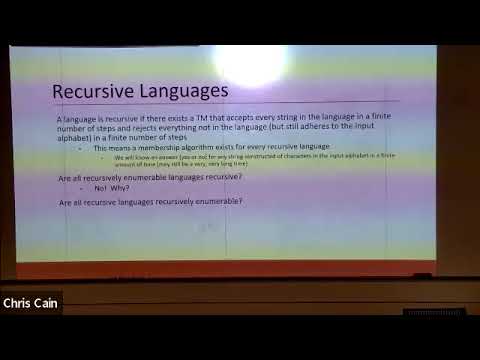
- A recursive language has a membership algorithm that halts with yes or no for every input string.
- The algorithm must terminate even for nonmembers, though it may take an impractically long time.
- Every recursive language is recursively enumerable, but the inclusion is strict because some recognizers loop on nonmembers.
- A generator lists every string over the input alphabet in increasing length order, such as A, B, C, then AA and AB.
- A membership Turing machine tests each generated string and halts with yes or no because the language is recursive.
- Accepted strings are copied to an output track, so every language member eventually appears in the enumeration.
- Testing one candidate until it halts can get stuck forever, so the procedure gives each candidate only a growing share of simulation steps.
- The diagonal schedule runs one step on W1, then advances through W2 and later strings while returning to earlier simulations.
- Every accepting computation eventually receives enough steps to accept, even if other candidates loop forever.
- The method is theoretically complete despite potentially enormous runtimes, including for a late candidate such as W10 trillion.
- A language is not recursively enumerable if no procedure can list all its members.
- Cantor's diagonalization shows that the real numbers between zero and one cannot be enumerated.
- For the power set of the positive integers, represent each subset as an infinite binary row and flip the diagonal bits to construct a missing subset.
- Because Turing machines have binary encodings but there are more languages than machines, some languages cannot be recognized by any Turing machine.
- The complement of a recursively enumerable language need not be recursively enumerable.
- If a recognizer loops on a nonmember, simply reversing accept and reject cannot guarantee finite acceptance for that string.
- The positive integers illustrate the risk: a successor-based search for -3 never reaches it unless the procedure has an additional way to stop and reject.
- The universal language contains encoded pairs ⟨M, W⟩ where M is a Turing machine and W is an input string.
- A pair belongs when machine M accepts W; for example, a machine recognizing AⁿBⁿ accepts the input AAABBB.
- Machine encodings are not unique in behavior: infinitely many distinct Turing machines can recognize the same language.
- Tape one holds machine and input encodings, tape two simulates the input tape, tape three tracks the simulated state, and tape four provides scratch space.
- The simulator consults M's encoded transitions using its current state and tape symbol, then updates the simulated state, symbol, and head position.
- When M accepts W, the universal machine accepts the pair; a looping or rejecting simulation does not add that pair.
- The construction establishes that the universal language is recursively enumerable and models how a general digital computer can simulate encoded programs.
Transcript excerpt
0:02 Time for us to get started. How's everybody doing? Excellent. We're feeling more vocal than usual today. All right, we'll start with our usual announcements. We have a homework assignment due tonight. I'll be getting the next one out to you reasonably quickly so that you can get started on that over the weekend. It's also getting time to start thinking about the next exam. I will be getting the exam that you took last week back to you tomorrow. So it will be a plan that we're we're going over that tomorrow. We'll have the opportunity to see how you did and go over all the questions on the exam.
0:50 I will not be recording that as usual, so I recommend being here in person or attending remotely at the same time. Other than that, I don't think there's anything else to to think about. Anyone have any questions on the schedule? >> Yeah, when it comes to seeing the test scores each day, I mentioned that or should we just wait until tomorrow too? >> We'll probably have to wait till tomorrow. I have not yet received the stickied version of them for review yet. So I actually don't have the ability to offer that. Sorry. But I will have them by tomorrow. Other questions? Okay. Last time we were talking about
1:41 the last bit of Turing machine models of addendums that we could make to Turing machines, and we also talked about interesting limitations we could make to Turing machines, and we ended up finding that the most interesting restriction we could make was a linear bounded automata, one that we restrict the length of the to the size of the input and what kinds of languages can we interestingly accept with that. And we looked at one example
This is the start of the transcript. Save this video free for the whole transcript, searchable and time-coded.
In this course
Related notes
Summary, takeaways, and chapters were generated by AI from the video's transcript and may contain errors. The video belongs to its creator, Chris Cain.