CSCD 420 Sep 24 2026
Overview
Chris Cain reviews set theory concepts needed for CSCD 420, including complements, De Morgan’s laws, subsets, power sets, and Cartesian products, then introduces formal language notation. He defines alphabets, strings, the empty string λ, star and positive closure, and illustrates language membership with strings of n A’s followed by n B’s; he also explains that the first assignment is due next Wednesday and recommends Overleaf for LaTeX.
Key takeaways
- A set’s cardinality counts distinct elements, and a subset relationship guarantees |S₁| ≤ |S| without the reverse implication being true.
- The power set of an n-element set contains 2ⁿ subsets; grouping those subsets by size produces the corresponding row of Pascal’s triangle.
- Cartesian product cardinality multiplies the sizes of its input sets, but the product’s ordered pairs make S₁ × S₂ generally different from S₂ × S₁.
- For an alphabet Σ, Σ* includes the empty string and all finite strings, while the positive closure excludes the empty string; both are infinite when Σ is finite and nonempty.
- The language {AⁿBⁿ | n ≥ 0} accepts λ, AB, and AABB, but rejects BA and ABAB because membership requires equal counts and all A’s before all B’s.
Chapters
- The first homework assignment is being released as a ZIP file containing the assignment materials.
- Chris Cain recommends importing the ZIP into Overleaf for students new to LaTeX.
- The assignment is due next Wednesday, and the class will cover all of its material by Monday.
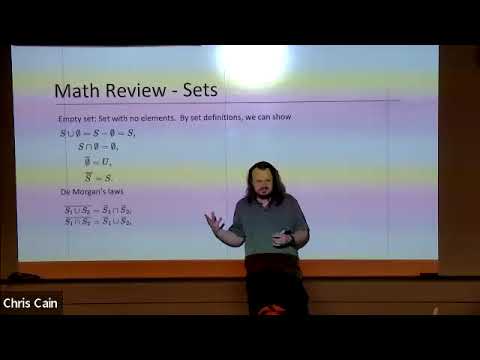
- A complement contains the elements in the universal set that are not in the specified set.
- The empty set has no elements: unioning or subtracting it leaves a set unchanged, while intersection with it yields the empty set.
- Taking a set’s complement twice returns the original set; the complement of the empty set is the universal set.
- De Morgan’s laws exchange union and intersection under complementation: the complement of a union is the intersection of complements, and vice versa.
- Cardinality counts distinct elements, so the set {A, B, C, A, B, C} has size 3, not 6.
- S₁ is a subset of S when every element of S₁ is also in S; a proper subset additionally leaves at least one element of S outside S₁.
- A subset implies |S₁| ≤ |S|, but that inequality alone does not prove a subset relationship, as equal-sized sets can contain different elements.
- The power set contains every subset of the original set, including the empty set.
- For {A, B, C}, the power set has 8 subsets: one of size 0, three of size 1, three of size 2, and one of size 3.
- Those subset counts form the row 1, 3, 3, 1 of Pascal’s triangle, and their sum is 2³.
- The Cartesian product S₁ × S₂ contains ordered pairs (x, y) with x from S₁ and y from S₂.
- For {1, 2, 3} × {A, B, C}, there are 9 ordered pairs; in general, the product’s cardinality is |S₁| × |S₂|.
- Cartesian products are not generally commutative because tuple order matters: (1, A) differs from (A, 1).
- Sets can contain tuples, and tuples can contain sets; the product is itself a set defined by collecting all qualifying pairs.
- An alphabet Σ is a finite, nonempty set of symbols; {A, B} is the example used in class.
- A string is a finite sequence of alphabet symbols, such as ABBA, and λ denotes the empty string.
- The course uses lowercase letters near the start of the alphabet for characters and letters near the end for strings.
- A superscript R denotes reversing a string, while a superscript n denotes concatenating that string n times.
- The star closure Σ* contains every string formed from zero or more alphabet symbols, so it includes λ.
- For Σ = {A, B}, the numbers of strings of lengths 0, 1, 2, and 3 are 1, 2, 4, and 8.
- The positive closure contains strings formed from one or more symbols, excluding λ.
- Both closures are infinite for any finite, nonempty alphabet because strings can be extended without an upper length limit.
- A formal language is a defined subset of an alphabet’s star closure, selecting the strings that satisfy its rules.
- For alphabet {A, B}, the language L = {AⁿBⁿ | n ≥ 0} requires all A’s to come first and the number of A’s to equal the number of B’s.
- AB and AABB belong to this language, and λ belongs when n = 0; BA and ABAB do not.
- A string in a language is called a sentence in this formal terminology, which does not necessarily mean a grammatical English sentence.
- The strings A-only, B-only, and strings with unequal numbers of A’s and B’s fail the AⁿBⁿ rule, while BA fails because the order is wrong.
- ABAB would belong to a different language defined by repetitions of the substring AB, but not to the language requiring Aⁿ followed by Bⁿ.
- Whitespace is set aside for now because it introduces complications in program syntax.
- Chris Cain previews further study of language rules and regular expressions as tools for analyzing and designing programming languages.
Transcript excerpt
0:00 It's from us. >> Okay, I think we're good to go. Finally. Internet connectivity issues, restarted everything, still wasn't working, one drive errors, and we're 1 minute late. Less than 1 minute late, we're good to go. How's everyone doing? >> Doing good. >> This seems small. >> Do you want to lock? >> Yeah. That's what's what I'm hoping. >> Maybe they're all just next door waiting on you to walk in. >> Yeah, but there's a class that overlaps this. So, unless they're like walking in, they'll be like, "Is this Never mind, this is a class in session." Turn around and walk out. So, hopefully a reasonable number of people have found the right place, and those who haven't will be here soon. >> How long is it?
0:48 About what? Not 20. >> Not 20? >> All right, so what? We're getting up the first assignment as we speak, and there will be opportunity class for me to introduce you a bit to LaTeX for those of you who are brand new to it. Our recommendation for this is to use Overleaf if you have not used Overleaf before. There will be a zip that is released that is just the contents of the homework assignment. You just import that zip into Overleaf, and you're good to go. You need help with that, we're computer scientists. Most of us are relatively independent. If you run into any issues with that, feel free to talk to me after class,
1:36 talk to Eva after class, and I can walk you through it. So, the assignment will be due next Wednesday. We'll have gone over absolutely everything for that by Monday. There's probably not a time you can do immediately, but between today's class and tomorrow's class, a good amount out assignment will
This is the start of the transcript. Save this video free for the whole transcript, searchable and time-coded.
In this course
Related notes
Summary, takeaways, and chapters were generated by AI from the video's transcript and may contain errors. The video belongs to its creator, Chris Cain.