CSCD 420 Sep 25 2026
Overview
CSCD 420 introduces formal languages and grammars as precise ways to define which strings are valid, connecting set operations and language closure to syntax checking in compilers such as Java. Through derivations of languages including aⁿbⁿ and aⁿbⁿ⁺¹, the class develops grammar construction, completeness, recursion, and induction as tools for describing infinite languages with finite rules.
Key takeaways
- A grammar defines syntax by specifying which strings can be generated from a start symbol using production rules.
- The productions S → ASB and S → λ generate exactly AⁿBⁿ because each recursive step adds one A before S and one B after S.
- A grammar is complete for a target language only if it generates every string in that language and generates no strings outside it.
- The language AⁿBⁿ⁺¹ can be generated by keeping the recursive rule S → ASB and changing the terminating rule from S → λ to S → B.
- Mathematical induction mirrors recursive grammar construction: prove a base string is derivable, then show one production step derives the next case.
- Compiler grammars make syntax checking possible for languages with infinitely many potential programs by applying a finite collection of rules.
Chapters
- Most class meetings will move to room 215, with Thursday remaining in room 219.
- Students are encouraged to complete as much homework as possible over the weekend before harder material arrives.
- For the alphabet {A, B}, Σ* is infinite, and the language of strings with equal numbers of A's followed by B's contains infinitely many strings.
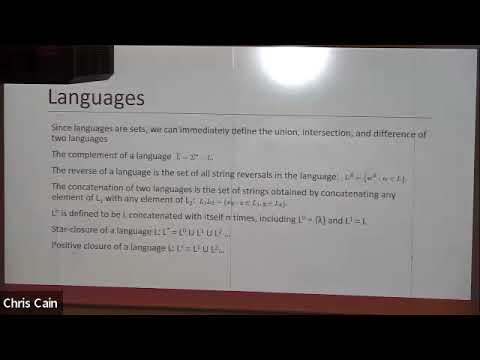
- Languages are sets of strings, so union, intersection, and difference apply using ordinary set membership.
- Σ* is the universal language for a chosen alphabet; a language's complement contains every string in Σ* that is not in that language.
- The reverse of a language contains strings whose reversals belong to the original language, while concatenation combines a string from L1 with one from L2.
- L⁰ contains the empty string, L* includes L⁰ and every finite repetition of L, and L⁺ excludes L⁰.
- A grammar determines whether a string is well-formed in a language, much as a compiler checks whether source code follows programming-language syntax.
- The sample English grammar expands a sentence into a noun phrase and predicate, then into article, noun, and verb.
- With articles “the” and “a,” nouns “boy” and “dog,” and verbs “runs” and “walks,” “the boy runs” is derivable but “boy runs” is not.
- A derivation tree makes each expansion visible and shows why strings such as “dog walks boy” cannot be generated by the stated rules.
- A complete grammar generates every valid string in its language and no invalid strings, enabling both language-to-grammar and grammar-to-language exercises.
- Grammar design proceeds from abstract concepts to smaller components, similar to reducing object-oriented structures to primitive types.
- Java syntax requires rules for imports, classes, interfaces, modifiers, blocks, statements, expressions, assignment operators, and prefix and postfix operators.
- A compiler uses grammar rules to identify syntactically valid Java programs; a new programming language also needs a compiler to translate its programs into executable form.
- The grammar is presented as a quadruple consisting of non-terminals, terminals, a start symbol, and production rules.
- Non-terminals are variables or abstract concepts that can be expanded; terminals are irreducible symbols that appear in completed strings.
- The start non-terminal is the required starting point for every derivation, and productions specify allowed replacements.
- For homework-scale grammars, capital letters can represent non-terminals and lowercase letters can represent terminals.
- The example grammar has start symbol S, terminals A and B, and productions S → ASB and S → λ.
- Applying S → λ immediately generates the empty string; applying S → ASB repeatedly and then terminating generates AB, A²B², and further equal-count strings.
- Each recursive expansion adds one A to the left and one B to the right, enforcing the order AⁿBⁿ.
- A derivation is complete only when no non-terminals remain in the string.
- The recursive grammar for AⁿBⁿ uses only two productions but describes infinitely many strings.
- A finite set of rules can therefore support the same kind of accept-or-reject decision needed for infinitely many possible Java programs.
- To test a proposed grammar, check that every generated string belongs to the target language and every target string can be generated.
- A recursive grammar needs a reachable way to terminate; replacing a recursive non-terminal with a terminal, such as S → a, can provide termination without generating the empty string.
- The grammar for AⁿBⁿ can be justified by induction, treating recursive derivations like a chain of falling dominoes.
- The base case derives A⁰B⁰, the empty string, using the terminating production.
- For the inductive step, assuming AⁿBⁿ is derivable, one more application of S → ASB adds one A and one B to produce Aⁿ⁺¹Bⁿ⁺¹.
- Repeating the recursive rule n times and then terminating derives the string for any natural number n.
- The class modifies the AⁿBⁿ grammar so that each generated string has one more B than A.
- The required change is to terminate with B instead of the empty string, producing B for n = 0 and AB for n = 1.
- Recursive expansions preserve equal counts of A's and B's around the terminating B, yielding AⁿBⁿ⁺¹.
- Changing the recursive production to ASB instead would add two B's per recursive step and produce a different count relationship.
- The grammar's non-terminal set lists every variable, while the designated start symbol identifies where derivations begin.
- Multiple grammars can describe the same language, so a construction must be checked for both soundness and completeness.
- For a language with exactly two A's and arbitrary B's, productions must allow B's before, between, and after the A's without generating additional A's.
- A student can test candidate rules by building derivations and verifying that they generate every intended arrangement and no unintended strings.
- English grammar must account for word order, punctuation, clauses, contractions such as “can't,” and exceptions involving sentence endings.
- Programming languages have many possible identifiers, but their syntactic rules can still be specified systematically through formal grammars.
- The class discusses whether communication could be made more concise through structured systems, including sign languages and facial expressions.
- Sign languages use meaningful motion patterns and logical structures, while English presents many exceptions that make a complete grammar difficult.
Transcript excerpt
0:03 Okay, as you've just heard, we're going to be meeting in 2:15 for the remainder of most of the class. So, Monday, Tuesday, Wednesday, Friday, we'll be in there and then only on Thursday will be in 219. So, last day in this room. Very exciting. Actually, not that exciting. I really like this room, but it's one more day out of the labs and the labs are very awkward in that there are screens everywhere and people can't see what's on the slides. I just try to stay out of that room unless we're actually doing real lab work, which will be very infrequent in this class. Most it's going to be collaborative in class work. Okay, homework is out. it's been
0:54 revealed for people. You cannot yet do absolutely all of it, but my recommendation over the weekend is to get as much of it done as you can. That way, you won't be in a crunch next week when we have some of the harder content and harder questions to address. I will have plenty of office hours and can make more of them as needed. Any questions on anything before we dive into new content? Last time we were introducing some of the concepts related to formal languages. This is a hierarchy above written language or spoken language or
1:41 programming language. It's just a hierarchy for languages in general. So we talked about alphabets. We talked about strings or sentences. We talked about languages being defined from those alphabets. And now we were looking at our first language which would be some number of A's followed by exactly that many B's and that is it. There's no further string allowed in that language. So we have looked at what is sigma star meaning what is what are the possible
This is the start of the transcript. Save this video free for the whole transcript, searchable and time-coded.
In this course
Related notes
Summary, takeaways, and chapters were generated by AI from the video's transcript and may contain errors. The video belongs to its creator, Chris Cain.