CS3130FS26Module4P2VidProc
Overview
The lecture extends binary decision-tree lower bounds to arrays containing one or more already ordered segments, then uses the bounds to set realistic comparison targets for merging sorted arrays. It also derives the tournament method for finding the second-largest element in n elements, requiring n + ceil(log2 n) - 2 comparisons, and previews quicksort's emphasis on partitioning rather than merging.
Key takeaways
- With ordered segments of lengths k1 through kr in an n-element input, the comparison lower bound is ceil(log2(n! / (k1! k2! ... kr!))).
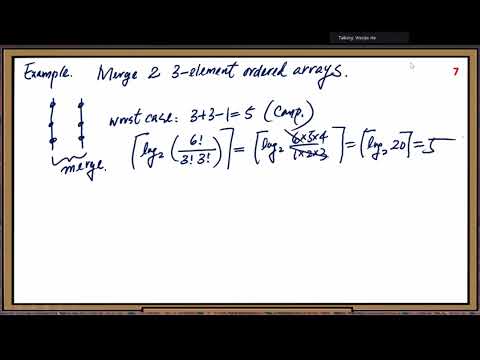
- Merging two sorted arrays of three elements each requires at least five comparisons, and the standard merge reaches that bound.
- For merging ordered arrays of lengths 3, 3, and 2, the lower bound is 10 comparisons; for the length-3 and length-2 ordered segments in an 8-element array, it is 12.
- A lower-bound number is not an algorithm: a complete solution must specify comparisons that achieve the target.
- In a tournament, only elements that directly lost to the maximum can be second-largest, so the maximum's tournament path supplies the candidates.
- Finding the second-largest of n elements takes n + ceil(log2 n) - 2 comparisons with the tournament method, which the lecture identifies as optimal.
Chapters
- A comparison algorithm can be represented as a binary decision tree, where each leaf represents a possible outcome.
- The worst-case number of comparisons corresponds to the tree height; a tree of height h has at most 2^h leaves.
- If the input condition merges multiple orderings into one outcome, the number of leaves needed decreases.
- For n distinct elements with one known ordered segment of length k, k! arrangements collapse into one case.
- The comparison lower bound is ceil(log2(n! / k!)); for ordered segments of lengths a, b, and c, use ceil(log2(n! / (a! b! c!))).
- The formula counts distinguishable input outcomes, then converts that count into a minimum binary decision-tree height.
- The standard merge worst-case bound for arrays of lengths 3 and 3 is 3 + 3 - 1 = 5 comparisons.
- The decision-tree lower bound is ceil(log2(6! / (3!3!))) = ceil(log2 20) = 5.
- Since the standard merge reaches the lower bound, it is optimal for two three-element arrays; the gap can grow for larger arrays.
- Homework Question 12 merges ordered arrays of lengths 3, 3, and 2, for a total of 8 elements.
- The lower bound is ceil(log2(8! / (3!3!2!))) = ceil(log2 560) = 10 comparisons.
- The unrounded logarithm is about 9.13, leaving a 0.87 gap to the ceiling; the lecture treats 10 comparisons as an attainable target and 11 as a weaker target.
- The estimate for Question 12 does not specify which comparisons to perform, so it cannot serve as the final algorithm.
- A valid solution must give comparison steps that demonstrate how the target count is achieved.
- Use the lower-bound calculation to guide problem solving, then separately construct and verify the algorithm.
- Question 14 has 8 elements, with an ordered prefix of length 3 and another ordered segment of length 2.
- Its lower bound is ceil(log2(8! / (3!2!))) = ceil(log2 3360) = 12 comparisons.
- Because the unrounded value is about 11.71, the small 0.29 gap makes reaching 12 especially difficult; 13 is presented as the standard target, while 12 earns bonus credit if achieved.
- For an arbitrary n-element array, use a tournament in which elements compete pairwise and winners advance.
- A leftover element may advance without playing in a round when n is not a power of two.
- The tournament identifies the maximum in n - 1 comparisons, since each comparison eliminates exactly one element.
- After finding the maximum, retain the comparison history rather than repeating comparisons.
- Only elements that lost directly to the maximum can be the second-largest; an indirect loser is below an element that already lost to the maximum.
- Each tournament level contributes at most one direct loser to the maximum's candidate set.
- The maximum's path through the tournament has ceil(log2 n) rounds, so there are at most ceil(log2 n) direct-loser candidates.
- Finding the largest among those candidates takes ceil(log2 n) - 1 additional comparisons.
- Combining that with the initial n - 1 comparisons gives n + ceil(log2 n) - 2 total comparisons; the lecture identifies this tournament algorithm as optimal.
- The second-largest formula comes with a tournament comparison procedure, unlike the merge lower-bound estimates, which only indicate a target.
- For homework problems asking for the second-largest element, apply the tournament method and its comparison count without restating the full derivation.
- The formula is presented as a result students may also need for later course questions.
- Merge sort performs its main work in the combine step, merging two sorted arrays with comparisons.
- Quicksort shifts the main work to the divide step: partition the array so the recursive results can be combined with no additional comparisons.
- The lecture introduces partitioning as the key quicksort idea and defers its detailed treatment until after Thanksgiving break.
Transcript excerpt
0:00 time we get the lower bound formula. Remember the binary tree. Yeah. So our decision tree is a binary tree and the height of the decision tree we use to represent the worst case. Worst case corresponds to the height efficiency. All right. Then the number of leaves. So the number of search outcomes that's the meaning. Yeah. So based on that we have this inequality. Yeah. So this inequality means the left
0:50 hand side of inequality the number of leaves for a complete binary tree with height h complete binary tree with height that's the maximum number of leaves right hand side just a general case the binary tree may not be complete yeah all right so based on this understanding so Now we want to go another step forward because uh in our homework assignment uh you have a good chance to see this situation. Yeah. For this homework assignment we have two
1:37 questions related to this topic. Question number 12 and question number 14. these two questions related to th this topic. All right. So let me talk about uh another uh we can call it extension of this method how to do the extension. So here let's consider a general case a general situation this special case we still we have n element array. All right. And we know
2:33 K of them are ordered. K of the elements are ordered. Yeah. For this situation, we want to derive the formula. Yeah. Because many times we need to use this version, right? So we still we consider decision tree general decision tree. Okay. All right. A binary tree very general. Okay. Very general. All right. Then the final
3:21 sorting result at a leaf level. Final sorting result. The leaf level. Then look at this condition. K of the
This is the start of the transcript. Save this video free for the whole transcript, searchable and time-coded.
In this course
Related notes
Summary, takeaways, and chapters were generated by AI from the video's transcript and may contain errors. The video belongs to its creator, DrHeUMSLTeaching.