CS3130FS26Module4BVidProc
 Watch on YouTube →
Overview
Dr. He explains binary search as a divide-and-conquer algorithm that compares the key with the array median, eliminating roughly half the ordered array per comparison. The lecture derives exact worst-case comparison bounds, distinguishes average-case analysis using a binary search tree, and introduces selection as finding the kth-smallest element in an unordered array without paying the Θ(n log n) cost of sorting.
Key takeaways
- For an ordered array of n elements, comparing the key with the median eliminates roughly half the candidates per step and yields logarithmic search.
- The exact worst-case comparison count for binary search is ⌈log₂(n + 1)⌉, equivalently ⌊log₂ n⌋ + 1; the distinction matters when n is a power of two.
- Average-case binary search cost must be computed from the search tree's level counts, not as the midpoint of best- and worst-case costs.
- For a key known to be present in a balanced search tree with 7 elements, the average cost is (1×1 + 2×2 + 3×4)/7 = 17/7 comparisons.
- Finding the kth-smallest element is a selection problem; sorting the entire unordered array costs Θ(n log n) and can do more work than selection requires.
Chapters
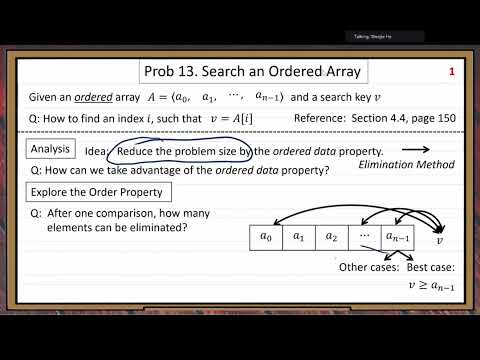
- The task is to find an index i where the search key v equals a[i] in an ordered array.
- The first comparison determines how much of the array can be eliminated, so the choice of comparison element affects the next problem size.
- Algorithm design should target the worst case rather than rely on favorable assumptions.
- Comparing v with the final array element can finish immediately if v is larger.
- If v is smaller, only the last element is ruled out, leaving nearly the entire array to search.
- The worst-case reduction of one element per comparison motivates choosing a comparison point near the middle.
- A comparison at an interior element leaves either a left or right subarray, depending on the comparison result.
- In the worst case, the shorter side is eliminated and the longer side remains to be searched.
- Choosing the median makes the two sides nearly equal, so either outcome eliminates about half the array.
- A median comparison reduces the remaining array to approximately half its previous size.
- After k comparisons, the remaining size is modeled as n/2^k.
- Balanced splitting is the key efficiency principle; highly unbalanced splits can lead to much worse performance, a contrast also relevant to quicksort.
- The search stops when the remaining interval is too small to split further.
- The lecture models the final remaining size as strictly less than 1, while the size after the previous comparison must be at least 1.
- Using both conditions bounds the number k of comparisons from below and above.
- Taking base-2 logarithms of the size inequalities expresses the comparison count in terms of log₂(n).
- Because k is an integer, the non-integer logarithmic bounds need ceiling and floor functions.
- A strict inequality requires care: simply rounding can mishandle the equality case and leave the estimate imprecise.
- Tightening the inequality by accounting for the extra 1 gives the lower-bound expression ⌈log₂(n + 1)⌉.
- An equivalent exact formula for the worst-case number of comparisons is ⌊log₂ n⌋ + 1.
- The two formulas agree, including when n is a power of two, where omitting the added 1 can produce an answer that is too small.
- The average is not generally the midpoint of the best and worst cases because search outcomes are distributed across a tree, not a straight line.
- For n = 7, a balanced binary search tree has 1, 2, and 4 nodes at comparison depths 1, 2, and 3.
- If the key may be absent, the calculation also needs an assumption about the probability P that it is present, using a weighted average.
- For a key known to be present among 7 elements, the level-weighted total is 1×1 + 2×2 + 3×4 = 17 comparisons.
- Dividing by the 7 possible matching elements gives an average of 17/7 comparisons.
- Keep the average as a fraction rather than rounding it to an integer; for other tree shapes, use the actual number of nodes at each level.
- The 7-element example is complete because 7 = 2³ − 1, giving three full levels.
- For a non-complete search tree, calculate each level's comparison depth multiplied by its actual node count.
- The lecture then shifts from searching an ordered array to selection in an unordered array.
- The general selection problem takes an array and positive integer k and returns the kth-smallest element, also described by its rank.
- Unlike binary search, selection cannot use sorted-array order to discard a half after one comparison.
- Sorting first costs Θ(n log n), so selection aims to avoid doing unnecessary work when only one rank is required.
- The selection algorithm must arrange elements into a special structure that supports eliminating one subproblem after a sequence of comparisons.
- After elimination, the original task is reduced to a smaller selection problem that can be handled recursively.
- The detailed elimination method is deferred; the lecture previews a quiz, programming project 2, and homework 2.
Transcript excerpt
0:00 Part B today binary search and selection problem. First binary search. So we still we use that elimination method. All right. Question number 13. Search an ordered array. Given an ordered array this time the data is ordered uh this property very useful. So we need to take advantage of this property and a search key uh v we need to find an index such that v
0:51 equals a of i. All right. Yeah. So to solve this problem uh for this module uh the general idea divide and conquer. So we apply this divide and conquer approach. Yeah. All right. But when we divide the original problem into smaller subpros, we need to make some decision. We need to make some important decision. Yeah. All right. So what kind of decision we need to make here? All right. Reduce the problem size. Yeah.
1:44 So the the basic idea in our mind we want to reduce the problem size, right? But when we reduce the problem size when uh we have freedom to choose we have freedom to choose you know how to reduce the problem size but when we choose make make our decision we need to do some analysis. What is the fastest way to reduce the problem size? When we consider the fastest way, we need to consider, you know,
2:34 worst case. The worst case we want to what do we want to do even for the worst case? What is the maximum size to be reduced for the worst case? What is the maximum size to be reduced? All right. Yeah, let's consider an ordered array and given key. We need to do comparison. So let us study how to do the first comparison. Yeah. So we have many different ways to
3:23 do first comparison. Okay. You can
This is the start of the transcript. Save this video free for the whole transcript, searchable and time-coded.
In this course
Related notes
Summary, takeaways, and chapters were generated by AI from the video's transcript and may contain errors. The video belongs to its creator, DrHeUMSLTeaching.