CS3130FS26Module3R2VidProc
 Watch on YouTube →
Overview
The CS3130 class reviews five challenging algorithm questions and emphasizes rigorous reasoning, comparison-count reductions, and reuse of intermediate results. The worked methods include reducing a 343-element local-maximum search to 330 comparisons, computing U^7V^9W^11 in 15 multiplications through shared repeated squaring, and finding the largest and second smallest in five comparisons by processing correlated candidate sets in the right order.
Key takeaways
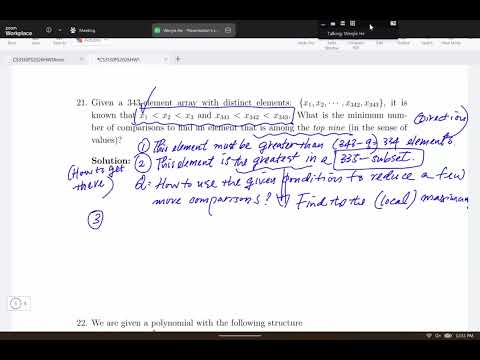
- For the 343-element local-maximum task, selecting a 335-element subset that includes the six condition-related elements exposes four known losers; removing them leaves 331 candidates and requires 330 comparisons.
- Computing U^7, V^9, and W^11 independently can cost 22 multiplications, while sharing repeated-squaring intermediates reduces the standard count to 15.
- A correct algorithm explanation must justify each saved comparison, such as showing why four specific elements cannot be a local maximum, rather than stating only the total savings.
- When candidate sets overlap at X9, resolving the second-smallest candidates before the maximum candidates allows both outcome branches to finish in five comparisons.
- For the final selection problem, ordered chains make eliminations provable: compare elements to build chains, merge the chains, and use the known rank to discard elements over multiple rounds.
Chapters
0:00
Grading Review and Wednesday Midterm Logistics
- The review focuses on the five most challenging questions, with the final two requiring the closest examination of students’ reasoning.
- Wednesday’s Part B is scheduled for 75 minutes and contains 10 basic computation questions.
- Part A, Part C, and two assignments are scheduled to open at 2:00, with both assignments due Sunday; laptop rules will be announced separately.
3:57
Translate the 343-Element Local-Maximum Requirement
- For the first problem, an element must be greater than 343 − 9 = 334 other elements to satisfy the stated top-nine requirement.
- Finding the largest element in any 335-element subset guarantees an element greater than the other 334 members of that subset.
- The solution should distinguish the high-level requirement from the concrete subset-selection method.
7:21
Choose a 335-Element Subset That Uses the Given Condition
- The subset is not arbitrary: include the six elements named in the condition so their known relationships can reduce later comparisons.
- The condition identifies four of those six elements as unable to be the local maximum, so those elements can be discarded.
- Selecting a subset without the six known elements forfeits the opportunity to use the condition.
10:34
Eliminate Four Losers and Count 330 Comparisons
- After removing the four known losers from 335 candidates, 331 elements remain for a local-maximum search.
- Finding the maximum of 331 elements takes 331 − 1 = 330 comparisons.
- A complete proof explains why the four elements cannot be the local maximum, rather than merely claiming that the condition saves four comparisons.
20:58
Why Independent Exponentiation Costs 22 Multiplications
- For the second problem, the target is U^7, V^9, and W^11, with 15 multiplications as the standard combined solution.
- Computing each power independently with repeated squaring leads many solutions to 22 multiplications because they fail to share work.
- The key optimization is resource sharing: reuse intermediate products across all three powers.
24:00
Share Repeated-Squaring Results Across U, V, and W
- Because 7, 9, and 11 are odd, factor out U·V·W and express the remaining exponents as even powers suitable for squaring.
- Continue factoring out selected bases and squaring shared products to build the required powers with fewer operations.
- Reuse an already computed product such as UV or VW when forming later intermediates; one approach gives 16 multiplications, while the better sharing strategy reaches 15.
30:17
Midterm Scoring: Weak, Standard, and Strong Solutions
- For challenging questions, a weak solution earns one point less than the standard solution; the example gives three of four points for a 16-multiplication result.
- A standard solution earns the full four points, with 15 multiplications serving as the standard for the exponent problem.
- A strong solution can earn two bonus points when it improves on the standard through a particularly clever technique, such as reaching 14 multiplications.
33:59
Solve the Condition-Constrained Selection Problem in Two Comparisons
- The third question is closely related to a homework exercise and uses the condition that X8 cannot be the maximum.
- Working separately through two subsets or finding the median of three elements adds unnecessary comparisons; the median approach takes three in the worst case.
- The intended method uses two comparisons, but a correct solution must analyze both outcomes after comparing X1 with X8.
42:19
Identify Candidate Sets for the Maximum and Second Smallest
- For the fourth problem, only X4, X8, and X9 can be the maximum.
- Candidates for the second smallest are X1, X2, X5, X6, and X9, based on the already ordered chains.
- X3 and X7 belong to neither candidate set and can be eliminated before the remaining comparisons.
48:11
Process the Second-Smallest Candidates Before the Maximum
- The candidate sets overlap at X9, so the order of work affects the total comparison count.
- Resolve the second-smallest candidate set first; processing the maximum candidates first can require one extra comparison.
- Compare X1 with X6, using symmetry to analyze one outcome, and then compare X2 with X9 or the symmetric alternative X6 with X9.
54:54
Use the X9 Branch to Reach Five Total Comparisons
- If X2 < X9, X9 remains a possible maximum, and one more comparison between X2 and X6 resolves the second smallest; the maximum then takes two additional comparisons.
- If X2 > X9, X2 is eliminated from second-smallest consideration and X9 requires two further comparisons there.
- In that second branch X9 cannot be the maximum, saving one comparison in the maximum candidate set; both branches total five comparisons.
1:02:02
Begin the Final Problem with Ordered-Chain Elimination
- The final problem relies on repeated rounds of comparisons to build ordered chains and eliminate elements.
- Compare X3 and X8; by symmetry, take the case X8 > X3, producing the chain X9 > X8 > X3 > X2 > X1.
- Because the target is the fifth-smallest element, the established ordering lets the method eliminate elements already known to exceed that rank.
1:05:45
Merge Short Chains and Repeat the Elimination Rounds
- After the first elimination, compare the unconnected elements X5 and X10 to form a second ordered pair.
- Merging the two ordered chains takes up to three comparisons; including the X5-versus-X10 comparison makes four for this stage.
- Continue building longer chains and applying another elimination round until the target, described as the second local maximum in the closing explanation, is identified.
Summary, takeaways, and chapters were generated by AI from the video's transcript and may contain errors. The video belongs to its creator, DrHeUMSLTeaching.