CS3130FS26Module3DVidProc
 Watch on YouTube →
Overview
The lesson builds from solving the Tower of Hanoi recurrence, C(n) = 2C(n−1) + 1, to deriving a closed form for the second-order Fibonacci recurrence. It introduces exponential trial solutions, obtains the characteristic roots (1 ± √5)/2, then combines the two solutions and applies F₀ = 0 and F₁ = 1 to derive Binet’s formula.
Key takeaways
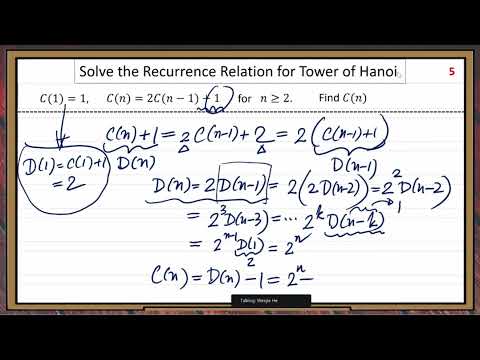
- For C(n) = 2C(n−1) + 1, defining D(n) = C(n) + 1 removes the constant term and leads to C(n) = 2ⁿ − 1.
- For a second-order homogeneous recurrence, trying Aₖ = tᵏ converts the recurrence into an algebraic equation for t; Fibonacci’s equation is t² − t − 1 = 0.
- The two Fibonacci characteristic roots, φ = (1 + √5)/2 and (1 − √5)/2, each generate a valid exponential solution.
- A linear combination of solutions remains a solution for a homogeneous linear recurrence, allowing two constants to be selected to satisfy the two Fibonacci base cases.
- Applying F₀ = 0 and F₁ = 1 gives Binet’s formula, Fₖ = (φᵏ − ((1 − √5)/2)ᵏ)/√5, despite the formula’s irrational components.
Chapters
- The Fibonacci sequence uses F₀ = 0, F₁ = 1, and Fₙ = Fₙ₋₁ + Fₙ₋₂.
- Two prior terms make this a second-order recurrence, which is harder to solve directly than a first-order recurrence.
- The lesson first uses the simpler Tower of Hanoi recurrence to build a method for solving recurrences.
- The Tower of Hanoi move count satisfies C(n) = 2C(n−1) + 1, with a constant term that Fibonacci’s recurrence does not have.
- Adding 1 to both sides gives C(n) + 1 = 2(C(n−1) + 1), exposing the same structure on each side.
- Define D(n) = C(n) + 1 so the transformed recurrence becomes D(n) = 2D(n−1).
- The transformed base case is D(1) = 2.
- Repeated substitution gives D(n) = 2ᵏD(n−k); setting n−k = 1 yields D(n) = 2ⁿ.
- Reversing the substitution gives C(n) = 2ⁿ − 1, or 7 moves for 3 disks.
- The Fibonacci recurrence is second-order, linear, homogeneous, and has constant coefficients.
- A general second-order homogeneous recurrence is written Aₖ = aAₖ₋₁ + bAₖ₋₂, with b ≠ 0.
- For Fibonacci, a = b = 1; the golden ratio φ = (1 + √5)/2 will appear in its closed-form solution.
- Treating Fibonacci values together as a sequence changes the viewpoint from individual indexed values to a structured object.
- Mathematical modeling means selecting a useful form for an unknown solution rather than treating Aₖ as structureless.
- The Tower of Hanoi solution 2ⁿ − 1 provides a precedent for considering an exponential form.
- Because the Fibonacci recurrence is homogeneous, the constant −1 in the Hanoi solution is omitted from the trial form.
- Assume a solution of the form Aₖ = tᵏ, where the base t is unknown.
- Substitution gives tᵏ = tᵏ⁻¹ + tᵏ⁻², which reduces to the quadratic equation t² = t + 1.
- Writing t² − t − 1 = 0 and applying the quadratic formula gives t₁ = (1 + √5)/2 and t₂ = (1 − √5)/2.
- The first root is the golden ratio φ; the second is −1/φ.
- Each root produces an exponential solution, φᵏ and ((1 − √5)/2)ᵏ, to the homogeneous recurrence.
- The characteristic roots are irrational, even though Fibonacci’s values are integers.
- Each exponential solution is valid, but neither by itself is guaranteed to satisfy both initial conditions.
- The next step is to generalize the two special solutions so their coefficients can be chosen to fit F₀ and F₁.
- Combine the two root-based solutions as Aφᵏ + B((1 − √5)/2)ᵏ, with constants A and B.
- Linearity ensures that a constant multiple or sum of solutions remains a solution to the homogeneous Fibonacci recurrence.
- The two independent exponential terms provide the flexibility needed to satisfy two initial conditions.
- Setting k = 0 and using F₀ = 0 gives A + B = 0.
- Setting k = 1 and using F₁ = 1 determines A = 1/√5 and B = −1/√5.
- These constants turn the general combination into Binet’s formula: Fₖ = (φᵏ − ((1 − √5)/2)ᵏ)/√5.
- The derivation links recurrence solving to mathematical modeling: choose a trial structure, substitute it, and solve the resulting equation.
- The Hanoi example demonstrates a useful transformation: adding a constant can convert a nonhomogeneous recurrence into a homogeneous one.
- For Fibonacci, moving from two special solutions to a linear combination and then fitting the base cases produces the closed form.
Transcript excerpt
0:00 So, this topic uh still Fibonacci formula, the second part. But, the main topic here is a linear recurrence relation. Solving how to solve linear recurrence relations. Yeah. So, this is a good example for uh problem solving. Yeah. So, here I want to use this as another good example for problem solving. But, this is a math problem. Uh but, uh strategy Well, you know, all the methods we used uh So, that's uh what are we doing again and again for this class.
0:49 All right. So, when we start Yeah. Uh first uh we know the our target we want to solve this recurrence relation. Remember the recurrence relation for Fibonacci numbers. F0 = 0. Two base case, F1 = 1. And the recurrence relation is this one. This is the recurrence equation we need to solve. Yeah.
1:37 And uh here you can see at the right-hand side, there are two terms. Yeah. So, we call it a second-order. Two terms. The subscripts consecutive integers. Yeah. Consecutive integers. Yeah. Second-order linear recurrence relation. All right, this one. Uh based on our knowledge, this is relatively hard at this point. Uh we are not ready to solve this kind of equations. So, when we start, we want to work on a simpler problem, simpler than this one.
2:27 Yeah. So, we need to prepare ourselves to get some experience, knowledge, understanding before we can work on this problem. Yeah. All right. The one we is a simpler than this one. Yeah. Two terms harder. So, one term case, much easier. So, we want to work on a recurrence relation at the right-hand side only one term at the right-hand side. Yeah. So, that one much easier to solve. So, we need to
3:16 start from that example. All right. And in that example, uh
This is the start of the transcript. Save this video free for the whole transcript, searchable and time-coded.
Related notes
Summary, takeaways, and chapters were generated by AI from the video's transcript and may contain errors. The video belongs to its creator, DrHeUMSLTeaching.