CS3130FS26Module3C2VidProc
 Watch on YouTube →
Overview
Dynamic programming preserves recursion while using a temporary in-memory dictionary to detect and reuse previously calculated results. Memoizing Fibonacci values changes the running time from exponential, approximately O(φ^n), to O(n); the lecture then derives the golden ratio and uses guess-and-verify reasoning, including mathematical induction, to analyze an array inversion problem with 10 inversions.
Key takeaways
- Memoized recursive Fibonacci uses an array as a lookup dictionary, calculating each requested value once and reducing runtime from approximately O(φ^n) to O(n).
- Dynamic programming’s temporary dictionary lives in main memory, so its cached results disappear when the program or computer stops; the appropriate structure may be 1D, 2D, or higher-dimensional.
- The golden ratio follows from the proportion a/b = (a+b)/a: setting x = a/b yields x² - x - 1 = 0 and the positive solution φ = (1 + √5)/2 ≈ 1.618.
- A guessed formula is not established by examples alone; mathematical induction can verify a proposed rule after experimentation suggests it.
- For the stated inversion problem, the proposed construction with k elements puts the largest first and the rest in ascending order, yielding k - 1 inversions; with 10 inversions, this suggests k = 11, subject to the promised verification.
Chapters
- The lecture distinguishes simple problems, such as Fibonacci numbers, that can use iteration from harder problems where recursion remains useful.
- Recursive algorithms can repeatedly evaluate the same function inputs, creating redundant calculations that dynamic programming aims to eliminate.
- Dynamic programming stores computed values in temporary main-memory storage, not permanent hard-drive storage.
- The dictionary metaphor refers to looking up results by input; depending on the problem, the structure can be a 1D array, a 2D table, or a higher-dimensional array.
- The term programming is described in its older sense of organizing data in tables, while dynamic refers to data that changes during computation.
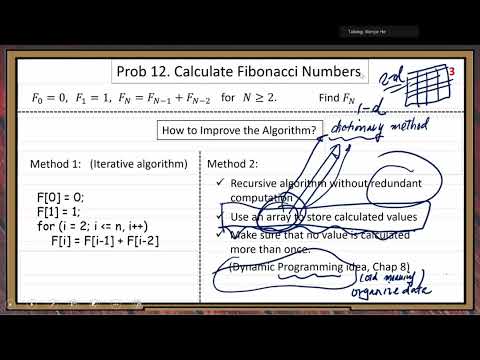
- The memoized Fibonacci method keeps recursive calls but checks an array, named nonf in the pseudocode, before calculating a value.
- The array is initialized with zeros, so a positive stored value indicates that a Fibonacci number has already been calculated.
- When a result is absent, the function computes it recursively, stores it in the array, and returns it.
- The detection step returns a stored Fibonacci value immediately instead of making more recursive calls.
- For an unknown value, the function handles the base cases, adds the two recursive results, and updates the dictionary before returning.
- The code changes are small, but each Fibonacci input needs to be calculated only once.
- With memoization, computing Fibonacci values through input size n takes O(n) time because each value is calculated once.
- Without lookup, recursive Fibonacci takes approximately O(φ^n), where φ, the golden ratio, is about 1.618.
- The exponential growth makes the unoptimized method impractical for larger inputs, while dictionary lookups avoid repeated calculations.
- Squares with side lengths 1, 1, 2, 3, and subsequent Fibonacci numbers can be arranged into adjoining rectangles.
- Quarter-circle arcs drawn through the squares create a spiral-like curve.
- The lecture mentions visual associations with the Mona Lisa as an example of claims made about Fibonacci-related proportions.
- For a longer segment a and shorter segment b, the special proportion sets a/b equal to (a+b)/a.
- Substituting x = a/b turns the proportion into x = 1 + 1/x.
- This relation leads to the quadratic equation x² = x + 1.
- Applying the quadratic formula to x² - x - 1 = 0 gives roots (1 + √5)/2 and (1 - √5)/2.
- The negative root is rejected because x represents a ratio of positive segment lengths.
- The positive root, φ ≈ 1.618, is the golden ratio and also appears in the exponential-time estimate for naive Fibonacci recursion.
- A formula can be found either by solving a problem directly or by guessing a candidate and then proving it correct.
- Mathematical induction is introduced as a verification tool for formulas, including the previously derived Fibonacci formula.
- The guess-and-verify approach is useful when a direct solution is too difficult to find.
- The described research process breaks a large goal into smaller subproblems, such as S1, S2, and S3.
- Researchers use experiments and collected data to form a reasonable guess for a subproblem, then verify it before proceeding.
- Repeated cycles of proposing and checking smaller results provide a path toward solving a larger problem.
- The array is divided into set A, containing elements in their correct positions, and set B, containing elements out of place.
- The problem gives 10 total inversions and asks for the maximum possible number of elements in set B.
- The lecture separates inversions into those within A, within B, and between A and B; it argues that suitable values can eliminate cross-set inversions and leave the count within B.
- For k elements in set B, the proposed arrangement places the largest element first and the remaining k - 1 elements in ascending order.
- That arrangement produces k - 1 inversions, one between the first element and each remaining element.
- Setting k - 1 = 10 gives k = 11; the lecture presents this as a guess to verify by mathematical induction.
Transcript excerpt
0:00 Yeah, because this is a you know undergraduate level class. So we will not go very deep in the dynamic programming because this mainly the graduate topic but it is so important so useful. So for our class I do a simpler version simple introduction to this dynamic program. Then in our programming project number two, we need to write a program uh using this dynamic programming method. So you you you compare the huge difference without using dynamic programming with dynamic programming the difference is huge. So then uh you know when you do uh real
0:50 world problem solving when you have a chance you can use this method. All right. First let me describe the situation under what situation should we use dynamic programming. Right. The first thing we want to keep the recursive algorithm. We want to keep using the recursive algorithm. We don't want to take this approach. Remember solving this problem calculating Fibonacci numbers there is a simple iterative algorithm. We just avoid the recursive algorithm. We can do it very fast. But the point is this is a simple problem, right?
1:38 Fibonacci calculate Fibonacci number. So now we need to consider you know real world relatively hard problem solving problems not for simple problems. Okay. So for very hard real world computing problems we cannot avoid recursive algorithms. We need to use the power of recursion. It's very powerful. Yeah. So that means we should not take this approach iterative approach. Okay. So now but when we apply the recursive algorithms there is another big problem.
2:28 That problem is the redundant calculation. Because when you call functions recursively, there is a there is a good chance you may call your recursive functions on the same parameter more than once. Yeah, repeatedly calling recursive functions on the same parameter input
This is the start of the transcript. Save this video free for the whole transcript, searchable and time-coded.
Related notes
Summary, takeaways, and chapters were generated by AI from the video's transcript and may contain errors. The video belongs to its creator, DrHeUMSLTeaching.