CS3130FS26Module3CVidProc
 Watch on YouTube →
Overview
The lecture derives Euclid’s algorithm for GCD from integer division, showing how replacing gcd(m, n) with gcd(n, m mod n) avoids slow prime factorization; it also connects factoring difficulty to RSA’s security. It then introduces Fibonacci computation: naive recursion repeats subproblems, while iteration and dynamic-programming memoization eliminate redundant work, with an array serving as a lookup dictionary.
Key takeaways
- Euclid’s algorithm follows from the identity gcd(m, n) = gcd(n, m mod n), reducing GCD computation to repeated integer division instead of prime factorization.
- The Euclidean recurrence terminates because each nonzero remainder is strictly smaller than its divisor; gcd(x, 0) = x supplies the stopping case.
- Naive recursive Fibonacci calculation repeats subproblems: the recursion tree for F6 already revisits values such as F2, and the waste grows rapidly for larger inputs.
- A loop computes Fibonacci values sequentially without redundant calls or a deep recursion stack, but does not retain the general recursive structure.
- Memoization combines recursion with an array lookup: save each computed Fibonacci value and return it on later requests, limiting each value to one computation.
- In the lecture’s signed 64-bit integer example, F92 fits while F93 overflows, illustrating how quickly Fibonacci values grow.
Chapters
0:00
Prime Factorization’s Cost and RSA’s Security Motivation
- The lecture contrasts GCD by prime factorization with faster approaches, noting that factoring numbers with thousands of digits could take months even across thousands of computers.
- RSA uses the difficulty of factoring a product of large primes as part of its security foundation.
- The example connects computational difficulty with practical protection of internet data.
2:00
RSA Public and Private Keys Depend on Number Theory
- RSA distributes a public key for encryption while keeping a private key for decryption.
- The lecture describes forming a large number by multiplying two huge primes and using number-theoretic modular operations, including Fermat’s little theorem.
- It presents quantum computing as a potential threat to factoring-based cryptography, while noting that such machines were not yet available at the scale imagined.
6:00
Replacing Factoring with Variable-Size Reduction
- Rather than factor numbers to find a GCD, the proposed strategy repeatedly reduces the problem size.
- The key is to develop a recurrence relation whose next input is smaller than the current pair.
- Integer division supplies the reduction step used to construct Euclid’s algorithm.
8:00
Integer Division Provides the GCD Reduction Step
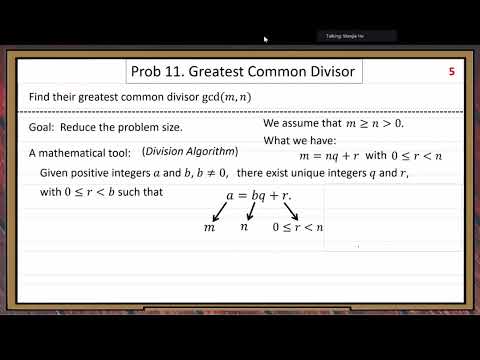
- For positive integers a and b, with b nonzero, the division algorithm gives unique integers q and r such that a = bq + r.
- The remainder satisfies 0 ≤ r < b, so replacing a with a remainder creates a smaller value.
- The lecture orders the inputs so m ≥ n before applying integer division.
12:00
Why gcd(m, n) Equals gcd(n, m mod n)
- Writing m = nq + r makes the relationship between the original pair and the remainder explicit.
- A common divisor of m and n also divides r = m − nq; conversely, a common divisor of n and r divides m.
- Therefore gcd(m, n) = gcd(n, r), and the new pair has a smaller combined size.
19:00
Euclid’s Algorithm: Base Cases, Recursion, and Termination
- The recurrence is gcd(x, y) = gcd(y, x mod y), with gcd(x, 0) = x as a base case.
- When x mod y = 0, y divides x and the algorithm returns y.
- Each recursive step reduces the remainder, eventually reaching zero; integer division replaces prime factorization as the core operation.
25:00
Optional GCD Project: Compare Trial Division with Euclid
- The optional project compares GCD by prime factorization, using the trial-division method from Module 1, against Euclid’s algorithm.
- Students are asked to choose a trial-division example taking roughly one minute, then time the same input with Euclid’s algorithm.
- The lecture contrasts a possible one-minute run with a Euclidean run measured in milliseconds.
29:00
Midterm Review Schedule and Quiz 3 Announcements
- The midterm is postponed by about one week, with a Part B review planned for Wednesday and a Part C review for the following Monday.
- Quiz 3 is scheduled to follow the homework deadline and cover material after Quiz 2; students are given about a week to complete it.
- The stated midterm plan places Parts A and C at 2:00, with their deadline at the end of Sunday.
35:00
Fibonacci Recurrence and 64-Bit Overflow
- Fibonacci numbers follow Fₙ = Fₙ₋₁ + Fₙ₋₂, with two base cases.
- Their rapid growth means signed 64-bit integers can represent F92, but calculating F93 overflows.
- The module plans both algorithmic methods and a later mathematical formula for Fibonacci numbers.
41:00
Naive Fibonacci Recursion Repeats the Same Work
- The direct recursive function branches into calls for Fₙ₋₁ and Fₙ₋₂ until it reaches the base cases.
- A recursion tree for F6 already shows repeated calls for values such as F2.
- For larger inputs such as F50, the many redundant calculations make brute-force recursion extremely slow and consume stack space.
49:00
Iterative Fibonacci Calculation Removes Repeated Calls
- An iterative method uses a loop to compute Fibonacci values in sequence, starting from the two base cases.
- Each new value uses already calculated smaller values, so every Fibonacci number is computed once rather than repeatedly.
- The method is fast and avoids a large recursion stack, but it does not preserve recursion as a reusable problem-solving technique.
52:00
Dynamic Programming Memoization Uses an Array as a Dictionary
- The recursive solution can retain its structure while storing calculated Fibonacci values in an array.
- Before computing a value, the function checks whether it is already known; if so, it returns the stored result instead of recalculating.
- Newly computed values are saved for later calls, ensuring each Fibonacci number is calculated at most once.
- The lecture calls this lookup-and-store approach dynamic programming and introduces the array as a dictionary for intermediate results.
Summary, takeaways, and chapters were generated by AI from the video's transcript and may contain errors. The video belongs to its creator, DrHeUMSLTeaching.