BIOL 105 Lecture 30 11/6/26
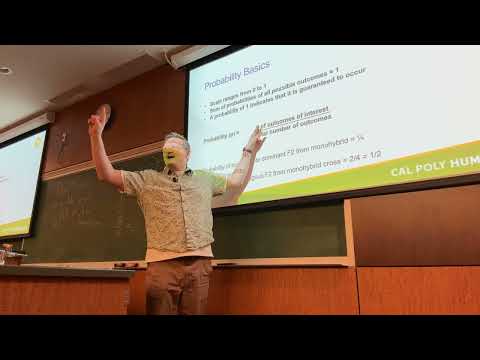
Overview
Jonathan Montgomery connects Mendel’s laws of segregation and independent assortment to probability, showing how product and sum rules predict inheritance outcomes without relying on large Punnett squares. Examples progress from monohybrid and dihybrid ratios to test crosses and multi-trait problems, including a three-trait phenotype probability of 9/64.
Key takeaways
- A test cross pairs an unknown dominant-phenotype organism with a homozygous recessive organism: all dominant offspring support a homozygous dominant parent, while a 1:1 phenotypic ratio supports a heterozygous parent.
- Use the product rule when independent events must all occur; for example, two six-sided dice show two ones with probability 1/36.
- Use the sum rule when one outcome has multiple mutually exclusive routes: Aa offspring from Aa × Aa arise through either A-from-one-parent/a-from-the-other or the reverse, totaling 1/2.
- For independent genes, a multi-trait genotype probability can be calculated by multiplying the single-gene probabilities instead of building a large Punnett square.
- A probability factor of 1 represents a guaranteed event and can be omitted from the arithmetic; checking parental alleles first can also reveal an impossible requested genotype.
- For two triple-heterozygous pea plants, the probability of dwarf stems with axial purple flowers is 9/64, from 1/4 for the recessive dwarf phenotype and 3/4 for each dominant flower trait.
Chapters
- The current week has a reading quiz due Sunday and a lab quiz on DNA extraction and plasmids.
- There is no Wednesday lecture or office hours next week because of Veterans Day.
- The next reading quiz covers chapters 14 and 15 for 10 points total; Exam 3 is scheduled for the following Monday, and its study guide is posted.
- The law of segregation says offspring inherit one allele for each gene from each parent; monohybrid crosses illustrate this pattern.
- The law of independent assortment describes genes inherited independently and is tested with dihybrid crosses.
- A heterozygote monohybrid cross predicts a 3:1 phenotypic ratio; a dihybrid cross with independent assortment predicts 9:3:3:1.
- These ratios describe probabilities across many offspring, not guaranteed counts in a single group of 4 or 16.
- An organism with a dominant phenotype may be homozygous dominant or heterozygous under complete dominance.
- Crossing the unknown organism with a homozygous recessive individual distinguishes the possibilities.
- A homozygous dominant parent produces all dominant-phenotype offspring; a heterozygous parent predicts a 1:1 dominant-to-recessive phenotypic ratio.
- Probability ranges from 0 to 1, where 0 means an event cannot occur and 1 means it is certain.
- Calculate probability as outcomes of interest divided by total possible outcomes.
- A fair coin has a 1/2 probability of heads; a six-sided die has a 1/6 probability of rolling a 2 and a 3/6 probability of rolling 1, 2, or 3.
- The product rule, also called the and rule, multiplies probabilities for independent events that must happen together.
- Rolling two six-sided dice has a 1/36 probability of producing two ones: 1/6 multiplied by 1/6.
- The sum rule, or or rule, adds probabilities when an outcome can occur in alternative ways, such as rolling 1, 2, or 3 for a total probability of 3/6.
- In a Punnett square, each cell’s probability comes from the combination of independent parental allele contributions.
- For an AaBb cross between two dihybrid individuals, the probability of an offspring being homozygous dominant for both genes is 1/4 × 1/4 = 1/16.
- For Aa × Aa, homozygous dominant offspring require a dominant allele from each parent, giving 1/2 × 1/2 = 1/4.
- Heterozygous offspring can result from dominant-then-recessive or recessive-then-dominant allele inheritance; add the two 1/4 pathways to get 1/2.
- Montgomery emphasizes multiplying independent events and adding mutually exclusive pathways to the same outcome.
- Montgomery corrects a confusing slide: the question concerns F2 offspring from crossing F1 heterozygotes, not the already heterozygous F1 generation.
- A standard heterozygote monohybrid cross produces a 1:2:1 genotypic ratio and a 3:1 phenotypic ratio.
- For an F2 offspring that is homozygous dominant or heterozygous, add those genotype probabilities: 1/4 + 1/2 = 3/4.
- For three independent heterozygous gene pairs, the probability of being homozygous dominant at all three is 1/4 × 1/4 × 1/4 = 1/64.
- In a four-gene cross, Montgomery checks whether each requested genotype is possible before multiplying its component probabilities.
- For the requested A, B, E, and H genotype, the allele probabilities are 1/2, 1/4, 1/4, and 1, respectively, yielding 1/32.
- A factor with probability 1 is guaranteed and does not change the product; impossible genotypes can be eliminated by checking the parental alleles.
- Two triple-heterozygous pea plants show the dominant traits: tall stems, axial flowers, and purple flowers.
- Dwarf stems require the homozygous recessive genotype, giving a 1/4 probability; axial and purple flowers each have a 3/4 probability.
- The requested combination, dwarf stems and axial purple flowers, uses the product rule: 1/4 × 3/4 × 3/4 = 9/64.
- Montgomery previews pedigree analysis, blood types, and additional practice for the next lecture.
Transcript excerpt
0:00 recording begins. It is November 6th, 2026, and this is biology 105. Thank you all for making it again. So, I should do a Friday lecture in week 11. That's no small feat. So, thank you for making it. Uh, let's see here. Here's our schedule. We're in week 11. You have a reading quiz due on Sunday. Don't forget to do the DNA extraction and plasmids quiz for your lab portion of the course. Next week, we do not have class Wednesday. We have Veterans Day. It is a holiday. All right? So, it's not listed in the schedule here, but there is no lecture on Wednesday. There also will be no office hours on Wednesday because it's a holiday and I'm not going to be working. Uh, at least not on campus. Anyways, next week there's another reading quiz. This means one quiz based on chapters 14 and 15, not two quizzes, 10 points
0:49 total. Then we do the Medelian engineext corn lab next week where we'll be talking about all these rules of phenotypic ratios that we're going to be talking about today and probably on Monday in lecture. It's great stuff. We'll also do some statistics with the kaiquare test. It's going to be a lot of fun. Then so not next week but the week after you have exam three. Okay. Uh that's coming up on Monday. Not next Monday but the Monday after next. Any questions about that? Yes, please. >> The study guide is posted. It's ready to go. Yep. Any other questions about that? Same length, same format. Scantrons. Great. Let's go ahead and get back into the lecture then. Here we go. >> Are we still a week ahead or
1:43 >> uh I mean we are doing week 12 material right now. Now we're on slide like 15 of
This is the start of the transcript. Save this video free for the whole transcript, searchable and time-coded.
In this course
Related notes
Summary, takeaways, and chapters were generated by AI from the video's transcript and may contain errors. The video belongs to its creator, Jonathan Montgomery.