BIOL 105 Lecture 29 11/4/26
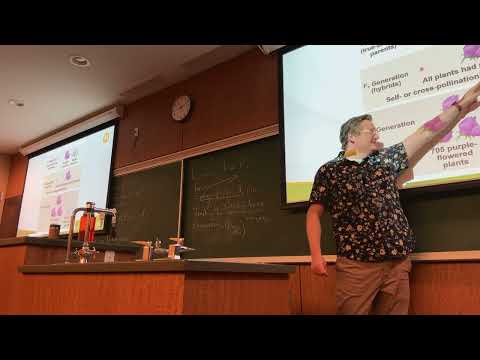 Watch on YouTube →
Overview
Jonathan Montgomery explains how Gregor Mendel used pea-plant crosses and probability to establish the laws of segregation and independent assortment. The lecture develops P, F1, and F2 generations, dominant and recessive alleles, genotype and phenotype, and probability-based predictions such as the 3:1 monohybrid phenotype ratio and the 1/16 chance of a double-recessive dihybrid offspring, while noting that linked genes do not assort independently.
Key takeaways
- A true-breeding purple PP pea plant crossed with a true-breeding white pp plant produces heterozygous Pp F1 offspring, which are purple under complete dominance.
- Crossing two heterozygous Pp plants yields expected F2 genotype proportions of 1 PP : 2 Pp : 1 pp and phenotype proportions of 3 purple : 1 white.
- A heterozygous parent passes either allele to a gamete with probability 0.5, so the chance of a PP offspring from Pp × Pp is 0.5 × 0.5 = 0.25.
- For a dihybrid cross between individuals heterozygous at both genes, independently inherited recessive traits each occur with probability 1/4, making the double-recessive outcome 1/16.
- Independent assortment applies to genes that assort independently, commonly genes on different chromosomes; linked genes can travel together and violate that assumption.
- Meiosis connects Mendel’s laws to cell processes: homolog separation at anaphase I explains segregation, while chromosome-pair orientation at metaphase I explains independent assortment.
Chapters
- The law of segregation says an organism passes only one of its two alleles for a trait into each gamete.
- The law of independent assortment says inheritance of one characteristic does not affect another when the genes assort independently.
- Genes linked on the same chromosome can be inherited together, so independent assortment does not describe every inheritance pattern.
- Mendel inferred these rules from repeated pea-plant crosses and consistent numerical ratios.
- The P, or parental, generation consists of true-breeding plants that produce offspring with the same trait when self-pollinated.
- A true-breeding purple plant and a true-breeding white plant each contribute one allele to their offspring.
- The F1, or first filial, generation is heterozygous for flower color because each offspring receives one purple allele and one white allele.
- The F1 plants are hybrids because they carry different forms of the flower-color gene.
- A monohybrid cross tracks one characteristic, such as flower color, by crossing two F1 hybrids.
- Purple is dominant in the example: an F1 plant with purple and white alleles has purple flowers.
- Genotype identifies the alleles an organism carries, while phenotype describes the expressed characteristic, such as purple or white flowers.
- The F2 offspring of two heterozygous plants show an approximately 3:1 dominant-to-recessive phenotype ratio.
- Homozygous individuals carry two copies of the same allele, such as PP or pp; heterozygous individuals carry different alleles, such as Pp.
- With complete dominance, PP and Pp plants have the dominant purple phenotype, while only pp plants have white flowers.
- The corresponding F2 genotype proportions are 1 PP, 2 Pp, and 1 pp, which produce the 3:1 phenotype ratio.
- These ratios describe expected proportions across offspring, not guaranteed counts in a small family or cross.
- A heterozygous Pp plant produces gametes with P or p at a probability of 0.5 each, reflecting segregation.
- A Punnett square lays out possible gamete combinations; for Pp × Pp, each of its four cells has a 0.25 probability.
- The probability of a homozygous dominant PP offspring is 0.5 × 0.5 = 0.25 because both parents must contribute P.
- Montgomery emphasizes multiplying the probabilities of required independent events rather than relying on Punnett squares as a universal method.
- In modern terms, an organism inherits one allele from each parent, and the alleles are different versions of a gene.
- A dominant allele can determine phenotype with one copy, while a recessive phenotype generally requires two recessive copies.
- During gamete formation, the two alleles separate so that half the gametes receive one allele and half receive the other in a heterozygote.
- Mendel developed this particulate model before genes or chromosomes could be observed directly.
- A dihybrid cross tracks two characteristics at once, illustrated with pea-seed shape and color.
- The example crosses true-breeding round yellow seeds with wrinkled green seeds, producing F1 plants heterozygous for both traits.
- If the two genes assort independently, offspring can combine dominant and recessive forms in multiple ways instead of inheriting only the original parental combinations.
- Each trait still follows its monohybrid 3:1 phenotype expectation when considered separately.
- A wrinkled green offspring must inherit two recessive alleles for seed shape and two recessive alleles for seed color.
- For a cross of two plants heterozygous at both genes, the probability of the recessive phenotype at each locus is 1/4.
- Independent assortment lets the two probabilities be multiplied: 1/4 × 1/4 = 1/16 for wrinkled green offspring.
- The same result can be represented in a 16-cell Punnett square, but the probability method scales more easily to additional genes.
- Anaphase I of meiosis separates homologous chromosomes, providing the cellular basis for the law of segregation.
- Metaphase I positions homologous chromosome pairs independently, supporting independent assortment for genes on different chromosomes.
- Mendel’s probability-based model explains observed ratios without requiring every small set of offspring to match those ratios exactly.
- The next topics previewed include multiplication and addition rules in probability, pedigrees, inheritance patterns outside Mendel’s laws, and blood types.
Transcript excerpt
0:00 Okay, recording begins. It's November 4th, 2026. This is biology 105. Thank you all for making it to another lecture. Hey, no problem. Um, yeah. So, just keep checking that schedule. You know, you have another exam coming up, I think, uh, not next week, but the week after. So, it's the week before fall break, right? On Monday, we'll knock that out. And otherwise, we're just going to keep covering material. You have lab this week. you have a reading quiz at this point. It's all old hat, right? So, let's get right into it. Enable content. Okay, so we're talking Mandelian genetics right here. That's a little intense. I'm going to lower that brightness a little bit. That okay for everybody?
0:48 All right, cool. We're talking Mandelian genetics right here. All right. Now, I already introduced Mendle's two laws. All right, the Mendle did all this work. Okay, he crossed all these pea plants. He looked at what the offspring looked like and he figured and he made some statements of each organism has two copies of this like instruction for a this this code for a trait. And each organism passes on only one copy of each code for the trait. Right? So you have two genes. All right? You pass on only one in your gamet. And then that's the law of segregation followed by the law of
1:35 independent assortment which states that the inheritance pattern for one characteristic does not influence the inheritance pattern for other characteristics. All right. So he built built all this data or figured out this these rules, these laws just based on a bunch of plant cross data. Something that looked like um this you know he crossed a bunch of flowers and found all these ratios and these ratios appeared to be consistent to him
This is the start of the transcript. Save this video free for the whole transcript, searchable and time-coded.
In this course
Related notes
Summary, takeaways, and chapters were generated by AI from the video's transcript and may contain errors. The video belongs to its creator, Jonathan Montgomery.