BIO105 Introductory Biology, Exam One Answer Key Video, David Champlin, USM
 Watch on YouTube →
Overview
David Champlin reviews BIO105 Exam One by explaining the answers and connecting them to biology concepts from class, quizzes, assignments, and the textbook. The walkthrough covers atoms and bonds, cell structures, proteins, membranes, metabolism, and evolution, while emphasizing active recall, strategic study, and a grading policy that can weight Exam One at either 10% or 20% of the final grade.
Key takeaways
- For final-grade calculations, Exam One will count as either 10% or 20%; a stronger result can count more, while the second exam and final take more weight if Exam One counts less.
- Use active recall to learn biology: practice retrieving concepts such as the pH relationship, atomic number, and cytoskeleton functions instead of relying only on rereading.
- Keep reaction energetics distinct: delta G describes the free-energy difference and helps determine equilibrium, while activation energy determines reaction rate and is lowered by enzymes.
- Water moves across a selectively permeable membrane toward higher solute concentration; aquaporins speed water movement without changing the equilibrium or using energy.
- Protein destination depends on its synthesis pathway: proteins for secretion or membranes use rough ER ribosomes, while hemoglobin is made by free ribosomes.
- A protein's primary sequence survives denaturation, but its secondary, tertiary, and quaternary structures can unfold.
Chapters
- Champlin explains that the answer key is meant to reinforce concepts, reveal mistaken reasoning, and prepare students for the cumulative final.
- Students should use the exam to strengthen lasting biology knowledge and learning skills for advanced courses.
- At semester's end, Exam One will count either 10% or 20% of the final grade, with the second exam and final adjusting accordingly; students do not need to choose.
- Exam grades are assigned using the anonymous class score distribution, not fixed 90/80/70/60 cutoffs; an example score of 52 out of 80 receives a C+.
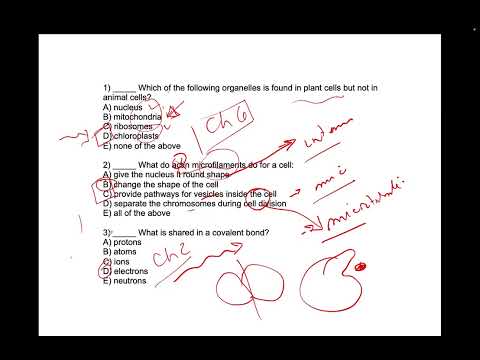
- Nuclei, mitochondria, and ribosomes occur in both animal and plant cells, while plant cells also have characteristic organelles.
- Actin microfilaments support cell shape, crawling, division, and phagocytosis; microtubules act as tracks for vesicles and chromosomes.
- Champlin recommends combining class material with relevant textbook sections and reflecting on study time, study methods, and exam anxiety.
- Covalent bonds share electrons, a foundational chemistry concept revisited across the course.
- An element's atomic number gives its proton count; mass number reflects protons plus neutrons, while an ion's charge indicates an electron imbalance.
- Chlorine-35 has 17 protons and 18 neutrons; a chlorine ion with a minus-one charge has 18 electrons.
- Changing neutron count creates an isotope, while changing proton count changes the element; gaining an electron creates an anion.
- When LDL binds its cell-surface receptor, the receptor changes shape, helping clathrin assemble a coated pit and then a coated vesicle.
- LDL carries hydrophobic cholesterol inside a particle whose outer surface is hydrophilic, allowing transport in watery blood.
- Rough ER ribosomes synthesize proteins destined for secretion or membranes; proteins travel to the Golgi, where sugars are added by glycosylation.
- A typical carbon atom has 6 protons and 6 neutrons, giving it an approximate mass number of 12.
- Fluorine is more electronegative than oxygen; electronegativity generally rises toward the upper right of the periodic table, excluding inert noble gases such as helium.
- A negative delta G means products have lower free energy than reactants, so the reaction is exergonic and can proceed spontaneously.
- Because pH is the negative logarithm of hydrogen-ion concentration, lower pH means higher hydrogen-ion concentration.
- Genome comparisons, including human, dog, and maple tree genomes, help infer relationships among organisms and organize life into the domains above kingdoms.
- Each amino acid has a shared core and a distinctive side chain, or R group, that determines properties such as polarity and hydrophobicity.
- Side chains containing oxygen or charge tend to be hydrophilic; carbon-and-hydrogen-rich side chains tend to be nonpolar and hydrophobic.
- A short chain of amino acids is a peptide, while a longer chain is commonly called a polypeptide; the boundary between peptide and protein is conventional.
- Peptide sequences are written from left to right in the direction ribosomes synthesize them, so the first residue is amino acid number one.
- A four-amino-acid chain is a peptide, and the covalent link connecting amino acids is called a peptide bond.
- The course highlights functional-group structures such as carbonyl and carboxyl groups; a carboxyl group can donate a hydrogen ion and act as a weak acid.
- Mitochondria are introduced as the cell's power plants, a concept that leads into later metabolism chapters.
- Denaturation does not break a protein's primary amino-acid sequence; it disrupts higher-level structures.
- DNA, proteins, and polysaccharides are polymers built from monomers; condensation or dehydration joins monomers, while hydrolysis uses water to break them apart.
- Protein denaturation unfolds secondary, tertiary, and quaternary structures while leaving the primary sequence intact.
- Champlin distinguishes the free-energy change, delta G, which helps determine equilibrium, from activation energy, which affects reaction rate.
- At chemical equilibrium, forward and reverse reactions continue at equal rates rather than stopping.
- Osmolarity is calculated by adding the concentrations of solutes that cannot cross the membrane; in the example, the inside totals 200 milliosmolar and the outside 100 milliosmolar.
- Water moves in both directions but has a greater net flow toward the higher solute concentration, so the lower-concentration outside solution is hypotonic relative to the inside.
- If the membrane reaches equilibrium, the example's internal glucose and sucrose concentrations dilute as the cell swells toward 100 milliosmolar.
- Aquaporins increase the rate of water movement but do not consume energy or change the final equilibrium.
- Orthologs are genes in different species with similar sequences and functions, evidence that they descended from a common ancestral gene.
- Comparing human and cow hemoglobin illustrates how DNA-derived amino-acid sequences can support evolutionary relationships.
- A carboxyl group can release hydrogen ions into water, increasing hydrogen-ion concentration and lowering pH.
- Microtubules help pull chromosomes apart, while hemoglobin is synthesized by free ribosomes rather than the rough ER.
- Anabolism builds molecules, such as DNA synthesis; catabolism breaks molecules down, and anabolic steroids take their name from this building process.
- Secreted LDL protein is synthesized on rough ER ribosomes, while smooth ER synthesizes lipids such as cholesterol and phospholipids.
- Exocytosis releases LDL when a vesicle fuses with the cell membrane; clathrin coats the forming vesicle and is later removed and recycled.
- Protein synthesis occurs on free ribosomes or rough ER in the concepts covered here; mitochondrial and chloroplast protein synthesis is noted as a more advanced extension.
- Activation energy determines reaction rate, while delta G describes the free-energy difference relevant to reaction direction and equilibrium.
- For acid rain at pH 4, the hydrogen-ion concentration is 10 to the minus 4 molar; each pH unit represents a tenfold concentration change.
- Water's hydrogen bonds help explain its specific heat and surface tension because energy is required to disrupt interactions between water molecules.
- A lower pKa indicates a stronger acid; adding a strong acid raises hydrogen-ion concentration more than adding a weak acid or base.
- In the reaction graph, enzyme B gives the fastest rate because it has the lowest activation-energy barrier; activation energy is a positive value.
- The graph's free-energy change is negative 6 kilocalories per mole, identifying an exergonic reaction.
- All cells on Earth have a cell membrane, while structures such as chloroplasts are not found in every cell.
- The size hierarchy proceeds from atoms and water molecules to proteins, ribosomes, and cells; human cells are generally larger than bacterial cells.
- Enzymes are usually protein catalysts that bind specific substrates and lower activation energy; denaturation leaves the primary structure intact.
- Passive transport does not require energy, whereas active transport does; cholesterol requires carrier particles such as LDL because it is hydrophobic.
- Intermediate filaments help support the nucleus, while microtubules provide tracks for vesicles and chromosome movement; motor proteins use ATP.
- Phospholipids are amphipathic, with hydrophilic and hydrophobic regions, and biological membranes contain phospholipids and proteins.
- Champlin closes by noting that exam questions draw on class, textbook sections, quizzes, and assignments, and invites students to follow up on remaining confusion.
Transcript excerpt
0:00 Okay, this is an answer key video and uh so let me get things going here. So this is an answer key video. And um I do this for all my courses. I give an exam and uh when I give the exam um in this course, our course, since it's multiple choice, it doesn't is isn't as effective as some other courses where there's a lot of writing. And uh so what the answer key video is I still explain the answers. And so I'm going to walk through the the uh you know, explanation of what the right answer is. And um and um I'll try to explain it and uh uh I'll also explain your grade and where we're at in our course. And uh so it's an important video for everybody to
0:48 watch, no matter how you did on the exam. Uh even if you got all the answers right, uh I try to make the answer key worthwhile uh to try to explain it more fully because uh you know, you might have gotten it right for the wrong reasons and stuff like that, okay? So we're going to talk through that. >> [clears throat] >> And um um the um and then if you still have questions, um I'll let me know uh because we want to follow up with this exam um for a couple of reasons. Uh one is it's an introductory course and so uh we're not trying to have you learn these concepts you know, uh just for a couple of months and then forget them. We're trying to build some uh understanding and then secondly, it's an intro course and we're also trying to
1:37 build uh learning skills uh to you know, strengthen you as a learner in your
This is the start of the transcript. Save this video free for the whole transcript, searchable and time-coded.
In this course
Related notes
Summary, takeaways, and chapters were generated by AI from the video's transcript and may contain errors. The video belongs to its creator, The New Evolution for Everyone.