Atoms and Chapters 2,3,4, BIO105 Introductory Biology, David Champlin, USM
 Watch on YouTube →
Overview
David Champlin introduces BIO105’s chemistry sequence, explaining how a small set of atoms and chemical behaviors builds the diverse molecules and cells of life. He uses a scale analogy, atomic structure, isotopes, electron shells, covalent bonds, and electronegativity to prepare students for the next lesson on water and its role in cells.
Key takeaways
- A typical eukaryotic cell is about 30 micrometers across, and scaling it to a 30-mile metropolitan area helps compare cells, organelles, bacteria, and proteins.
- Atomic number is the proton count that identifies an element, while mass number adds protons and neutrons to show the atom’s approximate mass.
- Ion charge reveals electron transfer: sodium becomes +1 after losing an electron, while chlorine becomes -1 after gaining one.
- Valence electrons help predict covalent bonding patterns: hydrogen forms 1 bond, oxygen 2, nitrogen 3, and carbon 4.
- Electronegativity differences create polar covalent bonds; oxygen draws water’s shared electrons more strongly than hydrogen, producing partial charges and attraction between water molecules.
Chapters
- Chapters 2, 3, and 4 cover biological chemistry, water, and other biological molecules.
- Champlin frames life’s molecular diversity as variations on a limited set of atomic building blocks.
- All cells exist in a water environment and have a cell membrane; proteins perform many cell functions.
- A typical eukaryotic cell is about 30 micrometers across, roughly 30 millionths of a meter.
- Champlin scales that cell up to a 30-mile-wide Boston metropolitan area to make cellular structures easier to imagine.
- In the analogy, organelles are neighborhood-sized, bacteria are school-sized, and proteins are truck-sized.
- Cells contain many copies of proteins, such as tens or hundreds of thousands of hemoglobin molecules in a red blood cell.
- Chapter 2 begins by reducing the cell to its smallest components, starting with atoms.
- Atoms are physical building blocks of all matter, including living organisms.
- Biology focuses on a limited subset of the periodic table, with a few elements especially abundant in life.
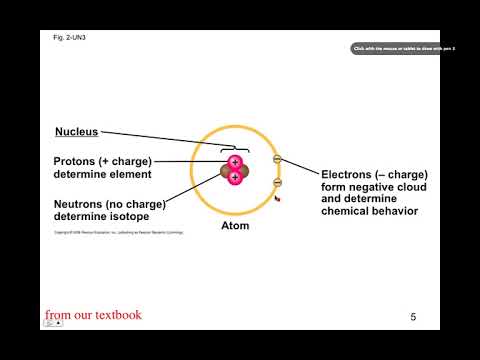
- Atoms contain protons and neutrons in the nucleus, with negatively charged electrons around it.
- An element’s atomic number equals its number of protons, so changing the proton count changes the element.
- Hydrogen has 1 proton, carbon has 6, and helium has 2.
- In sodium chloride, chlorine’s stronger attraction for an electron helps explain why dissolved salt forms ions.
- Mass number is the total number of protons and neutrons; electrons contribute almost no mass.
- Oxygen-16 has 8 protons and 8 neutrons, illustrating how mass number reveals neutron count.
- Isotopes of an element differ in neutron count; radioactive isotopes can release energy as they decay.
- Biologists use radioactive labels to track molecules and use carbon dating to estimate age.
- Electrons are the atomic components most involved in chemical interactions and can be shared or transferred.
- A sodium ion with a plus-one charge has 11 protons and 10 electrons after losing one electron.
- A magnesium ion with a plus-two charge has 12 protons and 10 electrons.
- A chloride ion has 17 protons and 18 electrons after gaining an electron from sodium.
- Periodic-table rows correspond to electron shells, which fill in order as electrons are added.
- Valence electrons occupy the outer shell; sodium has 1, while chlorine has 7.
- Atoms can share electron pairs in covalent bonds to fill outer shells; hydrogen typically forms 1 bond, oxygen 2, nitrogen 3, and carbon 4.
- Water forms when oxygen shares electron pairs with two hydrogen atoms, while full outer shells help explain why noble gases are relatively unreactive.
- Covalent bonds have a characteristic length and do not bend, but atoms can rotate around bonds, giving large molecules such as insulin flexibility.
- Molecular examples include methane, methanol, ethanol, and oxygen gas, whose atoms follow characteristic bonding patterns.
- Electronegativity describes an atom’s pull on shared electrons; it generally increases across a row and decreases down a column of the periodic table.
- Oxygen pulls shared electrons more strongly than hydrogen, creating partial charges and a polar covalent bond in water.
- Water molecules attract one another, a key property that Champlin develops in the next lesson on chapter 3.
Transcript excerpt
0:00 all right the next series of mini lectures are going to be about chapters 2 3 and 4. chapter 2 introduces some biological chemistry chapter 3 is about water a good molecule to start with and chapter 4 is about some other biological molecules you'll see that biological chemistry is awesome and because we get to focus just on a limited number of atoms and a limited number of chemical behaviors in life life is really rich and diverse but a lot of its diversity comes from um you know stacking the same lego blocks in a variety of different ways with the lego blocks being little atoms and molecules and so i wanted to start out with this image because we're going to be down at this level and
0:48 you can see the scale here and i've got another scale image i also put it on our handouts that i think is a nice one to conceptualize this the atoms that we're going to start out with are invisible they're smaller than the strongest microscope can view and even most of the molecules that we work with are invisible under any kind of microscope and so uh um it's going to be important to use some images from the book and that we can understand how these atoms get put together from uh into molecules and how they work but again you know huge amounts of biology that many students are interested in you know to study and work on for their whole career or to live in and enjoy happens up here and that's
1:36 more bio 107 and we're going to be down here at cells and molecules and where we're heading is uh where we're going to be going through the book um the the with these three chapters of
This is the start of the transcript. Save this video free for the whole transcript, searchable and time-coded.
Related notes
Summary, takeaways, and chapters were generated by AI from the video's transcript and may contain errors. The video belongs to its creator, The New Evolution for Everyone.