Intro Bio 2: Proteins
 Watch on YouTube →
Overview
Proteins are the tools of life: each protein’s three-dimensional structure, built from a chain of amino acids, enables a specific function, as illustrated by insulin. DNA inherited from parents encodes proteins, and BLAST comparisons of insulin genes across people and species reveal shared genes, variation, and evidence of common ancestry that contributes to phylogenetic trees spanning life.
Key takeaways
- A protein’s amino acid chain folds into a three-dimensional structure, and that structure determines its function, as illustrated by insulin.
- The pancreas builds human insulin from amino acids absorbed into the blood rather than using intact proteins from foods such as beef.
- DNA inherited from parents encodes proteins, and amino acid sequences can be stored and compared as lines of single-letter codes.
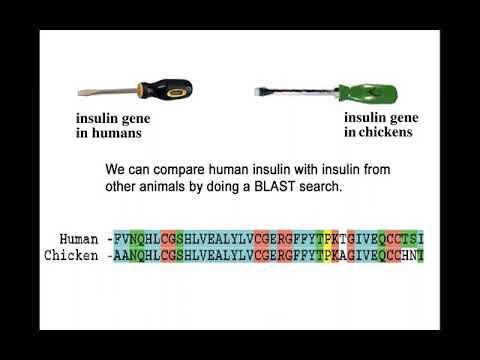
- BLAST ranks sequence matches, allowing researchers to compare insulin genes across people and species and identify related genes called orthologs.
- Similar insulin genes in humans and chickens are evidence that the species inherited the genes from a common ancestor.
- Phylogenetic trees built from DNA sequence comparisons connect organisms across life, from bacteria to plants and animals.
Chapters
- Insulin is synthesized in the pancreas and released into the blood; its three-dimensional structure enables its biological function.
- Proteins are chains of amino acids joined by covalent bonds, assembled from about 20 common amino acid types.
- Dietary proteins are digested into amino acids, which enter the blood and are used by cells to build human proteins rather than directly reusing animal proteins.
- DNA inherited from parents provides the information cells use to build proteins, and protein sequences can be represented with single-letter amino acid codes.
- BLAST searches genetic sequence databases for matches, ranks results, and can compare a human insulin gene with sequences from people, cows, or chickens.
- Insulin gene sequences are highly similar among people, with differences corresponding to gene variants called alleles.
- Similar insulin genes in humans and chickens are interpreted as orthologs, genes in different species descended from a shared ancestral gene.
- Shared sequence patterns suggest common ancestry, while mutations that disrupt an important protein function may be eliminated from a population.
- Older phenetic trees grouped organisms by visible similarities, such as having hair; modern phylogenetic trees use genetic evidence, including related insulin genes.
- Comparisons across thousands of gene and protein sequences produce evidence for evolutionary relationships far beyond the single insulin example.
- DNA sequencing and sequence searches support a phylogenetic tree spanning bacteria, plants, and animals.
- The course uses insulin as an introductory example, then builds on it with concepts including mutations, alleles, and large-scale genetic evidence.
Transcript excerpt
0:00 we're going to start our course off talking about proteins it's true our book doesn't get into proteins until the third or fourth chapter but after that every chapter and every lecture is about proteins proteins are the tools of life that do the work of life and so we're going to start out our course talking about insulin as our first example of a protein it's a really good example because every no everybody knows a little bit of something about insulin we know that insulin is in our body and that it's got a job to do and insulin is like a screwdriver insulin is a protein and a protein has a certain shape or structure just like a screwdriver has a certain shape and that shape gives it the function so insulin has a structure that gives it its function we're going to look at several proteins in this course as we go through the course you don't need to memorize this list because we'll
0:46 learn about them as we meet them and each one has a unique structure that gives it its function and in our bodies we have maybe you know fifteen thousand to twenty thousand different proteins each one with a a special structure and function and so we're going to start out talking about insulin and what do we know about insulin insulin gets made gets synthesized in the pancreas and then it gets released into the blood if we could zoom in on insulin and one molecule of insulin in the blood it would look like a little screwdriver it's got a structure a three-dimensional structure that gives it its function and of course it doesn't really look like that it looks more like this it's a series of several hundred atoms
This is the start of the transcript. Save this video free for the whole transcript, searchable and time-coded.
Related notes
Summary, takeaways, and chapters were generated by AI from the video's transcript and may contain errors. The video belongs to its creator, The New Evolution for Everyone.