Bonds, Covalent and Noncovalent, BIO105 Introductory Biology, David Champlin, USM
 Watch on YouTube →
Overview
In BIO105, David Champlin explains how electronegativity differences distinguish nonpolar and polar covalent bonds, and how molecular polarity shapes interactions with water. Examples including fats and oils, insulin, sodium chloride, and water's hydrogen bonds connect bond types to solubility, temperature, and the chemical environment in which biological reactions occur.
Key takeaways
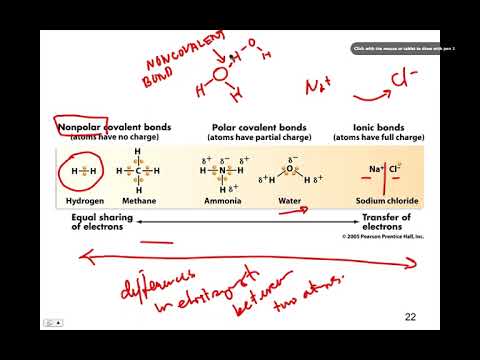
- Electronegativity differences determine whether a covalent bond is polar: water's O-H bonds are polar, whereas the bonds between identical hydrogen atoms in H2 are nonpolar.
- Water's polarity explains why it dissolves ionic sodium chloride: oxygen atoms orient around sodium ions, and hydrogen atoms orient around chloride ions, forming hydration shells.
- Nonpolar carbon-hydrogen-rich fats and oils do not mix well with polar water, while insulin can dissolve overall because its surface includes water-interacting polar regions.
- Covalent bonds share electrons, but noncovalent interactions such as water's hydrogen bonds arise from attraction without electron sharing and are comparatively weak and dynamic.
- Temperature and concentration affect whether substances remain dissolved: cooling or reaching saturation can cause dissolved material to precipitate.
- Champlin links cool, dry storage of medicines to reduced molecular activity and less water-mediated destabilization, helping preserve a longer shelf life.
Chapters
- Oxygen is more electronegative than nitrogen and carbon, while hydrogen has electronegativity comparable to carbon.
- Water has polar covalent O-H bonds; methane and the carbon-hydrogen bonds common in fats and oils are nonpolar.
- Water interacts strongly with other polar water molecules, so nonpolar fats and oils are excluded into droplets.
- Insulin has both polar and nonpolar surface regions, but its polar regions allow the molecule to dissolve overall in blood.
- When sodium chloride dissolves, water's partially negative oxygen atoms surround sodium ions, while its partially positive hydrogens orient toward chloride ions.
- These surrounding water molecules form hydration shells; cooling or saturating a solution can cause dissolved material to precipitate.
- Champlin uses water's molecular motion to explain how temperature affects dissolving and why warmer water can dissolve substances such as salts and insulin more readily.
- Hydrogen gas has a nonpolar covalent bond because both atoms have the same electronegativity, while sodium chloride's large electronegativity difference results in electron transfer.
- Champlin distinguishes covalent bonds, which share electrons, from noncovalent interactions, which attract molecules without electron sharing.
- Water molecules form weak, dynamic hydrogen bonds between hydrogen and oxygen; these interactions are continually made and broken.
- The lecture connects water exposure and warmth with greater molecular activity, using cool, dry medicine storage as an example of limiting chemical breakdown.
- Hydrophilic substances interact readily with water, while hydrophobic substances such as fats and oils do not; insulin can have both types of surface region.
- Ionic interactions and London dispersion forces are named as additional noncovalent interactions, with molarity and pH deferred to a later lecture.
Transcript excerpt
0:00 all right um this video is going to be short one and it's focused in on this and uh so at the end of the last uh video about atoms we started to build molecules and remember molecules are atoms joined together by covalent bonds and we have these two types of bonds and they are different because the atoms joined together have uh either the comparable electronegativity or different electronegativity and uh you don't need to calculate or know that electronegativity uh again we just have four elements that we're really interested in and what we're just going to point out right now is that these guys are on the same row and so oxygen is going to have more electronegativity than nitrogen and
0:50 and more than carbon and then it's a little bit hard to judge because they're on different rows which of these has more electronically but it turns out that hydrogen's electronegativity is similar to carbons uh carbon's got more proton pull but in the outer uh valence electrons are further from the nucleus and so um about the same and that means that hydrogen is less electronegative than oxygen and so what we'll see is that water is a formed polar polar covalent bonds and then we already talked about we saw in chapter two a simple molecule like methane
1:38 is nonpolar and it turns out that these types of connections are are present in a lot of fats and oils and the entire reason that uh jar of dressing separates into fats and oils is because the fats and oils get pushed out of the water because the water can't interact with other water molecules as a result of this slight charge that we talked about talked about in the previous video and so water is essentially sort of
This is the start of the transcript. Save this video free for the whole transcript, searchable and time-coded.
Related notes
Summary, takeaways, and chapters were generated by AI from the video's transcript and may contain errors. The video belongs to its creator, The New Evolution for Everyone.