Molarity and pH. BIO105 Introductory Biology, David Champlin, USM
 Watch on YouTube →
Overview
David Champlin’s BIO105 lesson connects molarity and pH to how dissolved substances affect biological interactions. It defines molarity as moles per liter, explains how water’s hydrogen-ion concentration determines pH, and applies molecular weights to preparing glucose and sucrose solutions.
Key takeaways
- Biological interactions depend on concentration: doubling the concentration of sugar in water doubles the frequency with which a bacterium encounters sugar molecules.
- Molarity is calculated as moles of solute per liter of solution, allowing biological chemists to express concentrations of vast numbers of molecules.
- A pH change of one unit represents a tenfold change in hydrogen-ion concentration, so even a small numerical shift can alter conditions for living systems.
- Equal molar concentrations contain equal numbers of molecules per volume, regardless of molecular size, so glucose and sucrose at the same molarity have equal encounter frequencies.
- Molecular weight converts between moles and grams: 180 g of glucose or 342 g of sucrose provides one mole of the respective sugar.
Chapters
- Cells live in water, and concentration, rather than the total number of molecules, determines how often substances interact.
- Concentration is the number of dissolved molecules per volume; doubling the water halves concentration, while doubling the solute doubles it.
- Molarity, written M, is moles per liter, a practical unit for the enormous numbers of molecules found in biological systems.
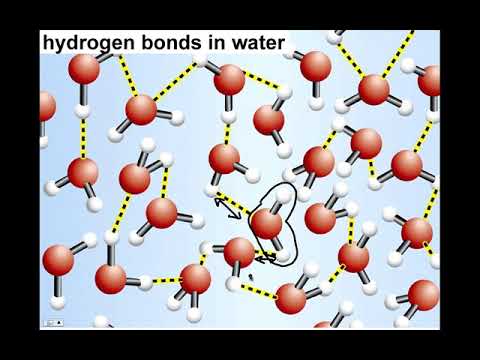
- Water’s partial charges attract neighboring molecules, and ongoing exchanges of hydrogen ions and hydroxide ions illustrate chemical reactions in solution.
- Square brackets denote concentration, so [H⁺] represents hydrogen-ion concentration in moles per liter.
- pH equals the negative logarithm of hydrogen-ion concentration: pH 4 corresponds to 10⁻⁴ M [H⁺].
- At neutral pH 7, hydrogen-ion and hydroxide-ion concentrations are equal; acidic solutions have relatively more hydrogen ions.
- A one-unit increase from pH 4 to pH 5 means a tenfold decrease in [H⁺], which can substantially change water chemistry and affect life.
- At equal molarity, bacteria encounter glucose and sucrose molecules at the same frequency, even though sucrose molecules are larger.
- A 1 M glucose solution requires 180 g of glucose brought to a final volume of 1 liter; a 1 M sucrose solution requires 342 g of sucrose per liter.
- Molecular weight links moles to mass: water is 18 g/mol, glucose is 180 g/mol, and sucrose is 342 g/mol.
- To prepare 3 M glucose, dissolve 3 moles, or 540 g based on glucose’s 180 g/mol molecular weight, and bring the solution to a final volume of 1 liter.
Transcript excerpt
0:00 all right we started talking about water because from our hand out one of the major seven themes in our course is that all cells every cell of any kind plants animals bacteria on this planet whether they live in the desert or in Antarctica or in your body all cells exist in a water environment and also water chemistry is a great way to introduce a lot of chemistry so we'll talk about water and we can imagine in a cup full of water and that cup can have stuff dissolved in it so we can zoom in on the water in the cup and we can see this maybe there's some sugar molecules dissolved in there maybe there's a bacteria in there biologists always talk about concentration of molecules because it's always concentration that matters the bacteria doesn't care how many total
0:48 molecules of sugar are dissolved in the water it cares about their concentration because the concentration is what determines how frequently the bacteria will bump into sugar and get to eat so at this concentration the bacteria will eat at a certain frequency if we double the concentration of sugar the bacteria would eat twice as often and that's just the key concept and it's true whether it's bacteria in a cup of sugar water bumping into food or whether it's your body and in your body a hormone in the blood bumping into a receptor it's always about concentration and concentration is the number of say sugar molecules in a volume of liquid in biology we're almost always talking about stuff dissolved in water so numbers of sugar molecules dissolved in
1:36 a volume of water if we double the water the concentration of sugar molecules is cut in half if we double the sugar molecules the concentration of sugar
This is the start of the transcript. Save this video free for the whole transcript, searchable and time-coded.
Related notes
Summary, takeaways, and chapters were generated by AI from the video's transcript and may contain errors. The video belongs to its creator, The New Evolution for Everyone.