BIO105 Introductory Biology, Wed., Oct., 7th, David Champlin, USM
 Watch on YouTube →
Overview
David Champlin connects molecular chirality and membrane chemistry to cell function, explaining how proteins are synthesized, modified, sorted, and moved. The lecture emphasizes the Golgi apparatus’s protein modifications—including mannose-6-phosphate tagging of lysosomal proton pumps—and contrasts the cytoskeleton’s microtubules, actin microfilaments, and intermediate filaments through examples such as vesicle transport, cell crawling, and division.
Key takeaways
- Molecular chirality matters in both biology and drug design: mirror-image molecules can behave differently, and asymmetric catalysis can favor production of one form.
- The Golgi apparatus modifies and sorts proteins; mannose-6-phosphate tags lysosomal proton pumps for delivery to lysosomes.
- Lysosomal function depends on both a working proton pump and correct targeting: failure of either acidification or mannose-6-phosphate receptor sorting can cause cellular material to accumulate.
- Rough ER ribosomes make proteins with signal sequences, whereas smooth ER supports lipid metabolism, including cholesterol processing for steroid hormone synthesis.
- Microtubules made of tubulin provide tracks for vesicle transport and chromosome separation; actin microfilaments reshape cells and power processes such as phagocytosis and cytokinesis.
- Intermediate filaments, including nuclear lamins, provide structural support and can disassemble and reassemble as the nucleus breaks down and reforms during cell division.
Chapters
0:00
Molecular Chirality and the 2021 Chemistry Nobel
- Chirality describes molecules that have the same formula but mirror-image forms, often called left- and right-handed enantiomers.
- Life uses consistent versions of amino acids and nucleotides, while ordinary lab synthesis can produce equal amounts of both forms.
- The 2021 Chemistry Nobel recognized Benjamin List and David MacMillan for asymmetric organocatalysis, methods that favor one molecular form in a reaction.
5:00
Course Plan: Membranes, Metabolism, and Protein Synthesis
- The class plans to finish Chapters 6 and 7, linking cell structures and membranes to the chemistry covered earlier.
- Phospholipids are amphipathic: each molecule has a hydrophilic region and a hydrophobic region, allowing membranes to form spontaneously in water.
- Upcoming metabolism material covers molecular building and breakdown, food-energy pathways, and photosynthesis; a quiz is scheduled on protein-traffic material.
10:00
The Golgi Apparatus Modifies Proteins in Transit
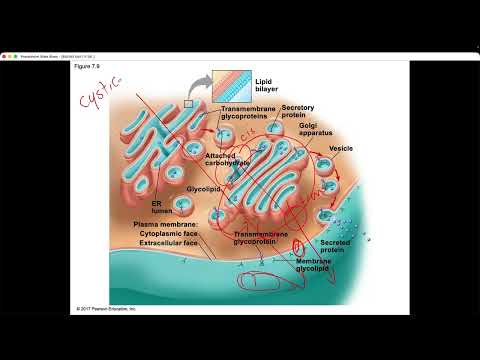
- Proteins with a signal sequence enter the rough endoplasmic reticulum (ER), travel in vesicles, and pass through the Golgi apparatus on their way to a destination.
- The Golgi is organized as stacked membrane compartments, with incoming traffic at the cis side and outgoing traffic at the trans side.
- Many proteins that leave the cell or become part of its surface are modified in the Golgi; hemoglobin is a contrasting example made by free ribosomes.
15:00
Glycoproteins and the Extracellular Matrix
- Some Golgi-processed proteins receive covalently attached polysaccharide chains, producing glycoproteins.
- The extracellular matrix (ECM) supports tissues and provides a surface for cells such as macrophages to crawl across.
- Collagen strengthens skin and cartilage, while water-attracting polysaccharides help make some ECM material gel-like and lubricating.
20:00
Lysosomal Proton Pumps Take a Tagged Route
- A lysosomal proton pump is synthesized through the rough ER and passes through the Golgi, where it receives a molecular sorting tag.
- The Golgi adds mannose-6-phosphate to the pump; the mannose-6-phosphate receptor recognizes the tag and directs vesicle traffic toward a lysosome rather than the cell surface.
- Once in the lysosome, the pump uses energy to move hydrogen ions into the lumen, making it acidic enough to digest material.
25:00
Lysosomal Storage Disease: Failed Pumps or Failed Sorting
- A defective lysosomal proton pump can prevent acidification, leaving cells unable to digest material delivered to lysosomes.
- A defective mannose-6-phosphate receptor can cause a similar storage problem: working pumps fail to reach lysosomes because the sorting signal is not recognized.
- Champlin uses these cases to connect gene mutations, protein function, organelle targeting, and cellular consequences.
30:00
Rough ER and Smooth ER Have Different Jobs
- Ribosomes dock on the rough ER to synthesize proteins carrying signal sequences; the ribosomes remain outside the ER while the protein product enters its lumen or membrane.
- The signal sequence helps direct a growing protein to the rough ER and is later clipped off.
- The smooth ER lacks ribosomes and supports lipid metabolism, including processing cholesterol used to make steroid hormones such as testosterone and estrogen.
35:00
Neurotransmitter Recycling and Drug Effects
- Nerve cells release neurotransmitters from vesicles into a small gap, where they bind receptors on a neighboring cell, and then recover them for reuse.
- Cocaine blocks neurotransmitter reuptake, prolonging stimulation of the next neuron.
- The example shows how medicines and drugs can affect exocytosis, endocytosis, release, or recycling at the cellular level.
40:00
Microtubules Transport Vesicles and Separate Chromosomes
- Microtubules are polymers of tubulin that continually assemble and disassemble, forming intracellular tracks for directed movement.
- Motor proteins use energy to move vesicles along microtubules rather than letting them drift randomly through the cell.
- During cell division, microtubules attach to chromosomes and pull them toward opposite ends of the cell.
45:00
Actin Microfilaments Change Cell Shape
- Actin microfilaments help cells change shape through coordinated polymerization and interactions with motor proteins such as myosin.
- A macrophage uses actin-driven shape changes to surround and engulf a bacterium during phagocytosis.
- During cell division, actin and myosin form a contractile ring that tightens and pinches one cell into two.
50:00
Macrophage Crawling and the Cytoskeleton Review
- Macrophages crawl by extending toward the ECM, attaching to it, and moving the cell body forward through actin-based contraction.
- Microtubules move cargo inside cells, while actin microfilaments drive shape changes, contraction, and crawling.
- Neural crest cells provide an additional example of cell migration: they travel during vertebrate development and contribute to facial tissues.
55:00
Intermediate Filaments and Exam Preparation
- Intermediate filaments provide relatively stable structural support; nuclear lamins form a layer that helps maintain the nucleus’s shape.
- During cell division, nuclear lamins disassemble as the nuclear envelope breaks down and later reassemble around the chromosomes.
- Champlin frames exam review around distinguishing cytoskeletal types by composition and function: tubulin microtubules transport cargo and chromosomes, actin microfilaments alter cell shape, and lamins support nuclear structure.
Summary, takeaways, and chapters were generated by AI from the video's transcript and may contain errors. The video belongs to its creator, The New Evolution for Everyone.