overview of Chapter One, BIO105 Introductory Biology, David Champlin, USM
 Watch on YouTube →
Overview
David Champlin explains how Chapter One's seven textbook themes connect to BIO105 at the University of Southern Maine, a course focused on chemistry, cells, genetics, and molecular biology. He emphasizes evolution as both a process and a pattern, reductionist study of biological parts, and experimental questions that ask how organisms work, illustrated by insulin gene knockouts, giraffe neck development, and snake limb loss.
Key takeaways
- Evolution explains both shared traits inherited from common ancestors and differences that accumulate as lineages diverge, making it relevant across BIO105’s seven course themes.
- Reductionism lets biologists explain organisms by studying components at smaller scales, from cells to atoms; BIO105 applies this approach to molecular biology, DNA, and cellular pathways.
- Discovery science can begin by collecting broad datasets, such as information about all proteins in a cell, and form hypotheses after patterns emerge.
- Experimental questions about how a trait develops or functions can be more testable than questions about why it exists; gene knockouts provide a way to examine effects by disrupting a biological component.
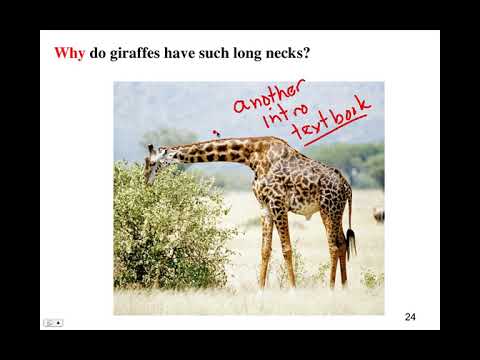
- Giraffes have the same number of neck bones as other mammals, but their neck bones grow longer, connecting an unusual trait to bone development and potential insights into human health.
- BIO105 exams can ask specific details from textbook experiments, including control groups and experimental design, so students should use the example tests to guide study.
Chapters
- The textbook introduces seven themes across the full course sequence: BIO105 covers chemistry, cells, and genetics, while BIO107 focuses on ecology, populations, and evolution.
- Champlin frames evolution as both a process and a pattern, explaining shared traits such as humans’ and dogs’ insulin through common ancestry and their differences through divergence.
- Evolution connects all seven themes because it accounts for both biological similarities and diversity.
- BIO105 emphasizes reductionism: breaking organisms into components, from cells down to atoms, to explain how they work.
- Champlin contrasts hypothesis-driven research with discovery science, which gathers large amounts of data before developing hypotheses, such as surveying all cell proteins rather than studying insulin alone.
- Structure relates to function at both organismal and molecular scales; insulin’s structure supports its function, just as different bird wing shapes suit soaring or diving.
- The course focuses on cells as life’s basic building blocks, DNA, and pathways that regulate information and energy flow.
- Champlin recommends asking how a biological feature works rather than why it exists, since testable mechanisms can yield clearer experiments.
- The textbook’s snake-color-mimicry study illustrates why students should understand experimental design and terms such as control group, alongside specific facts tested on exams.
- Observations that giraffes often feed below maximum neck height are correlational, not proof of why long necks evolved; a stronger causal test would manipulate neck length, though that is impractical.
- Developmental biology offers tractable alternatives: scientists can knock out the insulin gene and examine effects, study how giraffe neck bones grow longer despite having the same number of neck bones as other mammals, and investigate genetic changes associated with snake limb loss.
Transcript excerpt
0:00 all right this is going to be a summary of uh just some of the highlights of the first chapter in our textbook and uh in this first chapter the author uh focuses on seven themes for the whole textbook and the whole textbook is big and our course just covers a portion of it just the first third of it so we get bio 105 5 kind of covering some chemistry and some introduction to cells and genetics so sort of the nuts and bolts and then the second semester is about 107 and that's ecology and evolution populations and then some usm students take bio 109 as well some subset of bio majors take 109 and 109 is about
0:49 animal implant physiology so functional biology and that's the whole textbook and the authors introducing the whole textbook and so the author lists these seven themes and we can learn the themes and then go on to recognize that our course is a subset of that so we're going to have our own themes for our course uh and then the other part of chapter one is uh some introduction to some scientific research and sort of engaging you in um science um so here are the themes that the authors list in each section of the first chapter like that and we'll talk through them and then that's for our whole textbook um we're going to have seven themes just for our course and these seven themes are not in your textbook they're ones that i made up and they are here and so let me first
1:37 point out that it's a handout and if you go to our website we're going to have some handouts and they fit uh in let's see here so if you go to a buy 105 handout
This is the start of the transcript. Save this video free for the whole transcript, searchable and time-coded.
Related notes
Summary, takeaways, and chapters were generated by AI from the video's transcript and may contain errors. The video belongs to its creator, The New Evolution for Everyone.