ACCT 417 (Fall 2026) - Chapters 10 and 11 Homework
Overview
Michael Barnes reviews ACCT 417 homework for Chapters 10 and 11, connecting audit assertions to controls and procedures for revenue, receivables, purchases, and payables. He works through revenue and purchase cutoff examples, including consignment sales, receiving-report sequences, prepaid services, and subsequent cash disbursements used to search for unrecorded liabilities.
Key takeaways
- Completeness testing starts with source evidence and traces it into the accounting records; examples include prenumbered shipping documents for sales and receiving reports for merchandise purchases.
- An employee who maintains the accounts receivable ledger should not authorize write-offs, because the same person could both record and conceal improper reductions in customer balances.
- Negative receivable confirmations provide less assurance than positive confirmations and are best suited to low control risk, many small balances, and recipients likely to review the request.
- Revenue cutoff follows when the performance obligation is met, illustrated by shipment timing; consignment is not a sale because ownership remains with the consignor.
- The last December receiving report, number 49745, provides a cutoff reference: earlier sequential receipt numbers indicate goods belonging to December even if recorded in January.
- Reviewing cash disbursements after year-end can expose unrecorded prior-period liabilities, especially payments to vendors absent from the year-end payable listing or payments exceeding listed balances.
Chapters
- Michael Barnes reminds students that the Excel assignment is due the following week and the professional interaction assignment is due in two weeks.
- Student groups must choose presentation topics and dates by the end of the following week or Barnes will assign them.
- The class turns to Chapters 10 and 11 audit homework after the announcements.
- Maintaining the accounts receivable subsidiary ledger is a recording function, so it should be separated from authorization.
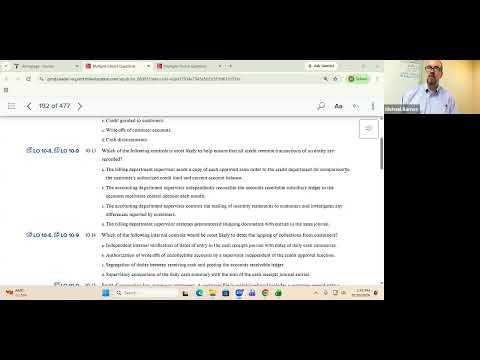
- The employee who records receivables should not approve customer account write-offs, which could conceal improper reductions; the answer to Question 10-12 is C.
- For Question 10-13, matching prenumbered shipping documents to sales journal entries tests completeness by identifying missing document numbers and unrecorded sales.
- Matching approved sales orders to credit limits is more closely related to authorization, while customer statements and reconciliations address other assertions.
- Accounts receivable turnover fell from 7.1 to 5.6 times; fictitious current-year sales can increase receivables and lower turnover, while unrecorded sales reduce both sales and receivables.
- Positive confirmations request a reply regardless of agreement and provide more assurance than negative confirmations, which request a reply only when a balance is disputed.
- Negative confirmations are most appropriate when control risk is low, balances are numerous and small, and recipients are likely to consider the requests.
- For Question 10-23, aging accounts receivable is used to evaluate the allowance for doubtful accounts, primarily under the valuation and allocation assertion.
- The receiving clerk should compare goods received with an approved purchase order and shipping documentation, rather than relying on the original requisition.
- A requisition records what a department requested, but the approved purchase order records what the company authorized.
- A vendor invoice commonly arrives after the goods, making it less suitable for the receiving clerk's initial check.
- To test whether all received merchandise was recorded, trace receiving reports, the source documents for goods received, into the accounting records.
- For Question 11-19, reviewing cash disbursements made after year-end helps find liabilities that applied to the prior period but were not recorded.
- A payable cutoff test around the balance-sheet date is different from the broader search using subsequent cash payments.
- For accounts payable completeness confirmations, the relevant population is vendors with whom the entity has done business.
- Trace shipping documents to sales invoices, the sales journal, and the receivables subsidiary ledger to test completeness.
- Inspect shipping documents from a few days before and after year-end to test receivables cutoff.
- Review the credit manager's receivables aging to assess the allowance for uncollectible accounts under valuation and allocation; confirm recorded receivables to test validity.
- Review draft financial statements for revenue disclosures, and inspect bank confirmations and loan agreements for evidence relevant to legal title and factoring.
- Revenue generally belongs in the period when the performance obligation is met; the examples use shipment dates to determine the appropriate period.
- When goods ship before year-end but the sale is recorded afterward, record the missing revenue and receivable; record cost of goods sold and inventory only if that side is also missing.
- When a sale is recorded before the goods ship, reverse revenue and receivables from the earlier period; the related cost entry depends on whether the goods have left inventory.
- A consignment shipment is not a sale because ownership remains with the consignor; reverse both recorded revenue and cost of goods sold when consigned goods are incorrectly treated as sold.
- The last receiving report for the audited December period is 49745, so report numbers before it belong to that period and later sequential numbers generally belong to January.
- A three-month consulting payment of $45,000 should be allocated across the service period: $15,000 is current-period expense and $30,000 is prepaid for later periods.
- Receiving reports document physical goods, not services; telephone and consulting services therefore require cutoff analysis based on when the service was incurred.
- A $42,000 materials purchase with receiving report 49743 was wrongly recorded in January based on the sequence and should be recorded in December; the class discussion flags the book's account classification as questionable.
- Trace payments made in the first nine days after year-end to the December accounts payable listing as part of the search for unrecorded liabilities.
- Payments to Lewis Hardware and Intermountain Gas need investigation because neither vendor appears on the payable listing.
- A payment of $157,206 to Stevenson Promotion also needs follow-up because the listing shows only $69,291 owed.
- A payment smaller than the listed payable can be legitimate because vendors may receive partial payments; unusual or unmatched payments are investigation signals, not proof of misstatement.
Transcript excerpt
0:01 Happy Halloween's Eve, everybody. Any exciting plans for the weekend? >> No. >> You're going home? Yeah, you know, do what you got to do. Are you going trick-or-treating when you get home? >> Uh it's It was my mom's birthday this weekend. It's my brother's next week. And then he's coming in He's going home anyway, so I was like I might as well go home with him. >> That's That's fair. All right. So, I told this joke to all my previous classes. I'm going to tell it to you guys. Here we go. Prior Luca Pacioli walked into a bar. Then he walked into it again. All right. I realize that. So, so for those of you who were in my AIS class last last fall, remember I dressed as Luca Pacioli for Halloween, you know? I brought my costume with me, but nobody else in the accounting business faculty board brought their costume. So, I was
0:47 like, I'm not going to look like Prior Luca again. But, I decided to tell it. So, those of you who don't know Luca Pacioli, father of accounting, okay? He invented double-entry bookkeeping. Double-entry bookkeeping. Get it now? Huh? Yeah, walked into a bar, walked into it again. Oh, yeah. Explaining the joke doesn't make it as funny. Uh anyway, so yeah. It was a bad joke anyway. So, yeah, let's go ahead and get started on some announcements. Um So, week from today, we got an exciting event. And almost as exciting as Halloween's Eve. What do we have a week from today? Excel assignment. If you've not started working on it, do it now. Skip Halloween, start working on Excel. Don't do that. Don't do that. Yeah. Yeah, so please make sure you start thinking about that, start working on
This is the start of the transcript. Save this video free for the whole transcript, searchable and time-coded.
In this course
Related notes
Summary, takeaways, and chapters were generated by AI from the video's transcript and may contain errors. The video belongs to its creator, Michael Barnes.