ACCT 417 (Fall 2026) - Chapter 7 Lecture
Overview
Michael Barnes explains how auditors evaluate internal control over financial reporting (ICFR) under Section 404 of the Sarbanes-Oxley Act, including management’s year-end effectiveness assessment and the auditor’s integrated audit of controls and financial statements. The lecture develops a likelihood-and-magnitude framework for classifying control deficiencies, walks through a bank lockbox testing example, and connects deficiencies to remediation, audit opinions, and required communications.
Key takeaways
- Section 404 makes public-company management responsible for maintaining ICFR and assessing its effectiveness at year-end, while the auditor separately expresses an opinion on ICFR.
- Auditors classify control problems using likelihood and magnitude: a remote failure is not a deficiency, a significant but non-material risk may be a significant deficiency, and a likely material misstatement indicates a material weakness.
- A control’s design and operation must both be evaluated; inquiry alone is weak evidence, so Bill Boyd corroborates his understanding of lockbox exception handling by reperformance and year-end follow-up.
- Compensating controls can reduce a reconciliation failure from a material weakness to a significant deficiency, as illustrated by Murray Company’s monthly variance analysis and reviews of large differences.
- A material weakness remains reportable unless management corrects and assesses it and the auditor tests the correction; unresolved material weaknesses lead to an adverse ICFR opinion.
- ICFR deficiency communications follow severity: control deficiencies go to management, significant deficiencies to management and the audit committee, and material weaknesses are also disclosed externally.
Chapters
- Michael Barnes directs students to the Week 7 Brightspace ICFR testing example and a grade item tracking completed tax assembly points out of 35.
- The COSO cube organizes internal control by five components, organizational levels, and objectives: reporting, operations, and compliance.
- Financial reporting is the COSO objective most directly relevant to a financial statement auditor.
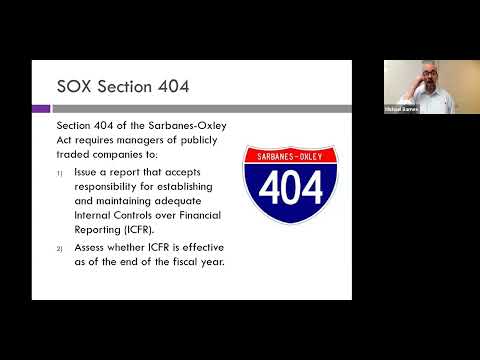
- Sarbanes-Oxley Section 404 requires public-company management to accept responsibility for establishing and maintaining ICFR and assess its effectiveness at fiscal year-end.
- An EarthWear annual report illustrates management’s assertion that ICFR is effective under the COSO 2013 framework.
- PCAOB Auditing Standard 2201 requires auditors to audit financial statements and ICFR in an integrated manner because evidence from each informs the other.
- A control deficiency can arise from a control that is missing or poorly designed, or from a properly designed control that does not operate effectively.
- A significant deficiency is important enough to merit attention but is not likely to cause a material misstatement; a material weakness is likely to do so.
- Classification considers both likelihood and magnitude: a remote chance does not qualify as a deficiency, while reasonably possible or probable failures are assessed for potential impact.
- The evaluation process has three steps: identify financial-reporting risks and related controls, select locations for evaluation, and assess evidence about operating effectiveness.
- Planning considers fraud risk, the entity’s risks, and how extensively to test controls at entity-wide versus functional locations.
- Auditors may use internal audit work after evaluating competency, objectivity, and a systematic, disciplined approach.
- Control selection includes entity-level controls such as the code of conduct, whistleblower hotline, control environment, and financial reporting process.
- Auditors connect significant accounts and disclosures to relevant assertions and likely sources of misstatement before choosing higher-risk controls to test.
- Testing decisions cover nature, extent, and timing: procedures may include inspection, observation, inquiry, reperformance, or walkthroughs; sample size depends on the population and assurance needed.
- Interim testing generally provides less assurance than year-end testing, so auditors perform follow-up procedures to confirm controls remained consistent.
- Perth Packing Company receives customer payments through a bank lockbox, and its IT system automatically applies matched cash to customer accounts.
- Unmatched payments appear on an unapplied cash exception report, which staff must manually review and resolve.
- In the example, auditor Bill Boyd first inquires about procedures, then reperforms the resolution process on a sample of 25 items and compares results with the company’s records.
- Because testing occurred at an interim date, Boyd also checks whether procedures changed and scans year-end exception reports to verify continued operation.
- Likelihood measures the chance that controls fail to prevent or detect a misstatement; magnitude estimates the resulting misstatement’s size.
- Murray Company’s untimely intercompany reconciliations are a significant deficiency in the example because monthly reviews of large differences and variance analyses provide alternative controls.
- Ragunner Company’s intercompany reconciliation problem is a material weakness because transactions are frequently material, differences are significant, and management has no alternative investigative controls.
- Remediation requires management to fix a material weakness and assess the correction, while the auditor must have time to test that the weakness no longer exists.
- If a weakness is not fixed, assessed, and tested by the reporting deadline, it remains a material weakness and results in an adverse ICFR opinion.
- ICFR opinions include unqualified, disclaimer, and adverse; there is no qualified ICFR opinion.
- Control deficiencies and significant deficiencies can accompany an unqualified opinion, major scope limitations can require a disclaimer, and material weaknesses require an adverse opinion.
- Auditors remain responsible for relevant subsequent events through issuance of the audit report, and must address incomplete or improperly presented management reports.
- An interim opinion can report that a material weakness identified at the financial statement date was corrected afterward.
- Under PCAOB AS 2201, significant deficiencies and material weaknesses must be communicated in writing to management and the audit committee before the audit report is issued.
- Control deficiencies are communicated to management; the audit committee is told that management received the communication, while material weaknesses are also reported externally.
Transcript excerpt
0:00 All right, folks. I have a lot of stuff to talk about before we get started. So, let's go ahead and get to it. Um, [clears throat] first and foremost, uh, I recommend that everybody you get on learn or on Brightpace. In the week seven stuff, there's a document called the IoffER testing example. We're going to walk through that today. You might want to have it in front of you uh, just so you can refer back to it. I'll have it on the screen when I'm reading through it, but uh, this is going to be the document we're referring to. Also, while you're on Brightpace, you might want to check and see. I've uploaded uh a document or not a document, a grade grade item that uh talks about what the tax assembly points checked to date are. Uh we finished approximately half of the tax assembly assignments already. So, uh this will just give you a point total of how many 35 you have. Uh the reason
0:47 we've done so many is they're very heavily frontloaded to the earlier chapters. So, about halfway done. Um yeah, so please check that. Uh, it's really weird the way I had set it up because I didn't want to make it out of 35. So, it would just everybody would freak out when they see 17 out of 35 or 16 out of 35 or whatever the points are. So, I just did it as a text item. It doesn't currently impact your grade, but it will impact your grade at the end of the semester. Um, depending on whether you completed it or not. Um, see, um, I did have a note about uh group presentations. I did hear back for some from some groups at the end of last
This is the start of the transcript. Save this video free for the whole transcript, searchable and time-coded.
In this course
Related notes
Summary, takeaways, and chapters were generated by AI from the video's transcript and may contain errors. The video belongs to its creator, Michael Barnes.