ACCT 417 (Fall 2026) - Chapter 16 Lecture
Overview
Michael Barnes explains how to audit cash and investments, emphasizing that cash is difficult to predict analytically because it connects to nearly every transaction cycle, while bank reconciliations provide a structured way to verify the recorded balance. He also outlines investment controls and substantive tests, focusing on existence, valuation, classification, and the increasing audit uncertainty of fair value estimates from quoted prices to management models.
Key takeaways
- Cash is difficult to audit with substantive analytics because revenue, purchases, payroll, debt, and asset transactions all affect its balance, leaving prior-year and budget comparisons with limited assurance.
- A bank reconciliation audit uses three core sources: the client's reconciliation, a bank confirmation for the bank balance, and a cutoff bank statement for reconciling items.
- Electronic clearing can shorten the cutoff-statement period from the traditional 7 to 10 days to roughly 3 to 5 days, while kiting risk arises when transfers between accounts are recorded at different times.
- Petty cash may be immaterial to the organization but material to the employees who control it, making custody and segregation-of-duties controls important even when substantive tests are limited.
- Investment existence is tested by inspecting securities or confirming holdings with third parties, while valuation tests consider impairments and whether declines are other than temporary.
- Fair value becomes more subjective from quoted market prices to comparable-asset prices to management models, increasing the need for auditor scrutiny and possible specialist assistance.
Chapters
- Michael Barnes says this is the semester's final lecture and reminds students that the EWC homework submission should include only a summary and the workbook's evaluation tab.
- The lecture covers the two remaining balance-sheet areas: cash and investments.
- Cash includes currency, bank accounts, certificates of deposit, time deposits, and savings accounts; cash equivalents include short-term liquid investments such as Treasury bills and money market funds.
- Cryptocurrency does not qualify as a cash equivalent when its value can fluctuate substantially, including changes of 20% overnight.
- A general cash account supports an organization's main operations; an imprest account sets cash aside for a specific purpose such as outsourced payroll.
- Branch accounts let locations operate where the organization's primary bank has no local presence, as in Barnes's Walmart and Kirksville example.
- Cash receipts and disbursements controls are covered by earlier transaction-cycle procedures, while monthly bank reconciliations serve as a key cash control.
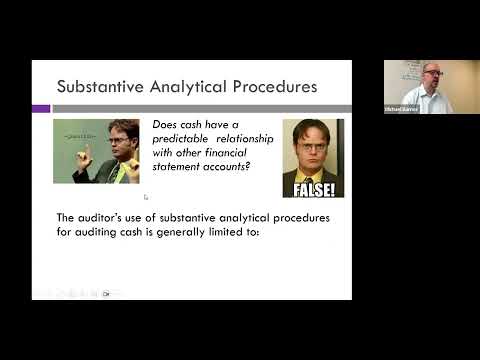
- Cash has no stable analytical relationship with a single account because revenue, purchases, payroll, debt, and other transactions all change it; prior-year and budget comparisons therefore provide limited assurance.
- Cash testing addresses the relevant financial-statement assertions, but rights and obligations are generally not a separate concern because cash is a bearer instrument: possession establishes ownership.
- The first document needed to audit a bank reconciliation is the client's reconciliation itself, which bridges the bank balance and the book balance.
- Auditors validate the bank balance with a bank confirmation and test reconciling items using a cutoff bank statement.
- A cutoff statement is traditionally requested 7 to 10 days after the reconciliation date; electronic transactions may allow a 3-to-5-day window.
- Auditors verify the reconciliation's mathematical accuracy, agree its book balance to the general ledger, and agree the bank balance to the bank confirmation.
- Deposits in transit and outstanding checks are checked against the cutoff bank statement to determine whether they cleared after period-end.
- Bank fees and NSF charges are agreed to the reconciliation, while cleared paper checks can provide evidence of the payee, endorsement, and amount.
- Barnes distinguishes tracing, vouching, and agreeing: agreeing checks whether two source documents match without asserting a testing direction.
- Uncleared deposits deserve particular scrutiny because they may indicate overstated cash; repeated nonexistent deposits can signal fraud and require expanded procedures.
- Extended bank reconciliation procedures examine reconciliations over a period rather than at a single date, and proof of cash validates additions to and removals from cash.
- Kiting exploits the float between two bank accounts: a transfer can temporarily inflate reported cash if one account records the deposit before the other records the withdrawal.
- Kiting tests remain relevant in some small or rural businesses, although faster electronic clearing has made the scheme less common.
- Imprest, branch, and petty cash accounts follow the same basic audit approach as other cash accounts.
- Petty cash may be immaterial to the organization but significant to employees with custody, so Barnes recommends controls testing even when substantive testing is not warranted.
- Segregation of duties, custody, authorization, and recording help prevent petty-cash theft.
- Cash disclosures should explain the policy for defining cash equivalents and identify restrictions such as sinking funds, compensating balances, foreign-exchange controls, and letters of credit.
- Investments include common and preferred stock, debt securities, and hybrid securities; inherent risk depends on how readily each holding can be valued.
- A large investment portfolio may call for a reliance strategy, while many organizations can use a substantive strategy when an internal-controls audit is not required.
- Investment controls should ensure transactions are recorded and properly initiated and authorized, with valuation and presentation handled appropriately.
- Segregate investment initiation from approval, acquisition from valuation monitoring, and securities custody from accounting to reduce risks of unauthorized trades, misstatement, or theft.
- Analytical procedures can compare current and prior investment balances, compare interest and dividend income with prior years and expected returns, and estimate interest income from face value, rate, and holding period.
- Interest income can be recomputed because debt instruments require interest payments; dividends cannot be estimated the same way because issuers are not required to pay them.
- Existence is a primary investment assertion: physically inspect certificates when accessible or confirm holdings with an issuer, custodian, broker-dealer, or counterparty.
- For valuation, auditors assess whether a decline in fair value is significant and other than temporary, which may require writing the investment down and recognizing a loss.
- Investments are classified as held to maturity, available for sale, or trading; trading securities are current, while the other categories are generally noncurrent unless management expects conversion to cash within 12 months.
- Misclassification can inflate liquidity measures: moving securities into the trading category can increase current assets and improve the current ratio used in debt covenants.
- The fair value hierarchy moves from quoted market prices, or mark-to-market, to prices for similar assets, or mark-to-matrix, and then to management estimates, or mark-to-model.
- Mark-to-model values are most subjective, so auditors may need specialists, a review of management's valuation methods, and independent expectations to assess reasonableness.
Transcript excerpt
0:03 Welcome to Wednesday of week 13, which like our third to last Wednesday of the semester, which I'm personally very excited about. I'm just kind of a fan of eliminating all Wednesdays, but uh they just never seem to go away. This one is actually a notable Wednesday in the fact that we have our final lecture of the semester today. So, even though we got a few more weeks left in the semester, we have no more lectures after this. Depending how you personally feel about lectures, she may just be really, really enthusiastic. I know I wouldn't want to sit in a classroom with me blabbering on for 50 minutes in a row. It could get really, really boring and tedious. I try my best to keep it upbeat, but let's be honest. Let's be honest, it's auditing. It's auditing. Uh, we still have some important stuff to go over today, so I'm going to get started, but I do have a couple of quick announcements that I want to remind you of. So first um with respect to the homework assignment
0:52 on uh Friday uh please make sure that you read the note on the homework assignment regarding the EWC workpaper. It is not a difficult assignment but it is uh a pretty long assignment. Um and uh it well not a long assignment. It's not long in the fact that it will take a while. It's long in the fact that there's a lot of content to it. So I don't want you to upload the entire word file as there's just a lot of nonrelevant content. So I've asked you to do two things. Provide a summary along with the evaluation tab of the workbook. That is all I want to see for the submission. Okay. Please make sure
This is the start of the transcript. Save this video free for the whole transcript, searchable and time-coded.
In this course
Related notes
Summary, takeaways, and chapters were generated by AI from the video's transcript and may contain errors. The video belongs to its creator, Michael Barnes.