8.5 Divide Radical Expressions --Lesson 33--FA26--Math190
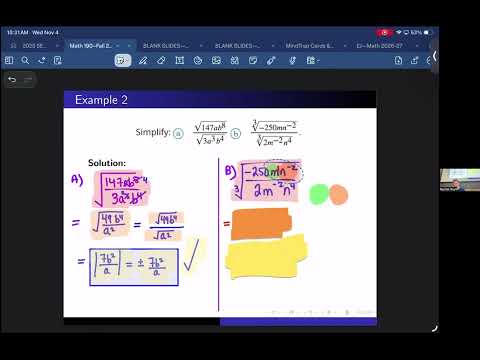
Overview
Rachel Soyk teaches how to simplify quotients of radical expressions by combining them under one radical, reducing coefficients and variable exponents, and extracting perfect powers. She then demonstrates rationalizing single-term denominators with matching radicals and two-term denominators with conjugates, using examples such as 4/√3 and 5/(2 − √3).
Key takeaways
- Before extracting a root from a quotient, combine the radicands and reduce both numerical coefficients and variable exponents.
- Even roots require attention to absolute values: the principal square root satisfies √(x²) = |x|, while odd roots such as cube roots retain the sign.
- To rationalize a one-term denominator, multiply by the radical already in the denominator, such as √3/√3 for 4/√3.
- For two-term denominators containing radicals, multiply by the conjugate to use the difference-of-squares identity and cancel the radical terms.
- After rationalizing, simplify the resulting numerator and denominator, as with √(3/20) becoming √15/10.
Chapters
- Combines numerator and denominator under one radical, then reduces numerical factors such as 72/162 to 4/9.
- Uses exponent subtraction to simplify variable quotients, including x³/x and x²/x⁵, before extracting roots.
- Simplifies cube roots such as ∛(8/x³) to 2/x; odd roots preserve the sign of negative radicands.
- For even roots, taking the square root of a variable square produces an absolute value, as in √(x²) = |x|.
- Removes √3 from 4/√3 by multiplying numerator and denominator by √3, yielding 4√3/3.
- Simplifies √(3/20) to √3/(2√5), then multiplies by √5/√5 to obtain √15/10.
- For a denominator such as √(6x), multiplies by √(6x) to eliminate the radical and then reduces common factors.
- Multiplies 5/(2 − √3) by the conjugate (2 + √3)/(2 + √3), making the denominator 2² − (√3)² = 1.
- For √3/(√u − √6), uses √u + √6 so the denominator becomes u − 6; simplifies √18 in the numerator to 3√2.
- Rationalizes a denominator √x − √7 using √x + √7, producing the difference of squares x − 7.
Transcript excerpt
0:02 So, section 8.5 dividing radical expressions. We have three learning objectives. Being able to divide radical expressions and then being able to rationalize either a one term or two term denominator. Volunteer. You've probably seen this slide like ten times by now. I really want to call on that guy in the green or gray sweater, but Youssef, go for it. >> We will need to use this property in reverse to simplify a fraction with
0:51 radicals. >> Oh, awesome. So again, being able to reverse engineer it back and forth. Guys, you're going to be masters by the end of class today. So we have two parts in example one. We're going to take this part A and make the entire fraction one cube root. And then we're going to ask ourselves, can we divide the top and bottom by a number uh that is a factor of both 72 and six 162 and we can. We can divide them both by nine. Nine goes into 72 eight times. And how many times does nine go into 162?
1:40 18 times. So we can rewrite this as the square root of 8x cubed all over 18x. We can also simplify that x cubed over x. We can take out one of them. And when we do, we're left with just x squared in the numerator. Now, 8 over 18, that's the same as 4 over nine. So the square root of 4 x squared all over nine. And now let's manipulate it again where we take the square root of the numerator and then the square root of the
2:26 denominator separately. Square root of 4 x squared is 2 x. Square root of nine is three. But because we're dealing with an even root index, we have either the absolute value
This is the start of the transcript. Save this video free for the whole transcript, searchable and time-coded.
In this course
Related notes
Summary, takeaways, and chapters were generated by AI from the video's transcript and may contain errors. The video belongs to its creator, Rachel Soyk.