8.7 Use Radical Functions --Lesson 35--FA26--Math190
Overview
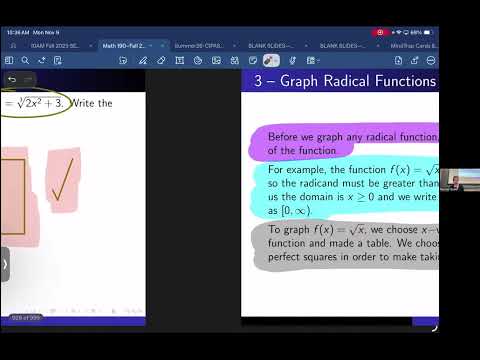
Rachel Soyk introduces three goals for Math190 section 8.7: evaluating radical functions, finding their domains, and graphing square-root and cube-root parent functions. She demonstrates that even-indexed radicals require a nonnegative radicand, while odd-indexed radicals allow all real inputs unless another restriction, such as a denominator, applies; examples include the domain of √(3x − 4) and the graph of √(x + 3).
Key takeaways
- For real-valued even roots, set the radicand ≥ 0 and solve the resulting inequality to find the domain.
- Odd-index roots accept negative as well as positive radicands, so a cube-root function without a denominator restriction has domain all real numbers.
- Function evaluation uses the principal square root: √9 equals 3, not ±3.
- The horizontal shift in √(x + 3) moves the parent graph √x three units left, placing its endpoint at (−3, 0).
- The range of √(x + 3) is [0, ∞), while the cube-root parent function has range (−∞, ∞).
Chapters
- Rachel Soyk defines a radical function as one expressed using a radical and evaluates inputs by substitution, as with f(5) for √(2x − 1).
- Substituting 5 gives √9; the function uses the principal square root, so f(5) = 3 rather than ±3.
- Substituting −2 gives √−5, which has no real value in this course's number system.
- For an even root, require the radicand to be greater than or equal to zero; for √(3x − 4), solving 3x − 4 ≥ 0 gives x ≥ 4/3.
- The domain of √(3x − 4) in interval notation is [4/3, ∞), with a closed endpoint because 4/3 is included.
- For the cube root of 2x² + 3, the odd index allows every real input, so the domain is (−∞, ∞).
- Odd-index radicals have unrestricted real domains when there is no additional restriction, such as a variable in a denominator.
- Before graphing a radical function, determine its domain; the parent function √x begins at (0, 0) and uses nonnegative x-values.
- The function √(x + 3) shifts the square-root graph 3 units left, has domain [−3, ∞), and has range [0, ∞).
- Perfect-square inputs 0, 1, 4, and 9 produce outputs 0, 1, 2, and 3 for √x, providing convenient plotting points.
- The cube-root parent function has domain and range (−∞, ∞); perfect cubes such as −27, −8, 0, 8, and 27 help construct its graph.
Transcript excerpt
0:03 So, with radical functions, section 8.7, there are three objectives. Being able to evaluate a radical function, finding the domain of the radical function, and then last but not least, graphing radical functions. Really honing in on the famous radicals, square root of x, which you've seen so many times already, and then uh cube root of x, which I don't know if you guys have seen that. You may have. Uh shown it. You've seen x cubed. x cubed is this guy. Right?
0:54 Some definitions uh or one definition. Two volunteers. Yes. Carlos, right? Carlos, I'll have you do green, and then who wants to do the sienna? I'll have you do orange. >> A radical function is a function that is defined by a radical expression. >> To evaluate a radical function, we find the value of f of x for a given function of x just as we did in our previous work with functions. >> Good. Thank you, guys. So, let's look at example one. We have two parts to this example. We want to evaluate what is f of 5 and what is f of -2. Again, evaluation questions
1:43 are the easiest questions in mathematics in general. So, when I see that you're getting evaluation questions wrong on quizzes, which you shouldn't. Everyone should be getting hundreds on these Uh, but getting them incorrect on tests and assessments tells me that you're just not putting in the work at all. Cuz these are literally you can do them with your eyes closed. And I'm saying that like if you don't even know the numbers, that's how easy it is. You can do them with your eyes closed. So in part A, we're going to rewrite the function and wherever we see an X, we're going to create some parentheses.
This is the start of the transcript. Save this video free for the whole transcript, searchable and time-coded.
In this course
Related notes
Summary, takeaways, and chapters were generated by AI from the video's transcript and may contain errors. The video belongs to its creator, Rachel Soyk.