8.6 Solve Radical Equations --Lesson 34--FA26--Math190
Overview
Rachel Soyk teaches a systematic method for solving radical equations: isolate a radical, raise both sides to the power matching its index, solve the resulting equation, and check every candidate in the original. Examples cover square and cube roots, rational exponents, quadratic factoring, extraneous solutions, and equations containing two radicals.
Key takeaways
- Isolate a radical before removing it; then raise both sides to the power indicated by its index, such as squaring for a square root or cubing for a cube root.
- Squaring can introduce extraneous candidates: in 2x = 1 − √(2 − x), x = 1 appears after squaring but fails the original equation, while x = −1/4 works.
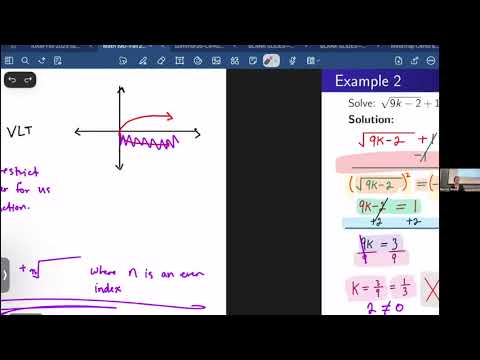
- The principal square root is nonnegative, so an isolated equation such as √(9k − 2) = −1 has no real solution.
- For equations with two radicals, isolate the more complicated radical first; in √m + 1 = √(m + 9), this leads to m = 16.
- A rational exponent with denominator 4 represents a fourth root, so raising both sides to the fourth power removes it, as in (3x − 2)^(1/4) + 3 = 5.
- Always substitute candidate values into the original equation: √(p − 1) + 1 = p has two valid solutions, p = 1 and p = 2.
Chapters
- The lesson introduces two objectives: solving equations with one radical and equations with two radicals.
- In the example √(5n − 4) − 9 = 0, adding 9, squaring both sides, and solving gives n = 17.
- For the square-root function, the principal root is nonnegative; restricting the domain keeps the graph a function.
- For √(9k − 2) + 1 = 0, isolating the radical requires it to equal −1.
- A principal square root cannot be negative, so the equation has no solution without further algebra.
- Checking candidates after squaring helps catch values that satisfy the transformed equation but not the original.
- Isolating √(p − 1) in √(p − 1) + 1 = p leads to squaring both sides.
- Rearranging gives p² − 3p + 2 = 0, which factors as (p − 1)(p − 2) = 0.
- Substitution confirms that both p = 1 and p = 2 satisfy the original equation.
- The equation 2x = 1 − √(2 − x) is rearranged and squared to produce 4x² − 3x − 1 = 0.
- The AC method splits −3x into −4x + x, giving factors (x − 1)(4x + 1) and candidates x = 1 and x = −1/4.
- Checking the original equation rejects x = 1 as extraneous and confirms x = −1/4.
- For ∛(5x + 1) + 8 = 4, isolating the cube root and cubing both sides gives x = −13, which checks in the original.
- A rational exponent of 1/4 represents a fourth root, so raising both sides to the fourth power solves (3x − 2)^(1/4) + 3 = 5.
- The fourth-root example yields x = 6, and substitution confirms that the original equation holds.
- Squaring √(r + 4) + 2 = r produces r² − 5r = 0 and candidates r = 0 and r = 5.
- Substitution shows r = 0 is extraneous, while r = 5 satisfies the original equation.
- For 3√(3x − 5) − 8 = 4, isolating and squaring the radical gives x = 7, which also checks.
- When both sides are cube roots, cubing ∛(4x − 3) = ∛(3x + 2) gives x = 5; substitution confirms the equality.
- For √m + 1 = √(m + 9), squaring and isolating √m gives √m = 4, so m = 16.
- Soyk closes with the core procedure: isolate one radical, raise both sides to its index, solve, and check candidates for extraneous solutions.
Transcript excerpt
0:03 All right. In 8.6, we have solving radical equations here and two learning objectives. Being able to solve radical equations and being able to solve radical equations with two radicals. Can I have three volunteers? Yes. What's your name? Christopher, I'll have you read the yellow. What's your name? Lester, you're going to read blue. Someone besides Muhammad Prince, I'll have you read pink. >> Radican.
0:51 >> Yep. equation to one of the equation is both equation both sides >> algebraic >> it's okay >> algebraic solution that would not be a solution to the original radical equation again we call this an extra solution as we did when we saw rational places. >> Beautiful. Yeah, that extraneous solution vocab word comes into play once again.
1:39 And so these are just the step-by-step procedures in solving a radical equation with one radical. Uh but we are going to do our first example together running through these steps. So first step is we want to isolate the radical on one side. So let's go ahead and add 9 to both sides. And when we do that, we're looking at the square root of 5 n - 4 is equal to 9. Now we get rid of that radical because it has an even index or just an index of two. We're going to square both sides so that we can get rid of that and we're looking at just 5 n minus 4 is
2:30 equal to 81. And now at this point we're back into the linear equation world utilizing inverse operations getting our n variable by itself by adding four to both sides. And so we get 5 n is equal to 85. Last but not least. Divide both sides by 5. And our n value, if we know that 85 / 10
This is the start of the transcript. Save this video free for the whole transcript, searchable and time-coded.
In this course
Related notes
Summary, takeaways, and chapters were generated by AI from the video's transcript and may contain errors. The video belongs to its creator, Rachel Soyk.