9.1, 9.2, and 9.3 Solve Quadratic Equations --Lessons 36, 37, and 38--FA26--Math190
Overview
Rachel Soyk teaches three methods for solving quadratic equations in Sections 9.1 through 9.3: the square root property, completing the square, and the quadratic formula. Across 11 examples, she connects solutions to parabola x-intercepts and uses the discriminant, b² - 4ac, to classify equations as having two distinct real roots, one repeated real root, or no real roots.
Key takeaways
- When solving x² = k, include both signs, x = ±√k; the radical symbol alone represents only the nonnegative principal square root.
- Completing the square uses the constant (b/2)², with b taken from the coefficient of x after the quadratic coefficient has been normalized to 1.
- If a coefficient is factored outside the quadratic expression, multiply the completing-square constant by that coefficient when determining how much to add to the other side.
- The quadratic formula works for ax² + bx + c = 0 after all terms are placed on one side; substituting negative coefficients in parentheses helps avoid sign errors.
- The discriminant b² - 4ac classifies roots: positive gives two distinct real roots, zero gives a repeated real root, and negative gives no real roots.
Chapters
- A quadratic has general form ax² + bx + c, and its graph is a parabola whose direction depends on the sign of a.
- Roots, zeros, and x-intercepts all refer to x-values where y = 0.
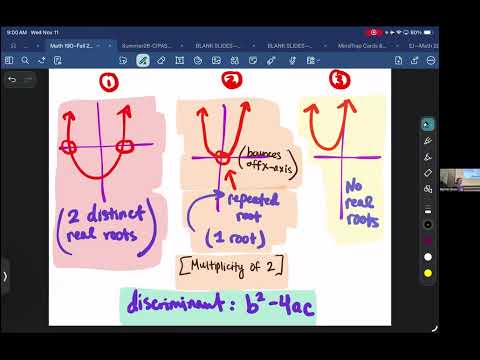
- A parabola can cross the x-axis for two distinct real roots, touch it for a repeated root, or miss it for no real roots.
- For equations such as x² = 9, solving for all equation solutions gives x = ±3.
- The radical symbol by itself denotes the nonnegative principal square root, so √9 = 3.
- Rachel Soyk distinguishes equation solving, which includes both signs, from function outputs and real-world distances, where negative values may not apply.
- For x² = 5, taking square roots gives x = ±√5.
- For 3z² = 108, divide by 3 first, then take square roots to get z = ±6.
- For (x - 4)² = 5, take square roots and isolate x to obtain x = 4 ± √5.
- For equations with a single variable term, move constants and isolate the squared variable before applying the square root property.
- The example with ⅔u² = 12 reduces to u² = 18, then u = ±3√2.
- For 2x² = 49, division gives x² = 49/2; rationalizing the denominator yields x = ±7√2/2.
- The completing-the-square constant is (b/2)², where b is the coefficient of the linear term.
- Adding this constant turns x² + bx into a perfect-square trinomial, which can then be written as a squared binomial.
- When solving an equation, add the same amount to both sides to preserve equality.
- For x² - 26x, the key gives (-26/2)² = 169, so the trinomial factors as (x - 13)².
- For y² - 9y, the needed constant is 81/4, producing (y - 9/2)².
- For n² + ½n, the constant is 1/16, giving (n + ¼)².
- For x² + 8x = 48, add 16 to both sides to form (x + 4)² = 64.
- Taking square roots and subtracting 4 gives the two solutions x = 4 and x = -12.
- For n² - 3n = 11, adding 9/4 gives (n - 3/2)² = 53/4 and n = (3 ± √53)/2.
- For 3x² - 12x, factor out the coefficient 3, leaving x² - 4x inside the parentheses.
- The inner expression needs a completing-square constant of 4, so it becomes x² - 4x + 4 = (x - 2)².
- In an equation, adding 4 inside parentheses multiplied by 3 changes the full left side by 12, so the right side must also increase by 12.
- For 3x² - 12x + 6 = 0, factor out 3 from the quadratic and linear terms to get 3(x² - 4x) + 6 = 0.
- Completing the square adds 4 inside the parentheses, which adds 12 overall; balancing produces 3(x - 2)² = 6.
- After dividing by 3 and taking square roots, the solutions are x = 2 ± √2.
- For 2x² - 3x = 20, factor out 2 to write 2(x² - 3/2x) = 20.
- The inner completing-square constant is 9/16, but the full equation changes by 2 × 9/16 = 18/16.
- Completing the steps gives x = -5/2 and x = 4; Rachel Soyk flags the common error of adding only 9/16 to the other side.
- For ax² + bx + c = 0, the formula is x = (-b ± √(b² - 4ac))/(2a).
- The example 2x² + 9x - 5 = 0 uses a = 2, b = 9, c = -5 and yields x = -5 or x = 1/2.
- Rachel Soyk recommends parentheses around substituted coefficients, especially when b or c is negative.
- For 2x² + 10x + 11 = 0, the discriminant is 12 and the solutions simplify to x = (-5 ± √3)/2.
- Simplify radicals such as √12 = 2√3 and reduce common factors in the numerator and denominator.
- To report a root as an x-intercept coordinate, pair each solution with y = 0.
- A positive discriminant means two distinct real roots and a parabola that crosses the x-axis; a zero discriminant means one repeated real root and a tangent touch.
- A negative discriminant means no real roots, so the parabola does not intersect the x-axis.
- The examples produce discriminants 20, 0, and -4/3, demonstrating all three cases; a zero-discriminant answer should explicitly identify the repeated root.
Transcript excerpt
0:02 All right. Section 9.1, 9.2, and 9.3 are all bunched together. Uh and [clears throat] we have let's see 3 6 12 About 22 slides in this section and 11 examples. But a lot of new definitions and uh fun visualizations to look out for uh to really get a good sense of your quadratic functions. Our learning objectives we have three. First one we're going to take it nice and slow and focus on
0:52 uh using the square root property. The second method I find to be probably the most challenging for students solving quadratic equations by completing the square. And then the last one I think a lot of students really enjoy uh solving quadratic equations using the quadratic formula. Just as a refresher uh our quadratic equations are in the general form of ax squared plus bx plus c. So all those famous trinomials that we've been looking at uh throughout these past weeks perfect square trinomials uh
1:37 were in this form. From a visualization standpoint we have quadratics looking like this parabola looking guy on our xy coordinate plane. We'll talk about this in a moment but if our a value is positive, then it's going to be right side up just like demonstrated here. And you have that bottom, that lowest point of our parabola representing our vertex, which again, if it's positive and we have that U-shape, our vertex is also known as a minimum.
2:26 Again, I'm kind of like foreshadowing a lot of these vocab words for you guys, but they'll be popping up a lot over these next uh few hours. And then uh some synonyms to be on the lookout for, these x intercepts are also known as our roots of our quadratic equation. Uh they're known as our zeros, right? When our y is zero,
This is the start of the transcript. Save this video free for the whole transcript, searchable and time-coded.
In this course
Related notes
Summary, takeaways, and chapters were generated by AI from the video's transcript and may contain errors. The video belongs to its creator, Rachel Soyk.