7.1 Multiply and Divide Rational Expressions --Lesson 24--FA26
 Watch on YouTube →
Overview
Rachel Soyk teaches how to simplify, multiply, and divide rational expressions by factoring polynomials, identifying restrictions, and canceling common factors. The lesson extends those techniques to complex fractions and rational functions, including finding domains by excluding denominator zeros and using keep-change-flip for division.
Key takeaways
- A rational expression is undefined wherever its original denominator equals zero, so those input restrictions must be recorded before simplifying.
- Cancel only common factors, not individual terms; factoring trinomials, perfect squares, and differences of squares reveals which factors can be canceled.
- For division of rational expressions, keep the first fraction, change division to multiplication, and flip the second fraction before factoring and canceling.
- A canceled denominator factor still marks an excluded value in the domain of the original rational function.
- The domain of 2x(x - 7)/[4(x² - 4x - 12)] excludes x = -2 and x = 6, giving (-∞, -2) ∪ (-2, 6) ∪ (6, ∞).
- Opposite factors such as x - 8 and 8 - x differ by -1, so canceling them without accounting for the sign changes the result.
Chapters
- Simplifies 90y/(15y²) by reducing coefficients and subtracting exponents to get 6/y.
- Multiplies 14/15 by 6/35, canceling common factors before multiplying to obtain 4/25.
- Divides 12/10 by 8/25 using keep-change-flip, then reduces the result to 15/4.
- Defines a rational expression as p/q, where p and q are polynomials and q cannot equal zero.
- Finds undefined values by setting each denominator equal to zero, such as 3c = 0 giving c = 0.
- Solves 2b + 5 = 0 to find the restriction b = -5/2, and factors a quadratic denominator to find its zeros.
- Defines a simplified rational expression as one with no shared numerator and denominator factors besides 1.
- Factors x² + 5x + 6 and x² + 8x + 12, then cancels x + 2 to leave (x + 3)/(x + 6).
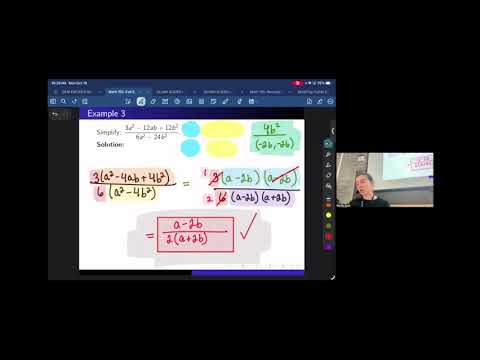
- Uses a perfect-square trinomial and difference of squares to simplify 3(a - 2b)²/[6(a² - 4b²)] to (a - 2b)/[2(a + 2b)].
- Shows that reversed factors such as a - b and b - a differ by a negative sign, so canceling them introduces a factor of -1.
- Factors x² - 9 as (x + 3)(x - 3) and x² - 7x + 12 as (x - 3)(x - 4) before multiplying.
- Cancels the shared x - 3 factors and reduces 2x/(6x²), producing (x + 3)/[3x(x - 4)].
- Uses the AC method and grouping to factor non-monic quadratics, and recognizes when a trinomial is prime over the integers.
- Rewrites division as multiplication by the reciprocal using keep-change-flip.
- Applies the sum and difference of cubes identities to factor expressions involving p³ and q³.
- Cancels the shared p + q factor after factoring, illustrating why factoring should precede multiplication.
- Treats a complex fraction as division of two fractions and converts the division bar into multiplication by a reciprocal.
- Factors 6x² - 7x + 2 using the AC method: splitting -7x into -3x and -4x leads to (2x - 1)(3x - 2).
- Factors 2x² - 7x + 3 as (2x - 1)(x - 3), then cancels shared polynomial factors across the product.
- Finishes the worked complex-fraction example with (3x - 2)/4.
- For a chain of rational expressions, first changes any division to multiplication by a reciprocal.
- Factors terms including 3x - 6, 4x - 4, x² + 2x - 3, and 8x + 16 before combining the fractions.
- Cancels shared binomials such as x - 1 and x + 2, then reduces the remaining numerical coefficients.
- Explains that a rational function has the form p(x)/q(x), with q(x) required to be nonzero.
- Finds the domain by solving 4(x² - 4x - 12) = 0; factoring gives restrictions x = -2 and x = 6.
- Writes the domain as (-∞, -2) ∪ (-2, 6) ∪ (6, ∞), excluding the denominator's zeros.
- Notes that canceling a factor does not restore its excluded input value, and that vertical asymptotes require examining the simplified function.
- Finds the product of f(x) and g(x) by multiplying their rational expressions using the same factoring methods.
- Factors constants and polynomials, including a difference of squares and a trinomial, before canceling matching factors.
- The worked product simplifies to 1 after all displayed factors cancel.
- Divides f(x) by g(x) by keeping the first rational expression, changing division to multiplication, and flipping the second expression.
- Factors x² - 4x as x(x - 4) and uses polynomial factors and common x terms to simplify the product.
- Concludes the worked quotient by reducing the remaining factors and numerical coefficient.
Transcript excerpt
0:03 7.1 Multiplying and Dividing Rational Expressions. Five learning objectives here. Being able to determine the values for which a rational expression is undefined, right? Undefined denominator is equal to zero. What are our restrictions here? It's a nice segue into understanding domains of functions. Objective two, simplifying rational expressions. Objective three and four, multiplying and dividing rational expressions. And then the last one is the same as the third and fourth just from a function notation standpoint. Let's start with some warm-up problems.
0:54 So first one we just want to simplify 90 y / 15 y^2 and we can um pull out a GCF, right? What can we divide uh the top and bottom coefficients by? They're both divisible by five, right? And so 90 / 5 gives you what? Well, we know 90 / 10 is 9. So divide by 5, what's double 9? 9 + 9 is 18, right? And then 15 / 5 is just
1:45 3, right? So we get 18 over 3. And 18 over 3 is just six. I forgot. Yeah, it had that there. And then how did we get that one? Well, when you divide terms that have the same base, you subtract the exponents. What's 1 - 2? 1. Last but not least, let's make it positive exponent. So our final result is just 6 over y. Question two, we're asked to multiply these two fractions. Let's see if we can do some simplification first.
2:35 What's eyeing me? Is this 14 and 35? Because they both share a factor. What? >> Seven. And 7 goes into 14 how many times? >> And seven goes into 35 how many times? Yep. And then the six and 15 share a common factor of three. Uh 3 goes into 15 how many times? And three goes into six? Two. So now
This is the start of the transcript. Save this video free for the whole transcript, searchable and time-coded.
Related notes
Summary, takeaways, and chapters were generated by AI from the video's transcript and may contain errors. The video belongs to its creator, Rachel Soyk.