8.4 Add Subtract and Multiply Radical Expressions --Lesson 32--FA26--Math190
Overview
Rachel Soyk teaches Math 190 Section 8.4 by showing how to add and subtract like radical terms, simplify radicals, multiply radical expressions, and apply polynomial multiplication. Examples progress from square, cube, and fourth roots to FOIL, perfect-square trinomials, and conjugates, emphasizing simplification before combining terms.
Key takeaways
- Combine radical terms only after simplifying them, and only when their indices and radicands match; for instance, √20 + 3√5 becomes 5√5.
- To simplify an nth root, extract factors that are perfect nth powers, including variable powers such as n³ from n⁵ under a cube root.
- When multiplying radicals with the same index, multiply the coefficients and radicands, combine variable exponents, then extract perfect powers, as in 6√2 · 3√10 = 36√5.
- Distribute or use FOIL for radical expressions, simplify each product, and then combine like radical terms; (3 - 2√7)² simplifies to 40 - 14√7.
- Products of conjugates follow a difference-of-squares pattern: (5 - 2√3)(5 + 2√3) eliminates the radical terms and equals 13.
Chapters
- Distributing the subtraction in (3x² + 9x - 5) - (x² - 2x + 3) gives 2x² + 11x - 8.
- FOIL turns (2 + a)(4 - a) into -a² + 2a + 8.
- Expanding (9 - 5y)² gives the perfect-square trinomial 81 - 90y + 25y².
- Radicals are like terms only when their indices and radicands match, so coefficients can be combined while the radical stays unchanged.
- For example, 2√2 - 7√2 simplifies to -5√2, and 4∛Y + 5∛Y becomes 9∛Y.
- Combining coefficients can eliminate a radical entirely, as in 2√(5n) - 6√(5n) + 4√(5n) = 0.
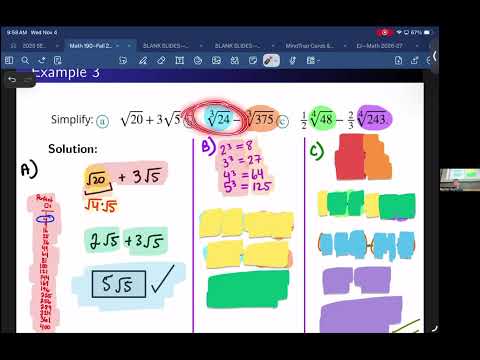
- Extract the largest perfect power before combining terms: √20 + 3√5 becomes 2√5 + 3√5 = 5√5.
- For cube roots, ∛24 - ∛375 simplifies to 2∛3 - 5∛3 = -3∛3.
- For fourth roots, simplifying the coefficients in ½∜48 - ⅔∜243 yields ∜3 - 2∜3 = -∜3.
- Factor perfect powers from both numbers and variables: 9√(50m²) - 6√(48m²) becomes 45m√2 - 24m√3.
- The square-root expression has no like radicals, but factoring out the greatest common factor gives 3m(15√2 - 8√3).
- For cube roots, ∛(54n⁵) - ∛(16n⁵) simplifies to 3n∛(2n²) - 2n∛(2n²) = n∛(2n²).
- Multiply coefficients and radicands separately, then simplify: 6√2 · 3√10 = 18√20 = 36√5.
- For cube roots, (-5∛4)(-4∛6) = 20∛24 = 40∛3.
- Combine variable exponents under the radical before extracting perfect powers: 10√(6p) · 4√(3p³) simplifies to 120p²√2.
- The fourth-root product 2∜(20y²) · 3∜(28y³) simplifies to 12y∜(35y).
- Distributing √6 across √2 + √18 gives √12 + √108, which simplifies to 2√3 + 6√3 = 8√3.
- Distributing ∛9 across 5 - ∛18 gives 5∛9 - ∛162 = 5∛9 - 3∛6.
- FOIL on (3 - 2√7)² produces 12 - 6√7 - 8√7 + 28, or 40 - 14√7.
- In (∛x + 4)(∛x - 2), the middle terms combine to give (∛x)² + 2∛x - 8.
- Squaring 2 + √3 gives 4 + 4√3 + 3, or 7 + 4√3.
- Squaring 4 - 2√5 gives 16 - 16√5 + 20, or 36 - 16√5.
- Conjugate factors cancel their radical middle terms: (5 - 2√3)(5 + 2√3) = 25 - 12 = 13.
Transcript excerpt
0:04 All right. So, section 8.4. Adding, subtracting, and multiplying radical expressions. So, we're going to end the side conversations. Oops, 6 9 12. We have about 18 slides in this section and about 11 examples. This section goes by pretty quickly, though, as well. So, what are our learning objectives? We have three. I might have the people who are talking come up and teach, and then I can sit down and chill. Cuz it's not fair that you're disrupting other people.
0:52 We'll wait. All right, much better. Thank you, guys. So, what are our three learning objectives here? Adding and subtracting radical expressions, multiplying rad- radical expressions, and then using polynomial multiplication to like radical expressions. So, a lot of taking roots of things. Let's first start with some warm-up problems. So, we have 3x² + 9x - 5 x² - 2x + 3.
1:42 So, we're going to go ahead and distribute this negative to each term inside that second trinomial. And when we do that, we can drop the parentheses, and we end up with our 3x² + 9x - 5 x squared + 2 x - 3. Now, let's combine some like terms. We have 3 x squared and x squared gets paired up. We have a 9 x and a 2 x gets paired up. And then we have our constants that get paired up, that -5 and -3. So, the yellows, when we combine those, that ends up becoming 2 x squared. The blues end up becoming 11 x. And then
2:35 the orange becomes -8. Giving us our final answer of 2 x squared + 11 x 8. That's it. Question two, we have two parts, a part A and a part B. Uh that part A, we have um a binomial times a bi- binomial. So,
This is the start of the transcript. Save this video free for the whole transcript, searchable and time-coded.
In this course
Related notes
Summary, takeaways, and chapters were generated by AI from the video's transcript and may contain errors. The video belongs to its creator, Rachel Soyk.