9.6 Quadratic Functions --Lesson 39--FA26--Math190
Overview
Rachel Soyk explains how to analyze and graph quadratic functions in standard form, using the leading coefficient, axis of symmetry, vertex, intercepts, and discriminant. Worked examples show how these properties determine a parabola’s shape and graph, and how the vertex gives its maximum or minimum value.
Key takeaways
- For f(x) = ax² + bx + c, the axis of symmetry is x = -b/(2a); evaluating the function at this x-coordinate gives the vertex.
- The sign of a determines both the parabola’s direction and the type of vertex extremum: a > 0 means an upward-opening graph with a minimum, while a < 0 means a downward-opening graph with a maximum.
- The y-intercept of a quadratic in standard form is always (0, c), because setting x = 0 eliminates the ax² and bx terms.
- The discriminant b² - 4ac tells how many real x-intercepts exist without requiring full factoring: positive means two, zero means one repeated root, and negative means none.
- A repeated root corresponds to a parabola that touches the x-axis at its vertex rather than crossing it.
- When graphing, use the vertex and symmetry to choose points on both sides, and follow standard presentation conventions such as labeled axes, an appropriate scale, arrows, and a function label.
Chapters
- A quadratic in standard form is f(x) = ax² + bx + c, with a ≠ 0; positive a opens upward and negative a opens downward.
- The axis of symmetry is the vertical line x = -b/(2a), and its x-coordinate is the x-coordinate of the vertex.
- For f(x) = x² - 1, shifting the parent graph y = x² down one unit gives vertex (0, -1) and symmetric points (-1, 0) and (1, 0).
- A complete graph should use a consistent one-unit scale, labeled axes, arrows, and a function label; include the vertex, intercepts, or axis of symmetry when requested.
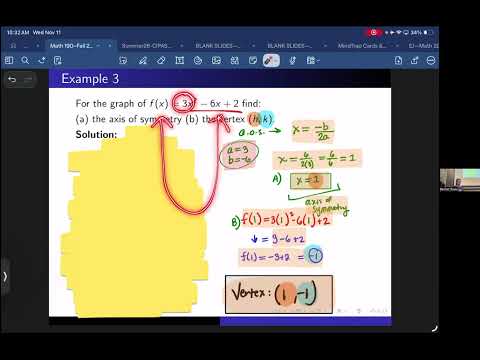
- Use x = -b/(2a) to find the axis of symmetry, then substitute that x-value into the original function to calculate the vertex’s y-coordinate.
- For f(x) = 3x² - 6x + 2, the axis is x = 1 and the vertex is (1, -1); because a is positive, the vertex is a minimum.
- Vertex form, f(x) = a(x - h)² + k, displays the vertex as (h, k), making it useful when completing the square.
- Set x = 0 to find the y-intercept: for ax² + bx + c, it is the point (0, c).
- Set f(x) = 0 to find x-intercepts; for x² - 2x - 8, factoring gives roots -2 and 4, so the intercepts are (-2, 0) and (4, 0).
- The discriminant D = b² - 4ac predicts the number of real x-intercepts: D > 0 gives two, D = 0 gives one repeated root, and D < 0 gives none.
- For 5x² + x + 4, D = 1 - 80 = -79, so the parabola has no real x-intercepts.
- For f(x) = -x² + 6x - 9, a < 0, the axis is x = 3, and the vertex is (3, 0); the repeated root means the graph touches the x-axis at (3, 0).
- The same function has y-intercept (0, -9), since its constant term is -9.
- For f(x) = x² + 4x + 5, the vertex is (-2, 1), the parabola opens upward, and its negative discriminant means it stays above the x-axis.
- A practical graphing sequence is to determine the opening direction, calculate the axis and vertex, find intercepts, add symmetric points, then plot and label the graph.
- An upward-opening parabola has a minimum at the vertex; a downward-opening parabola has a maximum there.
- For f(x) = x² + 2x - 8, the axis is x = -1 and substitution gives vertex (-1, -9), so the minimum value is -9.
- State an extremum using its y-value, such as “minimum value -9” or “minimum at y = -9,” rather than identifying the x-coordinate as the minimum.
Transcript excerpt
0:03 graphing quadratic functions using properties. So just to refresh our memory, general form of a quadratic ax^2 + bx + c. And what does this look like? We have a nice u-shaped parabola when our a is uh positive. What does this give us? Well, when we have this U-shaped, this bottom part known as a vertex is actually the lowest y value in our function. And this red line over here that cut the parabola in half perfectly is actually known as our axis of
0:52 symmetry. I abbreviated it as a do s. And so our formula for axis of symmetry isb over 2 a. This is um another really important formula uh to sort of start ingraining into your head. Why is it so important? Well, this axis of symmetry also gives us the xcoordinate point of our vertex of our minimum value in this case. And if we know the xcoordinate point, we can plug that xcoordinate point back into our function to find our ycoordinate point,
1:40 which gives us that x ycoordinate point, also known as our vertex point. And that's what we have highlighted in orange here. And then we're not always going to look at a U-shaped parabola, but maybe it'll be upside down. And that's when our a value is negative. And so we won't have a minimum there. We'll actually have a maximum, which ties in nicely into that last and final objective. So this whole section is really honing in on the characteristics of quadratic functions. uh identifying uh our axis of symmetry, using that to find our vertex, finding our x and y intercepts, whether
2:29 we're looking at it from a visual standpoint or a technical standpoint. Uh and then graphing it efficiently. And last but not least, uh solving for our max um and
This is the start of the transcript. Save this video free for the whole transcript, searchable and time-coded.
In this course
Related notes
Summary, takeaways, and chapters were generated by AI from the video's transcript and may contain errors. The video belongs to its creator, Rachel Soyk.