110926 L1 Chemistry 221 Video Lecture
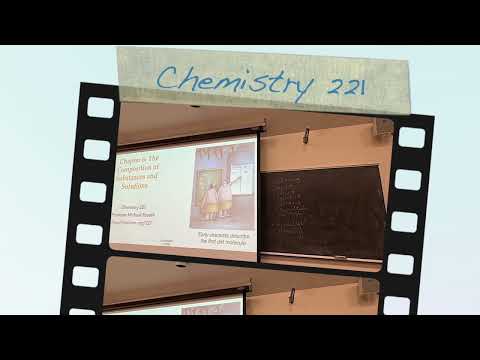
Overview
Michael Russell introduces Chapter 6's methods for identifying compound composition, focusing on molar mass, percent composition, and empirical formulas. He shows how to convert measured masses or percentages into mole ratios, reduce those ratios to whole numbers, and distinguish an empirical formula such as CH from a molecular formula such as C6H6.
Key takeaways
- Empirical-formula calculations depend on mole ratios, so convert every element mass to moles before comparing quantities.
- To simplify mole amounts, divide each by the smallest amount; if the resulting ratio contains a half-integer such as 3.5, multiply every ratio by 2 to obtain whole-number subscripts.
- Percent composition can be converted into an empirical formula by assuming a 100 g sample, treating each percentage as grams, and then following the grams-to-moles procedure.
- Molar mass supports both percent-composition calculations and the later conversion from an empirical formula to a molecular formula.
- An empirical formula is not necessarily the molecular formula: benzene is C6H6 molecularly but CH empirically, while water is H2O in both forms.
Chapters
- Exam 2 covers Chapters 4 and 5 and includes 12 multiple-choice questions plus 4 short-answer questions, with about 90 minutes to complete it.
- Students should turn in Exam Prep 2 and the valence bond molecular orbital lab; the empirical formula lab requires goggles because it uses flames, acids, and vacuum equipment.
- Molar mass is calculated by summing atomic masses, as in water at 18.02 g/mol and chloroform, CHCl3, at about 119.37 g/mol.
- For ionic solids such as NaCl, formula mass refers to the smallest repeating ratio in a lattice rather than a discrete molecule.
- An empirical formula gives the smallest whole-number ratio of atoms, while a molecular formula gives the actual atom counts in a molecule.
- Hydrogen peroxide, H2O2, reduces to the empirical formula HO; benzene, C6H6, reduces to CH.
- Butane, C4H10, reduces to C2H5 because dividing both subscripts by 4 would produce a fractional hydrogen count.
- Water's molecular and empirical formulas are both H2O because its subscripts cannot be reduced while remaining whole numbers.
- Ethanol has molecular formula C2H6O and a structure containing CH3, CH2, and OH groups.
- An elemental-analysis instrument can report mass percentages; the example ethanol sample contains 52.13% carbon, 13.15% hydrogen, and 34.72% oxygen.
- The measured percentages identify which elements are present and should add to approximately 100%, allowing for small measurement or rounding differences.
- Percent composition is an early step in identifying an unknown compound before determining its empirical and molecular formulas.
- For a 10 g sample containing 2.5 g hydrogen and 7.5 g carbon, percent by mass is element mass divided by total sample mass, multiplied by 100.
- The sample is 25% hydrogen and 75% carbon; when only two elements are present, one percentage can be found by subtracting the other from 100%.
- Known formulas also yield percent composition: water contains 16.00 g oxygen and about 2.02 g hydrogen per 18.02 g/mol.
- Water is therefore about 88.79% oxygen and 11.21% hydrogen; the same calculation works by dividing each element's mass contribution by the compound's molar mass.
- Nitrogen monoxide, NO, has a molar mass of 30.01 g/mol and contains 14.01 g nitrogen per mole.
- Its nitrogen mass percentage is 14.01 / 30.01 × 100, or 46.68%; oxygen's percentage can be calculated directly or as the remainder to 100%.
- Chemical formula subscripts express mole ratios, not mass ratios: H2O represents two moles of hydrogen atoms for each mole of oxygen atoms.
- Because empirical formulas require mole ratios, measured element masses must first be converted to moles using atomic molar masses.
- For a sample with 1.71 g carbon and 2.87 g hydrogen, divide each mass by its atomic molar mass to get about 0.142 mol carbon and 2.84 mol hydrogen.
- Divide each mole amount by the smallest amount to find the simplest ratio; the example ratio is approximately 1 carbon to 2 hydrogen.
- The resulting empirical formula is CH2, illustrating the core sequence: grams to moles, then divide by the smallest mole quantity.
- The formula's subscripts represent relative atom counts, so the intermediate decimal mole amounts are not written as formula subscripts.
- A sample containing 5.31 g chlorine and 8.40 g oxygen converts to about 0.150 mol chlorine and 0.525 mol oxygen.
- Dividing both values by 0.150 gives a ratio of 1 chlorine to 3.5 oxygen, which cannot be used as a whole-number empirical formula.
- Multiply both ratio values by 2 to clear the half-integer, yielding the empirical formula Cl2O7.
- Russell notes that a half-integer commonly calls for multiplying by 2 in this course, while unusual decimals may signal measurement error or sample degradation.
- For a compound containing 27.29% carbon and 72.71% oxygen, assume a 100 g sample so the percentages become 27.29 g carbon and 72.71 g oxygen.
- Convert those masses to moles using 12.01 g/mol for carbon and 16.00 g/mol for oxygen, giving approximately 2.272 mol carbon and 4.544 mol oxygen.
- Divide by the smaller mole amount to obtain a 1:2 ratio and the empirical formula CO2.
- A 100 g assumption is convenient but not mandatory; any assumed sample mass works if each element's mass is scaled consistently.
- An empirical formula captures the simplest whole-number atom ratio, while a molecular formula specifies the actual counts in an individual molecule.
- Benzene's molecular formula C6H6 reduces to empirical formula CH; water remains H2O in both forms.
- Acetic acid, C2H4O2, reduces to empirical formula CH2O by dividing every subscript by 2.
- Percent-composition data establishes an empirical formula, but additional information is needed to determine whether that ratio is the compound's full molecular formula.
Transcript excerpt
0:00 All right, good morning. I hope you had a great weekend. I'm glad to have you here. Uh this afternoon at 1:10 uh will be the time of exam 2. Exam 2 will be over chapters 4 and five. So today in a little bit I'll start talking about chapter 6. Just realize this stuff won't be on the midterm [cough] for the next section we're going to get to. But anyway, exam two uh format identical 12 multiple as to exam one. uh 12 multiple choice questions, four short answer questions, about 90 minutes to complete it. Um [clears throat] all of my exam sections this week will be very crowded, so just get ready. You're going to sit next to other people, stuff like that. Um but it'll we'll make it happen. It's going to be a party. Um so anyway, just realize it'll be a little bit more crowded than usual, but everything
0:48 should be under control. Anyway, when you take the second midterm, make sure you turn in exam prep two and the veence bond molecular orbital lab that we did last week. And then afterwards, we will go into 257 and do the empirical formula lab. This is a really fun lab, but there's lots of uh flames and acids and vacuums and all kinds of stuff. Goggles absolutely required. Hey, if you've got your own, definitely bring them. You'll have to use some of mine if you don't, which is totally cool. And then finally, this Wednesday is Veterans Day, so uh Mount will be completely closed. We won't have a lecture. I won't have office hours, stuff like that. Questions? Anyway, so in this chapter now, we're going to
1:38 look a little bit more about how scientists find the composition of chemicals. And it's one thing to say,
This is the start of the transcript. Save this video free for the whole transcript, searchable and time-coded.
In this course
Related notes
Summary, takeaways, and chapters were generated by AI from the video's transcript and may contain errors. The video belongs to its creator, Michael Russell.