111826 L1 Chemistry 221 Video Lecture
Overview
Michael Russell introduces chemical equations as recipes: reactants on the left form products on the right, with state symbols and coefficients describing substances and their amounts. He teaches atom-by-atom balancing using methane, propane, aluminum bromide, and boron hydride examples, emphasizing conservation of matter, unchanged formula subscripts, and smallest whole-number coefficients.
Key takeaways
- Chemical equation coefficients express relative amounts, while subscripts define a compound’s fixed composition and must not be altered during balancing.
- A balanced equation conserves the number of atoms of every element on each side, but the sum of the coefficients on the two sides does not need to match.
- For combustion reactions that form CO2 and H2O, balance carbon and hydrogen first, then oxygen; propane combustion balances as C3H8 + 5O2 → 3CO2 + 4H2O.
- When balancing leaves an odd number of atoms to match a diatomic molecule, use a temporary fractional coefficient and multiply all coefficients to obtain whole numbers, as in 2B4H10 + 11O2 → 4B2O3 + 10H2O.
- The seven diatomic elements are H2, N2, F2, O2, I2, Cl2, and Br2; recognizing them prevents incorrect reactant formulas in equations.
- Ionic reaction equations must conserve net charge as well as atoms; Na+ and Cl− combine to make neutral NaCl.
Chapters
- Michael Russell introduces Chapter 7 Part I as an introduction to chemical reactions and balancing equations.
- A chemical equation works like a recipe: it identifies the ingredients and their relative amounts needed to make a product.
- Russell notes that Thanksgiving week has no assignments due and recommends Problem Set 6 for Chapter 6 and Chapter 7 Part I practice.
- Reactants appear left of the arrow and products appear right; coefficients show the relative amounts involved.
- State symbols include (s) for solid, (l) for liquid, (g) for gas, and (aq) for a substance dissolved in water.
- The mnemonic “Have no fear of ice, clear brew” recalls H2, N2, F2, O2, I2, Cl2, and Br2, the seven elements written as diatomic molecules.
- For example, aluminum is written Al, while elemental oxygen is O2; aluminum and oxygen form aluminum oxide in the ratio 4Al + 3O2 → 2Al2O3.
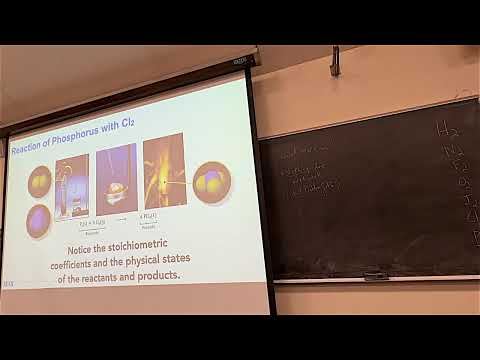
- Russell illustrates reactants and products with P4(s) + 6Cl2(g) → 4PCl3(l), identifying phosphorus tetramer and chlorine gas as reactants.
- Iron reacting with chlorine forms solid iron(III) chloride, with heat and a brown product providing visible signs of reaction.
- Evidence can include a temperature change, a precipitate, gas bubbles, or a color change; spectroscopy may be needed when changes are not visible.
- Methane combustion is introduced as a reaction of CH4 with O2 that produces CO2 and H2O.
- Balance methane combustion as CH4 + 2O2 → CO2 + 2H2O, accounting for one carbon, four hydrogens, and four oxygens on each side.
- Because each H2O contains two hydrogen atoms, a coefficient of 2 produces the four hydrogens present in CH4.
- Change coefficients in front of formulas, not subscripts within formulas; H2O remains water regardless of the coefficient.
- Use the smallest whole-number coefficient ratio, 1:2:1:2, rather than an equivalent multiple such as 2:4:2:4.
- Verify a balanced equation by listing each element and counting its atoms on both sides; for methane combustion, C = 1, H = 4, and O = 4 on each side.
- The decomposition of mercury(II) oxide releases oxygen gas, explaining why the remaining mercury weighs less than the starting compound.
- The law of conservation of matter requires all atoms in the reactants to be accounted for in the products; matter is not created or destroyed in the reaction.
- Antoine Lavoisier is credited with the conservation principle, developed through careful measurement of chemical reactions.
- Aluminum reacts with Br2 to produce aluminum bromide; bromine is diatomic, but aluminum is written as single Al atoms.
- The example’s product is the aluminum bromide dimer Al2Br6, containing two aluminum atoms and six bromine atoms.
- Balance the reaction as 2Al + 3Br2 → Al2Br6: two Al atoms and six Br atoms appear on both sides.
- Russell distinguishes this dimer example from the usual aluminum bromide formula AlBr3.
- Balance propane combustion as C3H8 + 5O2 → 3CO2 + 4H2O, adjusting carbon and hydrogen before oxygen.
- For combustion reactions that produce CO2 and H2O, Russell recommends balancing carbon and hydrogen first and the elemental oxygen last.
- For B4H10 + O2 → B2O3 + H2O, first balance boron and hydrogen, which requires 2B4H10 + 11/2O2 → 4B2O3 + 10H2O temporarily.
- Multiply every coefficient by 2 to remove the fraction, giving 2B4H10 + 11O2 → 4B2O3 + 10H2O, then verify B = 8, H = 20, and O = 22 on both sides.
- Balanced equations conserve each element’s atom count, not the sum of the coefficients on each side; those coefficient totals can differ.
- The phosphorus reaction P4 + 6Cl2 → 4PCl3 has four phosphorus atoms and twelve chlorine atoms on each side.
- A temporary fractional coefficient can help with a diatomic element; ethane combustion becomes 2C2H6 + 7O2 → 4CO2 + 6H2O after clearing the fraction.
- Use the smallest whole-number coefficients, balance elements present in multiple compounds before elements appearing alone, and recheck all atom counts.
- A complete ionic equation must conserve net charge as well as atoms; Na+ + Cl− → NaCl has zero net charge on both sides.
- Charge balancing will be useful in the upcoming net ionic lab and becomes especially important in later chemistry coursework.
- Russell closes by recommending repeated practice with equation balancing to build accuracy and confidence.
Transcript excerpt
0:01 Good morning. I hope your day has been going well. Uh, first of all, had some questions. Nobody believes me, I guess, but literally nothing is due next week, which I know seems bizarre after every week I blast you with what's coming out, but literally Thanksgiving week is next week and nothing's uh nothing's due. Uh, we'll have a lecture in here Monday at 9:00 a.m., but we will not have a lab uh Monday afternoon. We won't have lectures next week, Wednesday or Friday. Um, so it's a pretty chill week, which is kind of a nice thing and stuff. If you have time and you want to get ready for the week after Thanksgiving, I encourage you to look at problem set six. That'll get you ready for the material. Um, problem set six is over chapter 6 and 7 part one, which is what we're doing right
0:49 now. Uh, so you definitely have everything you need for the chapter 6 part, and we're working on the chapter 7 stuff. questions on that. Cool. I did want to say thank you to all your wonderful class presentations I saw on Monday. Wow. And I'm still processing and the grading pile is pretty high on my uh desk right now. But man, there was some good work and I sure appreciate it. Um definitely ethyl mercury, arsenic, good uses. My goodness, sodium, uh the list goes on and on and I sure appreciate it, man. Giving me lots of things to think about. Um, I am in the process of creating. It's a very slow week though this week, so there's a lot of it to go through. But I wanted to say thank you and stuff and very cool. And for what it's worth, I also watched
This is the start of the transcript. Save this video free for the whole transcript, searchable and time-coded.
In this course
Related notes
Summary, takeaways, and chapters were generated by AI from the video's transcript and may contain errors. The video belongs to its creator, Michael Russell.