111926 L2 Chemistry 221 Video Lecture Part III
Overview
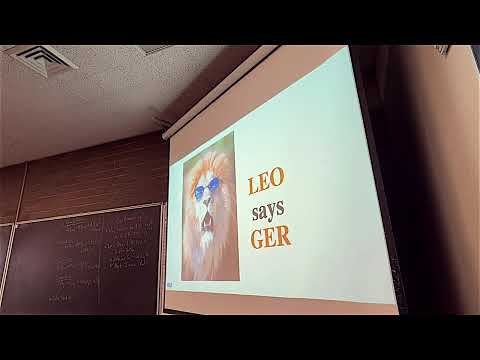
Michael Russell reviews reaction types from Chapter 7, connecting double-displacement and combustion reactions to oxidation-reduction chemistry. He teaches the LEO says GER mnemonic, electron-transfer and oxidation-number methods, and applies them to examples including copper and silver ions, iron and copper(II), and magnesium reacting with hydrochloric acid.
Key takeaways
- LEO says GER identifies the electron change: losing electrons is oxidation, and gaining electrons is reduction.
- The oxidizing and reducing agent names describe what each reactant does to the other: the reducing agent is oxidized while donating electrons, and the oxidizing agent is reduced while accepting them.
- A redox reaction must include both oxidation and reduction because electrons released by one species are transferred to another.
- Compare each reactant with its corresponding product: a more positive oxidation number indicates oxidation, while a less positive number indicates reduction.
- For oxidation-number calculations, use common values such as O = −2, H = +1, and F = −1, then set the total equal to the compound or ion's overall charge.
- In Mg + 2HCl → MgCl2 + H2, magnesium supplies two electrons as it becomes Mg2+, and two hydrogen ions each gain one electron to form H2.
Chapters
- In double-displacement reactions, positive ions exchange partners; the three types covered are precipitation, acid-base neutralization, and gas-forming reactions.
- A carbonate reacting with acid forms unstable carbonic acid, which breaks down into water and CO2; acids reacting with metal hydroxides form water and a salt.
- Combustion of an organic compound with O2 produces CO2 and water, while nitrogen-containing compounds may also form nitrogen dioxide.
- Oxidation-reduction, or redox, reactions transfer electrons between reactants and can release substantial energy.
- Russell connects redox chemistry to breathing, batteries, and the formation of water from hydrogen and oxygen.
- In the permanganate and iron example, purple MnO4− is reduced to Mn2+, while Fe2+ is oxidized to Fe3+.
- The mnemonic LEO says GER means Loss of Electrons is Oxidation and Gain of Electrons is Reduction.
- Zn becoming Zn2+ loses electrons and is oxidized; Cu2+ becoming copper metal gains electrons and is reduced.
- An oxidized species is the reducing agent because it donates electrons; a reduced species is the oxidizing agent because it accepts electrons.
- Oxidation and reduction always occur together because electrons lost by one reactant must be gained by another.
- When copper metal is placed in silver nitrate, copper changes from 0 to +2 and releases electrons, so it is oxidized.
- Silver ions change from +1 to 0 by gaining those electrons, so Ag+ is reduced and silver crystals form on the copper.
- For redox analysis, compare reactants with products; copper becoming more positive indicates oxidation, while silver becoming less positive indicates reduction.
- In Fe + Cu2+ → Fe2+ + Cu, iron changes from 0 to +2 and is oxidized, while copper changes from +2 to 0 and is reduced.
- The half-reactions show Fe → Fe2+ + 2e− and Cu2+ + 2e− → Cu.
- A metal appearing as a compound on one side and as a pure metal on the other is a useful redox clue, as in aluminum reducing manganese oxide to manganese metal.
- An element in its uncombined form, including the seven diatomic elements, has oxidation number 0; common values are oxygen −2, hydrogen +1, and fluorine −1.
- The sum of oxidation numbers equals the molecule's total charge: in H2S, sulfur is −2 because 2(+1) + x = 0.
- For SO3²−, three oxygen atoms contribute −6, so sulfur must be +4 to give the ion's overall −2 charge.
- In ClO4−, four oxygen atoms contribute −8, requiring chlorine to be +7; oxidation numbers help identify electron transfer when charge changes are not immediately obvious.
- Single-replacement reactions can be redox reactions, including copper displacing silver from silver nitrate and magnesium reacting with hydrochloric acid to release H2.
- In Mg + 2HCl → MgCl2 + H2, magnesium changes from 0 to +2 and is oxidized; hydrogen changes from +1 to 0 and is reduced.
- Russell also cites nitrogen monoxide reacting with oxygen to form brown NO2, and heated iron reacting with chlorine to form FeCl3.
- The lecture closes with course logistics: no class the following week, and the problem set and post-presentation assignment are due Tuesday, December 1.
Transcript excerpt
0:00 Okay, so before we left we were talking about the three types of what are called double displacement reactions. And in a double displacement reaction the positive cations ions swap partners. They start dancing with the other cations ions partner. So in ax y the a and the b here are the positive parts. They're going to shift. A starts dancing with y b starts dancing with x. And with the solubility guide, one of those will be a solid. That's the precipitate in a precipitation reaction. Now, acid base reactions are also these double displacements. Now, you've got an acid HX and a base MO. Excuse me. The M and the H now are
0:47 swapping partners. Excuse me. You end up making HOH, which is H2O, and then MX some kind of salt. But it's the water which is the energy part here. All right? Making water actually creates a lot of energy. Now, gas forming reactions, I've only shown the carbonate and the acid here. But you'd have some kind of metal carbonate and some kind of acid like HNO3. And the metal will start dancing with the nitrate, but usually that's boring. It's the H+ and the carbonates coming together to make that unstable carbonic acid which further breaks down to water and CO2. But all three of these are double displacement reactions. So the cat ions are swapping partners. And in the net ionics lab, we're only going to
1:35 focus on those three types. But again, if you know the sterling parts, you're going to be good to go. If you see a carbonate with an acid, gas forming, something acid with some kind of metal hydroxide, acid base. And if you don't know, then you'll go to the solubility tables to see if a precipitate forms or
This is the start of the transcript. Save this video free for the whole transcript, searchable and time-coded.
In this course
Related notes
Summary, takeaways, and chapters were generated by AI from the video's transcript and may contain errors. The video belongs to its creator, Michael Russell.