110526 L2 Chemistry 221 Video Lecture Part I
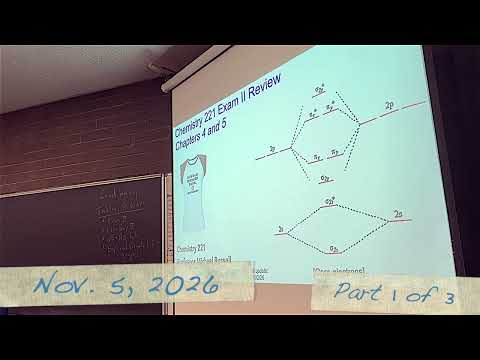
Overview
Michael Russell reviews Chemistry 221 Midterm II topics, covering exam logistics and worked problems in Lewis structures, formal charge, VSEPR geometry, and molecular polarity. He shows how electron counting and octet rules identify invalid structures, then applies electron-domain geometry to SCl2, IF2−, and acetylene.
Key takeaways
- A reliable Lewis-structure check uses two steps: verify appropriate octets or duet limits, then ensure the pictured electrons match the total valence-electron count, including charge adjustments.
- Period 2 atoms such as C, N, O, and F cannot exceed four electron pairs in the structures covered, while Russell's course heuristic allows expanded octets for larger atoms such as iodine.
- Formal charges are computed as valence electrons minus bonds minus lone-pair electrons; their sum must equal the molecule's net charge.
- VSEPR counts each single, double, or triple bond as one electron domain, which lets the Lewis structure predict both electron-pair geometry and molecular shape.
- In trigonal-bipyramidal IF2−, three equatorial lone pairs leave the two fluorines in axial positions, producing a linear 180° shape with canceling bond dipoles.
- Acetylene's C≡C bond gives each carbon an octet, and its linear, symmetric arrangement makes the molecule nonpolar overall.
Chapters
- The Midterm II is scheduled for next Tuesday and lasts about 90 minutes, with 12 multiple-choice questions and four short-answer questions.
- Students should bring Exam Prep 2, the valence bond molecular orbital lab, and may bring a calculator; a new periodic table will be provided.
- The empirical formula lab follows the exam and uses gases, flames, acids, and vacuums, so goggles are required.
- For a Lewis-structure question, first check whether atoms have appropriate electron shells, including hydrogen's one-bond limit and the usual octets for carbon, nitrogen, and oxygen.
- Then count total valence electrons, adjusting for molecular charge, and compare the total with the bonding and lone-pair electrons shown.
- The NO⁺ example should have 10 valence electrons, or five electron pairs; the displayed structure has five pairs, making its charge label the inconsistency.
- Carbon, nitrogen, oxygen, and fluorine are period 2 elements and cannot exceed four electron pairs around the atom in the structures Russell reviews.
- The invalid example places five bonding pairs on nitrogen and more than four pairs on oxygen, violating the period 2 limit.
- Russell contrasts these atoms with larger elements such as phosphorus, sulfur, and iodine, which the course treats as capable of expanded octets.
- Calculate formal charge as valence-group number minus the number of bonds minus the number of lone-pair electrons.
- In the shown formate resonance structure, hydrogen, carbon, and the double-bonded oxygen each have formal charge 0; the singly bonded oxygen has charge −1.
- The formal charges must sum to the ion's overall −1 charge, and the negatively charged oxygen is a likely site for an incoming H⁺.
- SCl2 has 20 valence electrons: sulfur contributes 6 and two chlorine atoms contribute 14.
- After forming two S–Cl bonds and completing each chlorine octet, the remaining two lone pairs go on sulfur.
- Sulfur has four electron domains, giving a tetrahedral electron-pair geometry; with two lone pairs, the molecular shape is bent, with an angle near 109°.
- Iodine is the central atom because it is less electronegative than fluorine; the two fluorines occupy the outer positions.
- IF2− has 22 valence electrons: 7 from iodine, 14 from the fluorines, and 1 added for the negative charge.
- After each fluorine receives three lone pairs, the remaining three lone pairs are placed on iodine, giving the central atom an expanded octet.
- Iodine has five electron domains, so IF2− has a trigonal-bipyramidal electron-pair geometry.
- The three lone pairs occupy equatorial positions to reduce 90° lone-pair repulsions; the two I–F bonds occupy the axial positions.
- The fluorines sit 180° apart, making the molecular geometry linear; their opposing bond dipoles cancel, so Russell classifies IF2− as nonpolar.
- Acetylene, C2H2, has 10 valence electrons, with the two carbon atoms in the center and one hydrogen attached to each carbon.
- The initial single-bond arrangement leaves the carbons without octets, so shared electron pairs form a C≡C triple bond.
- Each carbon ends with four electron pairs around it, and the triple bond is the high-energy bond Russell connects to acetylene's use in welding.
- A single bond and a triple bond each count as one electron domain around carbon, producing a linear arrangement with a 180° bond angle.
- Although each C–H bond can be considered polar, the molecule's symmetry makes the opposing polarities cancel, so acetylene is nonpolar overall.
- The review pauses for a break at about 48:50, near the end of the 49-minute lecture.
Transcript excerpt
0:00 All right. Good morning. I hope your morning has been going well. I'm honored to have you here. Uh, what we're going to do today is we're going to start an exam review for the upcoming second midterm. And just as a reminder that next Tuesday, uh, that's when we'll take the second midterm. And at that time, you'll turn in the completed exam prep two. So just like before the first midterm, there was an exam prep one where there was a single page double-sided question followed by the answer, show your work. And that's what exam prep two is. So again, I'm hoping that exam prep two won't be a big deal, but you get to question three and you're like Uh, don't be afraid to reach out on the exam prep. I'm happy to help. The tutors can help, all that kind of jazz.
0:47 You'll also turn in the valence bond molecular orbital lab. And [clears throat] afterwards, we are going to do a lab called the empirical formula lab. This is a pretty cool lab. We're going to have gases and we're going to have flames and acids and vacuums and all kinds of stuff. So goggles will definitely be required. If you've got your own, definitely bring it. I'll have some, of course, you can borrow if you need to. Uh, should be pretty cool. My camera here is That's better. Uh, questions, that kind of stuff. Okay. [clears throat] So midterm two next week for you in this section next week Tuesday. So that'll be the only thing we won't look at problem set six or anything like that. We'll just take the midterm during that time. So when you come next Tuesday 8:30, bring exam prep
1:38 two, the valence bond molecular orbital lab. You can bring your calculator. I
This is the start of the transcript. Save this video free for the whole transcript, searchable and time-coded.
In this course
Related notes
Summary, takeaways, and chapters were generated by AI from the video's transcript and may contain errors. The video belongs to its creator, Michael Russell.