111226 L2 Chemistry 221 Video Lecture Part I
Overview
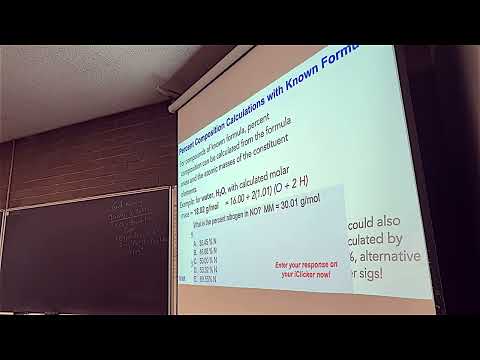
Michael Russell introduces Chapter 6 methods for identifying unknown compounds, moving from elemental mass percentages to an empirical formula and then using molar mass to determine the molecular formula. Worked examples include water’s 18.02 g/mol molar mass, the empirical formula CO2 from percent composition, and a compound with empirical formula CH2O and molar mass 180 g/mol, which yields C6H12O6.
Key takeaways
- An empirical formula gives only the smallest whole-number atom ratio, so compounds such as acetic acid and glucose can both have empirical formula CH2O while differing in molecular formula.
- To derive an empirical formula from measured element masses, convert each mass to moles, divide all mole amounts by the smallest, and multiply the ratios when needed to eliminate fractions.
- Percent composition can be converted into element masses by assuming a 100 g sample, after which the same grams-to-moles ratio method applies.
- The molecular formula is found by dividing the measured compound molar mass by the empirical formula mass and multiplying every empirical subscript by the resulting whole number.
- A covalent molecule’s formula mass and molar mass use the same formula, while ionic compounds such as NaCl are represented by repeating lattices and use the mass of a smallest formula unit.
Chapters
- Presentations are scheduled for the following Tuesday at 8:30 a.m.; students should bring their presentation paper and completed empirical formula lab.
- Students can present with Google Slides, PowerPoint, Keynote, or a chalk talk, but must be ready to log in on the classroom Windows computer.
- Presentation order will be chosen first come, first served by signing up on the blackboard.
- For covalent CHCl3, add the atomic masses of one carbon, one hydrogen, and three chlorine atoms to obtain a molar mass of 119.37 g/mol.
- Water’s molar mass is 18.02 g/mol, calculated as 16.00 for oxygen plus two hydrogen masses of 1.01 g/mol.
- Ionic solids such as NaCl form extended three-dimensional lattices; formula mass refers to the mass of the smallest formula unit rather than a separate molecule.
- First determine the empirical formula, the smallest whole-number ratio of atoms, from measurements of the compound’s elemental composition.
- Then use a mass spectrometer to measure molar mass and combine that result with the empirical formula to obtain the molecular formula.
- Elemental analysis techniques such as atomic absorption provide each element’s percent by mass, with percentages expected to total approximately 100%.
- For a 10 g sample containing 2.5 g hydrogen and 7.5 g carbon, divide each element’s mass by 10 g and multiply by 100% to get 25% hydrogen and 75% carbon.
- For water, oxygen contributes 16.00/18.02 × 100%, or about 88.79%; hydrogen contributes 2 × 1.01/18.02 × 100%, or about 11.2%.
- Nitrogen monoxide, NO, has a molar mass of 30.01 g/mol and is 46.68% nitrogen by mass; formulas describe mole ratios, while percent composition describes mass.
- Convert each element’s mass to moles, divide every mole amount by the smallest, and use the resulting ratio to establish the empirical formula.
- A sample with 1.71 g carbon and 0.287 g hydrogen gives about 0.142 mol carbon and 0.284 mol hydrogen; the 1:2 ratio yields CH2.
- CH2 is an empirical formula rather than necessarily the molecular formula: C2H4 and C4H8 share the same smallest whole-number ratio.
- A sample with 5.31 g chlorine and 8.40 g oxygen gives mole amounts of about 0.150 mol Cl and 0.525 mol O, producing a ratio of 1:3.5.
- Multiply every ratio by 2 to remove the half-number and obtain the empirical formula Cl2O7.
- For the empirical formula lab, convert the measured grams of copper, chlorine, and water to moles, compare their ratios, and round values near whole numbers as instructed.
- Assume a 100 g sample so each mass percentage becomes the same number of grams; for example, 27.29% carbon becomes 27.29 g carbon.
- For a gas containing 27.29% carbon and 72.71% oxygen, conversion to moles gives about 2.272 mol C and 4.544 mol O.
- Dividing by the smaller mole amount gives a 1:2 ratio, so the empirical formula is CO2; any other assumed sample mass can also work if used consistently.
- Acetic acid has molecular formula C2H4O2, which reduces by a factor of 2 to empirical formula CH2O.
- Benzene, C6H6, reduces to CH, while water, H2O, is already in its smallest whole-number ratio.
- Different compounds, including acetic acid and glucose, can share the empirical formula CH2O while having different molecular formulas.
- Divide a compound’s measured molar mass by the molar mass of its empirical formula; the result is a whole-number multiplier for every empirical-formula subscript.
- For empirical formula CH2O and measured molar mass 180 g/mol, the empirical formula mass is approximately 30 g/mol, giving a multiplier of 6 and molecular formula C6H12O6.
- For glyceraldehyde with empirical formula CH2O and molar mass 90.08 g/mol, the multiplier is 3, giving C3H6O3.
Transcript excerpt
0:00 All right. Good morning. I hope your morning is going well. I hope your Wednesday was awesome and I'm really glad to have you here. Uh we're going to start talking about chapter six today, but before we do that next Tuesday morning at 8:30 a.m. we should talk about what's going on. We will not be looking at problem set six and quiz six, all that kind of jazz, but next Tuesday is the time of class presentations. So at the very least make sure you come in ready to give your class presentation and also turn in your class presentation paper. The empirical formula lab that we did on Tuesday will be due. And also it'll make your life cool if you bring what I call the post class presentation assignment with you. This is something that was in the packet I gave you on the first day. Uh it was
0:49 basically the last full page. All right. [clears throat] I'm going to try and bring copies as well, but this will um be one of the things you can fill out while watching the other presentations. Uh it'll save you some time later, stuff like that. >> Uh lab essay and then my um presentation? >> Yep. >> And we can send uh like if I were to do Google Slides, I can send it to your email? >> Yep. You are responsible for logging in everything up to yourself. So you can absolutely use Google Slides, Microsoft Office, whatever, but you are responsible for logging in up here and doing it. >> You got it. >> This is a Windows computer. If you are a Mac person using Keynote, which is what I use by the way, uh make sure that you translate your Keynote into PowerPoint
This is the start of the transcript. Save this video free for the whole transcript, searchable and time-coded.
In this course
Related notes
Summary, takeaways, and chapters were generated by AI from the video's transcript and may contain errors. The video belongs to its creator, Michael Russell.