111226 L2 Chemistry 221 Video Lecture Part III
Overview
Michael Russell introduces mass percent, volume percent, and parts per million as alternatives to molarity, showing how to calculate mixture composition and dilute pollutant levels. He then combines Chapter 6 methods in an unknown-compound problem: percentage composition gives the empirical formula CH₄O, a molar mass of 32.04 g/mol confirms the same molecular formula, and a 98.5 mg sample in 5.00 mL gives a molarity of about 0.614 M.
Key takeaways
- Mass percent requires matching mass units: 25.0 g NaCl in 80.0 g total mixture is 31.3% NaCl by mass.
- Trace concentrations can be calculated with ppm = solute mass / solution mass × 10⁶; 5 mg in 100 g is 50 ppm.
- With the approximation that water density is 1 g/mL, a 75 ppm concentration corresponds to 75 mg solute per liter, or 0.075 g per liter.
- For empirical formulas, convert each element's percentage to grams using a 100 g sample, convert grams to moles, then divide every mole amount by the smallest.
- The integer ratio between a compound's molar mass and its empirical-formula mass determines the molecular formula; a ratio near 1 means the formulas are identical.
- The unknown sample's 98.5 mg in 5.00 mL yields about 0.614 M when its molar mass is 32.04 g/mol; concentration examples must use consistent units.
Chapters
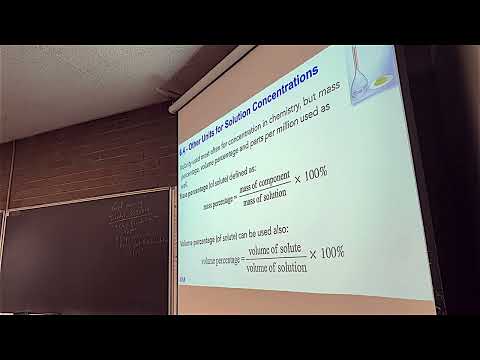
- Mass percent is the mass of the component divided by the total mass, multiplied by 100; 25.0 g NaCl in a mixture with 55.0 g KCl is 31.3% NaCl by mass.
- For the spinal-fluid example, 3.75 mg glucose in 5 g of sample is converted to consistent mass units before calculating a mass percentage of 0.075%.
- Russell gives a radiator example with 50 g ethylene glycol and 120 mL water, reporting 29.4%; the example mixes mass and volume units, so those quantities must be made compatible before treating the result as a volume percent.
- For mass-based ppm, divide the solute mass by total solution mass and multiply by 10⁶; ppb uses 10⁹ and parts per thousand uses 10³.
- A sample containing 5 mg pollutant per 100 g solution converts to 50 ppm after changing 5 mg to 0.005 g.
- Assuming water has a density of 1 g/mL, 75 ppm arsenic corresponds to 0.075 g arsenic in 1 L of water.
- For an unknown sample with 49.9% oxygen, 37.5% carbon, and 12.6% hydrogen, assume 100 g so the percentages become gram quantities.
- Converting those masses to moles and dividing by the smallest amount gives an approximate C:H:O ratio of 1:4:1, so the empirical formula is CH₄O.
- The empirical-formula mass is about 32.05 g/mol; comparing it with the measured molar mass of 32.04 g/mol gives a ratio near 1, making the molecular formula CH₄O as well.
- A 98.5 mg sample is 0.0985 g, which corresponds to about 3.07 × 10⁻³ mol using the 32.04 g/mol molar mass.
- Dividing by 5.00 mL, or 0.00500 L, gives a solution molarity of approximately 0.614 mol/L.
- Russell identifies the compound as probably methanol and summarizes the workflow: use composition percentages for the empirical formula, molar mass for the molecular formula, then moles per liter for molarity.
Transcript excerpt
0:00 We're going to look at a few more things. Marity is the king of the unit in chemistry, but there are other kinds of units that are used. And a couple of them that are worth mentioning real fast are mass percentage and volume percentage. Um, mass percentage is related to the mass composition percent. We talked about the beginning of this section. It's when you have like the mass of one component and you divide it by the total mass of the solution. So imagine having a solution like hydrochloric acid, but you're measuring out on the scale like how many grams of things there are. This isn't done a lot, but it is done sometimes. And again, mass percentages of solute plus solvent will always equal 100% kind of thing. But you can also do volume percentages.
0:47 These are, I think, even more rare, but I have seen them once in a while. Um, you could have 30% HCl and 70% water for 100% volume percentages. Again, these are kind of more the offball things. Um, mass percent we will talk about a little bit more in Chem222. There are some uses of mass percent we haven't talked about, but I'm trying to introduce you to these things so if you see them, you won't think it's, you know, from a different class or something like that. Um, this is just an example of how this kind of thing works. You have here 25 g of sodium chloride and 55 g of potassium chloride. And they're both white solid, so they mix well together. Anyway, we can find then the mass percentage of
1:36 sodium chloride in the mixture. So what you would do in your calculator is in this case we want mass percent of the NaCCl. So mass percent of what you're looking
This is the start of the transcript. Save this video free for the whole transcript, searchable and time-coded.
In this course
Related notes
Summary, takeaways, and chapters were generated by AI from the video's transcript and may contain errors. The video belongs to its creator, Michael Russell.