111626 L1 Chemistry 221 Video Lecture
Overview
Michael Russell reviews Chemistry 221 Chapter 6 concentration calculations, covering molarity, solution preparation, dilution with C1V1 = C2V2, mass and volume percentages, and parts per million. He integrates empirical-formula analysis, molecular-formula identification, and molarity in a sample problem that identifies CH4O and calculates a 0.614 M solution, then introduces Chapter 7 reactants, products, state symbols, and coefficients.
Key takeaways
- Molarity is moles of solute per liter of solution, so preparing a target solution requires converting the specified volume to liters before finding the required moles.
- Dilution follows C1V1 = C2V2 because adding solvent changes concentration and volume but preserves the solute’s moles; use consistent volume units on both sides.
- A requested amount of dilution water is not the final solution volume: for 50 mL of 3.0 M NaOH diluted to 0.50 M, the final volume is 300 mL and the added water is 250 mL.
- Mass percent and ppm both compare solute mass with total solution mass, but ppm multiplies that ratio by 10^6 and is suited to trace contaminants.
- For a compound’s empirical formula, convert element percentages to assumed masses, then to mole ratios; compare the empirical-formula molar mass with the measured molar mass to determine the molecular formula.
- Chemical equations communicate more than chemical identities: reactants and products are separated by an arrow, state symbols specify physical form, and coefficients indicate relative amounts.
Chapters
- The afternoon lab begins at 1:10 with students turning in the empirical-formula lab and presentation paper.
- Each presentation should be about 5 minutes; students may use the podium in room 251 or give a chalk talk with note cards.
- The post-presentation assignment is due the week after Thanksgiving, and there will be no problem set 6 or quiz 6 during the presentation lab.
- A solution consists of a solute, the reactive component, and a solvent, often water; molarity is moles of solute per liter of total solution.
- To prepare a known concentration, weigh the solute, dissolve it in part of the solvent, then add solvent to the volumetric flask’s calibration mark.
- The nickel(II) chloride hexahydrate example uses 0.210 mol in 0.250 L to calculate a concentration of about 0.841 M.
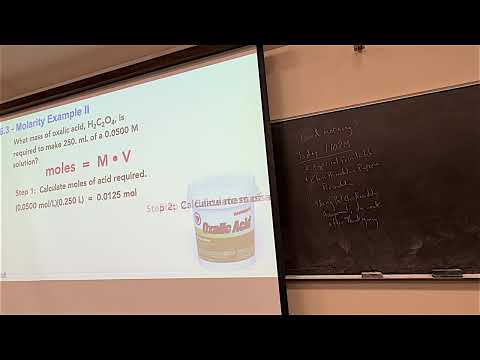
- For 250 mL of 0.0500 M oxalic acid, multiply concentration by 0.250 L to find 0.0125 mol.
- Convert the required moles to mass using oxalic acid’s molar mass, about 90.04 g/mol, yielding 1.13 g.
- This method reverses a concentration calculation: specify the solution volume and molarity, then determine the mass to weigh.
- Dilution adds solvent without changing the solute’s moles, so initial and final concentration-volume products are equal: C1V1 = C2V2.
- A volumetric pipet transfers a measured aliquot of concentrated stock into a volumetric flask, which is then filled to its mark and mixed.
- Adding water to 0.850 L of 5.00 M copper(II) nitrate to make 1.80 L gives a final concentration of 2.36 M.
- The initial volume must be paired with the initial concentration, and the final volume with the final concentration; matching volume units can be milliliters or liters.
- Diluting 20 mL of 3.00 M HCl with 100 mL of water gives 120 mL total and a final concentration of 0.50 M.
- Diluting 50 mL of 3.0 M NaOH to 0.50 M requires a final volume of 300 mL, so add 250 mL of water.
- Diluting 60 mL of 0.25 M HCl to a final volume of 500 mL gives 0.030 M HCl.
- When the problem asks how much water to add, subtract the original solution volume from the calculated final volume.
- Mass percent is mass of the component divided by total solution mass, multiplied by 100; a 10% mass solution contains 10 g solute per 100 g solution.
- A mixture of 25 g NaCl and 55 g KCl contains 31.3% NaCl by mass; the KCl percentage can be found by subtraction from 100%.
- For the spinal-fluid example, 3.75 mg glucose in a 5 g sample is about 0.075% by mass after converting milligrams to grams.
- Volume percent uses component volume divided by total solution volume; 50 mL ethylene glycol in 170 mL solution is 29.4% by volume.
- Parts per million is the solute mass divided by total solution mass, multiplied by 10^6; parts per billion uses 10^9.
- For dilute aqueous samples, the lecture approximates water density as 1.00 g/mL to convert a measured volume into solution mass.
- A sample containing 5 mg of pollutant per 100 g of solution contains 50 ppm after converting 5 mg to 0.005 g.
- Keep numerator and denominator in the same mass units before calculating ppm; convert solution volumes to mass when needed.
- Assuming water density of 1.00 g/mL, one liter of water has a mass of about 1,000 g.
- At 75 ppm arsenic, one liter contains 0.075 g of arsenic, based on 75 parts per million by mass.
- The example discusses a reported change in an allowable well-water arsenic level from 10 ppm to 50 ppm and uses a 75 ppm sample to demonstrate exposure calculations.
- The calculation translates a concentration into an amount consumed, giving a quantitative basis for discussing water-quality reports.
- A 5 mL unknown solution leaves 98.5 mg of compound after evaporation; analysis reports 49.9% oxygen, 37.5% carbon, and 12.6% hydrogen.
- Assuming a 100 g sample converts the percentages to grams; converting those masses to moles and dividing by the smallest amount gives the empirical formula CH4O.
- The measured molar mass, about 32 g/mol, matches the empirical-formula molar mass, so the molecular formula is also CH4O.
- Converting 98.5 mg to 3.07 × 10^-3 mol and 5 mL to 0.005 L gives a solution concentration of 0.614 M.
- Chemistry 221 covers sections 7.1 and 7.2; stoichiometry is reserved for the beginning of Chemistry 222.
- A chemical reaction transforms starting materials into desired products; hydrogen and oxygen forming water is an introductory example.
- Reactants appear to the left of the arrow and products to the right; an example discussed is solid aluminum reacting with gaseous oxygen to form solid aluminum oxide.
- State symbols identify substances as solids, liquids, gases, or aqueous solutions, and the large numbers before formulas are stoichiometric coefficients.
Transcript excerpt
0:00 Good morning. Happy Monday. Cool to have you here. Hope you had a great weekend. Today is class presentations day. So, when you come to lab this afternoon at 1:10, uh we won't do the problem set six, quiz 6, all that kind of jazz. But what we'll do is you'll turn the empirical formula lab in that we did last Monday. And then the main thing will be that you'll give uh your class presentation to the group and you'll also turn in your class presentation paper. So again the presentation about 5 minutes long. You can use the podium in 251 to load up PowerPoint stuff like that. Uh if you wish to do that of course make sure you've got all that information ready, usernames, passwords, login apps or whatever you need these
0:47 days. Um make sure you have that ready to go. Uh, but you can also just get up and talk. All right, you can just get up and what I do called chalk talk. You can have notes in front of you. Uh, don't bring your paper, but note cards are cool. You can kind of flip through it that way. And honestly, that's fantastic. Uh, you'll also turn in the class presentation paper. The paper, uh, again, we've talked about we've been working on ref versions, all that kind of jazz. That'll be ready to go. I do recommend that you bring a copy of the postclass presentation assignment with you. This was something at the end of the class presentation packet that I gave you on the first day, but you can also get one online and stuff like that. Um the front page is you'll fill out the presentations as you see them. So, for example, maybe sodium will be first and
This is the start of the transcript. Save this video free for the whole transcript, searchable and time-coded.
In this course
Related notes
Summary, takeaways, and chapters were generated by AI from the video's transcript and may contain errors. The video belongs to its creator, Michael Russell.