110626 L1 Chemistry 221 Video Lecture
 Watch on YouTube →
Overview
Michael Russell reviews material for Chemistry 221's Monday midterm, which covers Chapters 4 and 5 and uses 12 multiple-choice questions plus 4 short-answer questions. The review works through molecular polarity, hybridization, sigma and pi bonds, bond angles, and molecular orbital theory, including bond-order and magnetic-property calculations for N₂⁺ and O₂⁻.
Key takeaways
- A dipole moment indicates molecular polarity, which depends on both bond polarity and molecular symmetry: symmetric SF₆ and linear BeF₂ are nonpolar, while NF₃ is polar because its lone pair breaks symmetry.
- Count electron clouds to determine hybridization and geometry: four clouds around boron in BCl₄⁻ give tetrahedral geometry and sp³ hybridization.
- Bond multiplicity maps directly to orbital bonds: a double bond is one sigma plus one pi bond, and a triple bond is one sigma plus two pi bonds.
- Molecular orbital bond order is calculated as ½(bonding electrons − antibonding electrons); the resulting values are 3 for N₂, 2.5 for N₂⁺, and 1.5 for O₂⁻.
- An unpaired electron makes a species paramagnetic: N₂⁺ and O₂⁻ are paramagnetic, and molecular orbital theory explains why neutral O₂ is paramagnetic despite its Lewis structure.
- For the second-row diatomic examples, orbital ordering changes between nitrogen and oxygen: N₂ uses the 2-1-2-1 sequence, while O₂ uses the 1-2-2-1 sequence.
Chapters
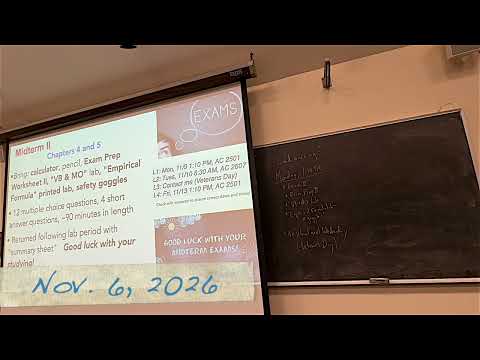
- Michael Russell says the Monday Chemistry 221 midterm covers Chapters 4 and 5, with 12 multiple-choice and 4 short-answer questions.
- Students should bring a calculator; a periodic table will be provided, and an exam-prep worksheet includes questions and answers for showing work.
- The valence bond and molecular orbital lab is due, and students should bring a printed empirical formula lab and safety goggles.
- Wednesday is closed for Veterans Day, so there is no lecture or office hours.
- A dipole moment measures molecular polarity, so a question asking which molecule has one is asking which molecule is polar.
- Radon is a single atom, not a molecule, and should be excluded from the molecular comparison.
- SF₆ is nonpolar because its six identical S–F bonds are arranged symmetrically around sulfur.
- BeF₂ is nonpolar with two identical fluorines arranged on opposite sides of beryllium, while NF₃ is polar because its lone pair disrupts symmetry.
- For BCl₄⁻, place boron at the center and count 32 valence electrons: 3 from boron, 28 from four chlorines, and 1 for the negative charge.
- Four B–Cl bonds give boron four electron clouds and a tetrahedral electron-pair geometry.
- Tetrahedral electron-pair geometry corresponds to sp³ hybridization; Russell also reviews linear as sp, trigonal planar as sp², and octahedral as sp³d².
- Every single bond is one sigma bond, formed by head-to-head orbital overlap.
- A double bond contains one sigma bond and one pi bond; its second line represents the pi bond.
- The cystine structure discussed contains 13 sigma bonds and 1 pi bond.
- A triple bond consists of one sigma bond and two pi bonds.
- Determine bond angles from electron-cloud geometry around each atom, rather than measuring the simplified Lewis drawing.
- The sulfur with two lone pairs and two single bonds has four electron clouds and a tetrahedral arrangement, giving an angle near 109.5°.
- The carbon with one double bond and two single bonds has three clouds and trigonal planar geometry, giving an angle near 120°.
- The nitrogen with three bonds and one lone pair has four clouds and a tetrahedral electron geometry, giving an angle near 109.5°.
- A neutral nitrogen atom has 7 electrons, with electron configuration 1s² 2s² 2p³.
- The three 2p electrons occupy separate orbitals before pairing, following the rule that electrons fill available orbitals singly first.
- For N₂, combine the orbitals of two nitrogen atoms to form molecular orbitals; two atomic orbitals produce two molecular orbitals, one lower in energy and one higher.
- For molecules involving nitrogen, Russell uses the 2-1-2-1 ordering for the 2p molecular orbitals: two π orbitals, one σ orbital, two π* orbitals, then one σ* orbital.
- Two nitrogen atoms contribute 14 total electrons to the N₂ molecular orbital diagram.
- Electrons fill from the lowest-energy orbitals upward; degenerate π orbitals receive one electron each before pairing.
- The completed neutral N₂ diagram has 10 bonding electrons and 4 antibonding electrons.
- Calculate bond order as one-half of bonding electrons minus antibonding electrons; neutral N₂ has bond order ½(10 − 4) = 3.
- To form N₂⁺, remove one electron from the highest occupied molecular orbital, leaving 9 bonding electrons and 4 antibonding electrons.
- N₂⁺ has bond order ½(9 − 4) = 2.5, which is greater than zero, so the model predicts a stable species.
- N₂⁺ is paramagnetic because its molecular orbital diagram contains an unpaired electron; neutral N₂ is diamagnetic.
- Each oxygen atom has 8 electrons and the atomic configuration 1s² 2s² 2p⁴.
- For oxygen and the heavier second-row cases discussed, use the 1-2-2-1 ordering: σ2p, two π2p orbitals, two π*2p orbitals, then σ*2p.
- Filling the O₂ diagram leaves unpaired electrons in antibonding π* orbitals, making oxygen paramagnetic.
- Russell notes that a basic Lewis structure does not reveal O₂'s paramagnetism, while molecular orbital theory does.
- Form O₂⁻ by adding one electron to the lowest unoccupied molecular orbital of neutral O₂, an antibonding orbital.
- The resulting count is 10 bonding electrons and 7 antibonding electrons, giving bond order ½(10 − 7) = 1.5.
- O₂⁻ remains paramagnetic because the added electron leaves an unpaired electron in the molecular orbital diagram.
Transcript excerpt
0:00 Good morning. Happy Friday. Hope your day is going well. Hope you have an even better weekend. We are in day 3 of an exam review for next Monday's midterm exam too. So for those of you in Monday's section, Monday, 110 PM, 2501, you'll come in, you'll do exam two, uh, exam two, like we've did talk about this format's identical to exam one, 12 multiple choice questions for short answer questions. Chapters 4 and 5 only. All right? So bring your calculator, definitely, although I don't know if you need it, period table will be there. To help you get ready for it, of course, besides the review, there is an exam prep worksheet also happening. This is a series of questions and the answers given.
0:50 You show your work how to go from the question to the answer. I'm hoping it's not too big of a deal, but if you do get stuck by all means, reach out to me, the tutors, your friends, stuff like that, it's a good set of skills to have before you take them in term. That's my cheesy reason for doing it. You'll also turn in the valence bond and molecular orbital lab. And bring a printed copy of the empirical formula lab. Of all the labs we're doing in chem 221. This one is probably the most spectacular because we're going to heat things with Bunsen burners, and we're going to use strong assets, and we're going to have a vacuum filtration setup, and color changes, and it's kind of a cool app, in my biased opinion. Your goggles will definitely be needed. So if you have your own pair of bring them, you'll have, you can use one of mine if you didn't bring it and stuff.
1:38 Should be pretty fun.
This is the start of the transcript. Save this video free for the whole transcript, searchable and time-coded.
In this course
Related notes
Summary, takeaways, and chapters were generated by AI from the video's transcript and may contain errors. The video belongs to its creator, Michael Russell.