ZOO*3700 - Lecture 12 - Feeding I: Deposit & Suspension
 Watch on YouTube →
Overview
Alex Smith compares deposit feeding and suspension feeding as widespread strategies shaped by where food is found and how organisms capture it. Deposit feeders process nutrient-poor sediment across vast areas, while suspension feeders use cilia, mucus, or appendages to collect dilute particles from moving water; examples include earthworms, sea cucumbers, sponges, krill, and bivalves.
Key takeaways
- Deposit feeders exploit organic matter mixed into sediment across broad areas of the seafloor, but must process large volumes because most ingested material is indigestible.
- Earthworms influence both soil structure and carbon cycling: their calciferous glands produce calcium carbonate, and their activity can accelerate leaf-litter decomposition.
- Sea cucumbers are ecosystem engineers that aerate and clean sediment; some also absorb food through respiratory trees connected to the anus.
- Suspension feeding requires both water flow and a capture mechanism, commonly cilia, mucus-based nets, or specialized arthropod appendages.
- Sponge choanocytes combine flagellar pumping with collar-based particle capture, and recent evidence suggests some sponges selectively retain particular bacteria.
Chapters
- The lecture begins a three-part survey of invertebrate feeding, covering deposit and suspension feeding before symbiosis, grazing, browsing, hunting, and parasites.
- The invertebrate digestive tract is organized into foregut, midgut, and hindgut, with a muscular pharynx involved in food intake.
- The course aims to connect feeding strategies with the ecology and evolution of the groups that use them.
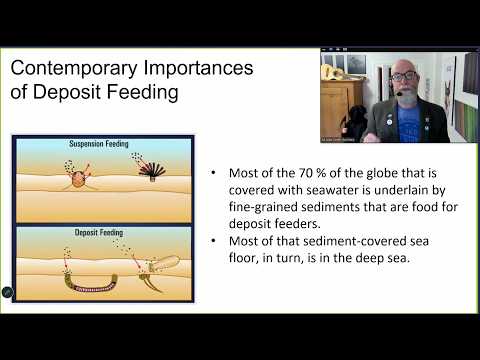
- Fine-grained marine sediments provide food across much of the seafloor, making deposit feeding important in deep-sea and other benthic habitats.
- Organic detritus, plankton, microbes, and feces settle into surface sediments, where deposit feeders consume material mixed with largely indigestible particles.
- Deposit feeding likely arose early in animal evolution, as organisms living beneath the photic zone could use detritus raining down from above.
- Direct deposit feeders, including some polychaetes and echinoderms, ingest sediment with little specialized particle selection.
- Indirect deposit feeders use structures such as tentacles, palps, cilia, or mucus to select and transport food before ingestion.
- Scaphopod mollusks use mobile captacula with ciliated, frilled surfaces to gather particles from the substrate and bring them to the mouth.
- Organic material makes up only a small share of sediment, and it may be difficult to digest or available for only a short time.
- Many deposit feeders compensate by ingesting large amounts and using long, coiled digestive tracts to increase processing time.
- Optimal foraging theory predicts choices that maximize net energy gain per unit feeding time, raising the question of how selective deposit feeders can be.
- Earthworms process soil using a muscular pharynx, crop, and gizzard, which break up and sort ingested material.
- Earthworm calciferous glands release calcium carbonate; production can rise with temperature and may affect carbon storage in terrestrial environments.
- Darwin studied earthworms at Down House, and carbonate granules produced by worms may persist in soils for very long periods.
- Introduced earthworms have altered North American forest leaf litter by accelerating decomposition and changing habitats used by plants such as spring ephemerals.
- Sea cucumbers use mucus-covered feeding tentacles to collect algae, invertebrates, and waste particles from sediment.
- By turning over the upper sediment layer, they reduce cyanobacterial mats, improve aeration, and remove microbes.
- A reef estimate cited in the lecture gives about 14 kilograms of feces per sea cucumber per year and roughly 64,000 metric tons across one reef, compared with the mass of five Eiffel Towers.
- Some sea cucumbers also absorb suspended food through respiratory trees connected to the anus, allowing deposit feeding through the mouth and suspension feeding through the rear opening.
- Echiuran spoon worms use a flattened, laterally curved proboscis to gather sediment particles and move them toward the mouth with cilia and muscular action.
- Mucus helps capture and concentrate food on the proboscis before ingestion.
- Suspension feeders capture particles suspended in water; the strategy evolved repeatedly in groups including sponges, brachiopods, bryozoans, mollusks, annelids, and arthropods.
- Suspension feeders need water flow, supplied either by their location or by their own movements, and a structure that captures food particles.
- Bryozoan cilia generate currents, produce or interact with mucus, sort particles, and deliver suitable food to the mouth.
- Some tunicates, including larvaceans, feed with large mucus houses that act as nets around the mouth.
- Crustaceans such as barnacles use specialized limbs as filters, combining food capture with appendages that may also serve other functions.
- Downstream ciliary collectors, such as snail veliger larvae, move particles into a food groove leading to the mouth.
- Upstream collectors, including some echinoderm larvae, divide the work between cilia that create flow and cilia that retain particles.
- Feeding strategy can change with life stage: a planktonic larva may suspension-feed even when its adult form feeds differently.
- Suspension feeders often face nutritionally dilute food and competition for space, so capture area and the volume of water processed constrain feeding.
- Sponge choanocytes use a flagellum to generate water flow and a collar to trap particles; research suggests sponges may selectively retain certain bacteria.
- Sponge filtration efficiency rises as pumping slows, with efficiency gains diminishing as pumping rate increases.
- Glass sponge structure has inspired proposed passive oil-cleanup designs, while krill use thoracopods to form filtering baskets.
- Bivalve gills use cilia to move water and capture particles; a tank demonstration shows bivalves clearing turbid water.
- The lecture closes with reminders about the week's lab data collection, the second lab report, the Invert R assignment, and the next case study.
Transcript excerpt
0:00 Good morning. Good morning. Good morning. Good morning. And happy Monday. Let's start out with some congratulations. First of all, put your right hand up in the air and your left hand up as well. Self five. You've got all of the words in the word find right off the bat. And uh let me just clear those for a second so we can continue. So, previously on zoologology 3700, uh last week we were talking about abiotic stressors, water stress on Monday and uh coincident with a uh an arrival in the terrestrial environment and temperature stress on Wednesday. And we talked about how temperature and precipitation or temperature and moisture have these
0:48 enormous kind of big picture effects on the biology of most living things. Uh we talked about regulation and conforming. Uh we talked about how to measure these things and the nuance involved in measuring and how we really want some kind of a uh a simplified uh elegant measure of thermal capacity particularly as we enter into the anthroposine and exist through the climate crisis. It will be very much associated with how we can predict winners uh winners and losers in in the climate crisis. And where are we going today? Well, today is the start of a three lecture voyage into all of the different ways that invertebrates have to feed. Uh, today we're going to talk about deposit and
1:35 suspension feeders. So, we're going to be in an in a marine uh environment for most of the day. On Wednesday, we're going to talk about symbiosis and grazing and browsing and hunting. And then a week from today, we're going to talk about parasites. So, just like Patrick, there's a lot to consume here. Um because as you can imagine with more
This is the start of the transcript. Save this video free for the whole transcript, searchable and time-coded.
Related notes
Summary, takeaways, and chapters were generated by AI from the video's transcript and may contain errors. The video belongs to its creator, Alex Smith.