ZOO*3700 - Lecture 11 - Abiotic stress II - Temperature
 Watch on YouTube →
Overview
Alex Smith explains how temperature shapes invertebrate physiology, behavior, and distribution, then evaluates three common tolerance measures: CTmax, chill-coma recovery, and heat-shock proteins. Examples from moths, beetles, snails, wasps, coral lineages, and thermal-tolerance databases show both the value of these tools and why protocol differences, sampling gaps, and biological variation matter when predicting climate-change impacts.
Key takeaways
- CTmax is not a single universally standardized measurement: heating increments, hold times, and endpoints such as spasms or loss of movement can change the estimated thermal limit.
- CCRT ranks cold recovery after a standardized exposure, but it is distinct from CTmin, which estimates a temperature threshold through a different assay.
- HSP70 helps refold damaged proteins, prevent aggregation, or support protein degradation, yet its presence is not a heat-specific signal because other stresses can induce it.
- GlobTherm's approximately 2,000-species dataset contains 389 invertebrate taxa, but strong Northern Hemisphere and ant sampling biases limit how confidently its broad patterns represent all invertebrates.
- Heat tolerance can vary within a species: Persian Gulf coral lineages were more heat tolerant than Indian Ocean lineages, and hybrid offspring inherited that capacity.
- Climate-driven range shifts can disrupt predator-prey overlap when interacting species move at different rates, creating effects that thermal-tolerance measurements alone cannot capture.
Chapters
0:00
Temperature, Biomes, and the Biphasic Effect on Performance
- Whittaker biome diagrams and Holdridge life zones use annual temperature and precipitation to predict broad patterns such as rainforest and tundra.
- Temperature affects enzyme activity, membrane properties, and muscle performance, often producing a biphasic response: performance rises toward an optimum and declines beyond it.
- Thermal stress is a major selective force across marine, freshwater, and terrestrial environments.
6:30
Invertebrate Thermoregulation and the Manduca Moth Example
- Invertebrates use behavioral thermoregulation, including basking, burrowing, changing activity times, and selecting habitats.
- Radiation, convection, conduction, and evaporation all influence heat gain or loss, linking thermal stress to water balance.
- Manduca sexta warms its flight muscles through shivering and can perform at high temperatures, while the winter moth Operophtera performs at low temperatures and loses performance as it warms.
11:03
CTmax Assays and the Problem of Defining Failure
- Critical thermal maximum, or CTmax, measures the temperature at which locomotor function is lost during gradual heating.
- A ramping assay might increase temperature by 0.5°C increments with one-minute holds; the heating schedule affects the measured endpoint.
- Researchers have used different endpoints, including spasms, loss of movement, failure to right itself, and paralysis, which complicates comparisons among studies and taxa.
- A suvid-style water bath, temperature coil, and camera can standardize heating and record responses in small invertebrates.
18:55
Chill-Coma Recovery Time Measures Cold Tolerance
- Chill-coma recovery time, or CCRT, times how long an animal takes to resume movement after a standardized cold exposure.
- After an organism is removed from an ice bath, faster recovery indicates greater cold tolerance; the slowest individuals are scored as less tolerant.
- Exposure duration, acclimation, cooling rate, and the definition of recovered movement can all change the result.
- CCRT provides a recovery-based index, while CTmin is a separate approach for estimating a temperature threshold.
24:38
HSP70 and Cellular Responses to Protein Damage
- Heat-shock factor 1 can induce heat-shock proteins such as HSP70, molecular chaperones that respond to stress-related protein damage.
- HSP70 can refold damaged proteins, prevent protein aggregates, or help co-chaperones degrade aggregates.
- Despite its name, the heat-shock response can also be induced by stresses such as hypoxia and aging, and acute heat does not trigger it in every taxon.
28:13
GlobTherm and Global Patterns in Thermal Tolerance
- The GlobTherm database compiled data for about 2,000 species, including 389 invertebrate taxa, across terrestrial, freshwater, intertidal, and marine environments.
- Its CTmax data show a mid-latitude peak, but records are unevenly distributed, with substantial Northern Hemisphere sampling and many insect records.
- Ants make up about 30% of the invertebrate records, and differences in CTmax ramping methods limit direct comparisons.
- A later aquatic database covered about 900 species, including 470 invertebrate taxa, and showed similar geographic and methodological limitations.
34:48
Elevation Gradients, Snail HSP Responses, and Thermal Melanism
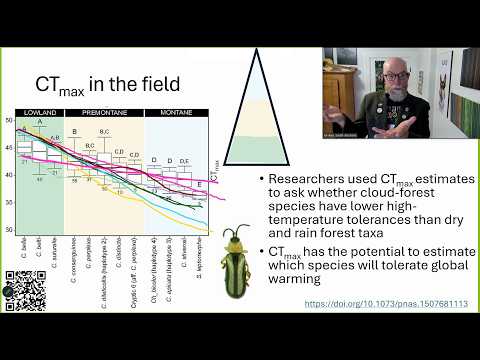
- Beetle CTmax measurements across Costa Rican cloud forest, rainforest, and dry forest elevations followed the predicted pattern: beetles from hotter low-elevation sites tolerated higher temperatures.
- HSP synthesis in intertidal snails increased with temperature, but the temperature of peak synthesis differed among species from high, middle, and low tidal zones.
- A wasp example supported thermal melanism: darker, high-elevation individuals absorbed more solar heat and showed better flight performance in cold conditions.
42:54
Climate Warming, Range Shifts, and Coral Heat Tolerance
- As temperatures exceed performance limits, species may shift elevation or move deeper in marine habitats, changing distributions and ecosystem structure.
- Coral lineages from the hotter Persian Gulf showed greater heat tolerance than lineages of the same species from the Indian Ocean.
- Crossing the coral lineages produced offspring that inherited heat tolerance, suggesting warmer-water populations may act as reservoirs of useful variation.
46:07
Museum Specimens Test Thermal Melanism Across Time
- Thermal melanism predicts that warming environments may favor lighter coloration because darker surfaces absorb more radiant heat.
- Researchers can test this prediction using natural-history collections by measuring color changes in specimens collected across decades.
- A butterfly series from Alberta's Rocky Mountains showed increasing lightness over roughly a century, but the pattern did not hold across the species' entire range.
47:55
Climate-Driven Predator-Prey Mismatch and Key Takeaways
- If predators and prey shift their ranges at different rates, their overlap can contract, reducing predator survival and potentially increasing prey abundance.
- A cod-plankton example illustrates how temperature-driven distribution changes can disrupt feeding relationships and alter population sizes.
- Reliable climate projections require thermal measurements across species ranges, sexes, and life stages, with methods and sampling limitations reported clearly.
Summary, takeaways, and chapters were generated by AI from the video's transcript and may contain errors. The video belongs to its creator, Alex Smith.