03 - InvertR - Assignment 1 - Dispersal - making your video
 Watch on YouTube →
Overview
Alex Smith frames the invertebrate R dispersal assignment as a three-minute elevator pitch: students must distill their research on larval dispersal among isolated deep-sea hydrothermal vents into a clear, engaging narrative. He gives a practical structure and production rules, including audience-aware language, three printouts, repeated practice, an unedited recording, and submission through an unlisted YouTube link.
Key takeaways
- The assignment’s three-minute limit is intended to build a transferable ability to condense complex research into a persuasive narrative for settings such as interviews, conferences, and graduate-school applications.
- A strong pitch should open with a hook, state why larval dispersal at isolated hydrothermal vents matters, and calibrate scientific terminology to peers and knowledgeable non-experts.
- The suggested structure connects an introduction and problem to three plots, their interpretation, and the consequences or next steps.
- Students must use the provided printouts rather than PowerPoint slides and should plan how annotations and handling the paper add value on screen.
- The final submission must be an unedited video under three minutes; repeated practice and peer feedback help improve both timing and delivery.
- YouTube uploads should be set to unlisted, verified as accessible by someone with the link, and submitted to CourseLink.
Chapters
0:00
Why the Invertebrate R Assignment Uses a Three-Minute Video
- The assignment asks students to communicate research on larval dispersal between isolated hydrothermal vents in a three-minute video rather than a long written report.
- Alex Smith presents concise scientific storytelling as a transferable skill for academic, government, and business settings.
- He recommends using an elevator-pitch scenario: explain the research, its importance, and what is needed within the brief time of a few elevator floors.
4:00
Build an Engaging Pitch Around the Audience and Research
- Start with a clear purpose and an opener that quickly explains why larval dispersal at deep-sea hydrothermal vents matters.
- Shape the explanation for scientific peers and knowledgeable non-experts; terms such as “metapopulation” are appropriate when used correctly.
- Organize the three minutes around an introduction, the problem, the three plots, how their analysis informs the problem, and the consequences or next steps.
- Use examples from Three Minute Thesis competitions to study concise presentation techniques and consider how to interact with each printout.
9:00
Record, Review, and Submit the Three-Minute Video
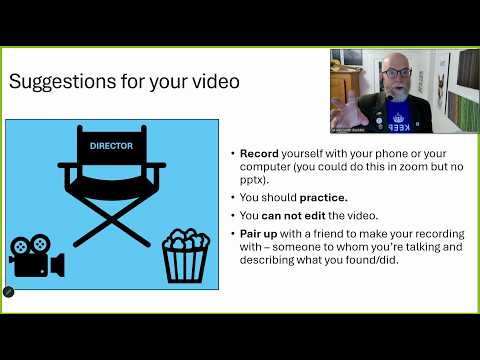
- Record with a phone or Zoom, use the assignment printouts instead of PowerPoint, and practice several times before choosing a take.
- Submit one unedited recording that starts and stops before the three-minute mark; Smith recommends rehearsing with friends, family, or another student for feedback.
- Make the printouts visible and actively annotate or draw on them; a clipboard, whiteboard, or reinforced backing such as a cereal box can stabilize the paper.
- Upload to YouTube as unlisted, test the link with another person to ensure it is not private, then submit that link through CourseLink.
Summary, takeaways, and chapters were generated by AI from the video's transcript and may contain errors. The video belongs to its creator, Alex Smith.