ZOO*3700 - Lecture 10 - Abiotic stress I - Waterloss
 Watch on YouTube →
Overview
Alex Smith explains how terrestrial invertebrates, especially insects, conserve water despite continuous losses through the cuticle, respiratory openings, and excretion. He compares cuticular waxes, spiracle control, the cryptonephridial system, isopod and snail adaptations, trehalose-based cryptobiosis, and Namib Desert beetles that collect fog, then connects water stress to community-level changes.
Key takeaways
- Terrestrial animals can lose water even in very humid air: permeable surfaces permit net water loss below roughly 99.4% relative humidity.
- Insect cuticular waxes reduce evaporation, but the cuticle must remain somewhat permeable so ammonia can diffuse out; extreme heat can melt waxes and trigger a lasting jump in water loss.
- Spiracle closure conserves water at the cost of oxygen uptake and carbon dioxide release, making respiratory water management a direct trade-off with activity and metabolism.
- The cryptonephridial system uses countercurrent flow and potassium chloride concentration to recover water from insect feces, allowing some insects to excrete exceptionally dry waste.
- Terrestrial isopods compensate for a thin, water-permeable cuticle with humid microhabitats, staggered biphasic molts, pseudotracheae, and brooding in a moisture-retaining marsupium.
- Some Namib Desert beetles collect fog with specialized wing-cover surfaces, while trehalose helps other invertebrates survive dehydration by stabilizing cellular structures.
Chapters
0:00
Why Water Loss Is a Major Terrestrial Stress
- The lecture begins a two-part abiotic stress unit, covering water loss before temperature stress.
- Terrestrial animals can lose body water across permeable surfaces below roughly 99.4% relative humidity.
- Despite ultraviolet radiation, temperature swings, and water scarcity, animal diversity is highest on land.
4:00
Insect Water Budgets and the Small-Body Problem
- Insects gain much of their water from food, with absorption occurring primarily across the midgut into the hemolymph.
- Water leaves through the cuticle, respiratory system, and watery feces or urine; Malpighian tubules and the hindgut help conserve it.
- Small animals face faster water loss because surface area increases more slowly than volume as body size increases.
- Insects can detect environmental conditions using compound eyes, antennae, palps, legs, and ovipositors.
11:00
Cuticular Waxes, Humidity, and Heat Damage
- The insect epicuticle contains lipid and wax layers deposited through wax canals, creating a key barrier to water loss.
- The cuticle cannot be fully waterproof because ammonia must diffuse out, creating a trade-off between water retention and waste removal.
- Cuticular water loss rises as relative humidity falls, but temperature-related loss can remain stable until a species-specific threshold.
- Above that threshold, wax components can melt and cause a sharp, lasting increase in water loss.
18:00
Spiracles Balance Water Retention and Oxygen Intake
- Insects reduce respiratory water loss by closing spiracles, the openings that connect the tracheal system to the air.
- Spiracle closure limits oxygen intake and carbon dioxide release, so it can constrain movement and metabolism.
- Closer muscles can regulate spiracles at different rates along the body, helping direct airflow through the tracheal system.
- Closing even half the spiracles can sharply reduce water loss; closing 80 to 90 percent retains more water but further limits gas exchange.
24:00
Cryptonephridial Systems Recover Water from Insect Feces
- In beetles and some butterflies and moths, Malpighian tubules lie alongside the rectum to form a cryptonephridial system.
- Opposing flows of feces and tubule fluid create countercurrent exchange, drawing water across the rectal epithelium and back into the hemolymph.
- Leptophragmata concentrate potassium chloride, strengthening the osmotic pull that extracts water from the gut contents.
- The system can produce extremely dry feces and, in some cases, help insects take up water vapor from the atmosphere.
31:00
Terrestrial Isopods: Molting, Pseudotracheae, and Brooding
- Terrestrial isopods have a thinner, less waxy epicuticle than insects, making them dependent on humid refuges under logs and in crevices.
- Their biphasic molt sheds the posterior and anterior body regions at different times, limiting the exposure associated with a full-body molt.
- In terrestrial lineages, gills are replaced by pseudotracheae that support gas exchange while improving tolerance of dry conditions.
- Females brood eggs and early larvae in a marsupium beneath the body, maintaining a humid environment during development.
39:00
Snail Shell Color and Tardigrade Cryptobiosis
- Terrestrial snails such as Cepaea nemoralis can withdraw into their shells, seal the opening with mucus, and estivate through dry periods.
- Dark shell morphs become inactive sooner than light morphs when humidity drops below about 50%, while lighter shells are more common in high-solar-intensity settings.
- Tardigrades, rotifers, nematodes, and some crustacean eggs can enter cryptobiosis; tardigrades contract into a desiccation-resistant tun.
- Antarctic tardigrades recovered from samples stored for about 30 years resumed activity after water was added.
42:00
Trehalose Protects Cells During Dehydration
- The non-reducing sugar trehalose occurs at high concentrations in dehydration-resistant tardigrades, nematodes, crustaceans, and insect larvae.
- One proposed mechanism is that trehalose forms hydrogen bonds with cellular macromolecules, helping preserve their structure as water disappears.
- A second hypothesis is vitrification, in which trehalose forms a glass-like matrix that protects proteins and membranes until rehydration.
46:00
Namib Desert Beetles Harvest Water from Fog
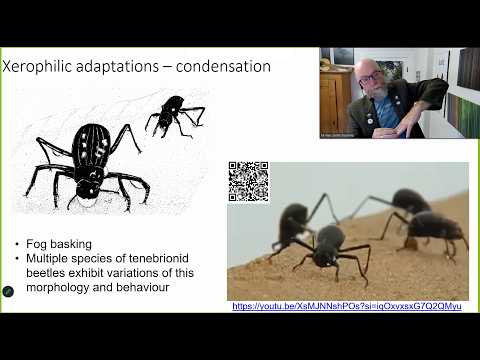
- Namib Desert fog-basking beetles climb dunes and raise their hind ends so moisture from fog condenses on their bodies.
- Specialized bumps on the wing covers collect droplets, while waxy surfaces and ridges channel water toward the beetle's mouth.
- Other desert beetles, including Lepidochora discoidalis, make furrows in the sand to collect moisture and drink from the ridges.
50:00
Water Stress Changes Invertebrate Communities
- Dry conditions can shift feeding from specialist species toward generalists that consume a wider range of plants.
- Parasitoids may infect or prey on hosts more successfully during dry seasons, while predator-prey consumption rates also change.
- The lecture closes the water-loss unit and previews temperature stress, alongside a lab assignment to write a dichotomous key.
Summary, takeaways, and chapters were generated by AI from the video's transcript and may contain errors. The video belongs to its creator, Alex Smith.