ZOO*3700 - Lecture 01 - Introduction
 Watch on YouTube →
Overview
Alex Smith introduces ZOO*3700 as a shift from learning the invertebrate phyla in ZOO*2700 to investigating their physiological, ecological, and evolutionary strategies. He emphasizes that invertebrates dominate biodiversity and ecosystem function despite most species remaining unnamed, then outlines the course’s lectures, labs, assessments, R-based assignments, and expectations for collaborative, responsible learning.
Key takeaways
- Invertebrates are central to ecosystem resilience and maintenance, and their enormous diversity makes them a major source of biological strategies for medicine, engineering, and material science.
- Only a small fraction of invertebrate species may be named, but phylogenetic relationships let biologists make testable predictions about the physiology and ecology of poorly known species.
- Smith’s course treats sensory biology from an invertebrate perspective: many organisms are tiny, may not see visible light as humans do, and rely heavily on chemical or mechanical cues.
- Smith distinguishes AI assistance from AI substitution: tools may support tasks such as generating R code, but should not replace data collection, analysis, or the effort required to learn.
- Peer study groups support learning and reflect how science is conducted collaboratively; shared lab work can also reduce specimen collection and its ecological impact.
- The Invert R assignments connect quantitative analysis to current conservation questions by asking students to examine deep-sea hydrothermal-vent communities under mining pressure.
Chapters
0:00
Why Invertebrate Diversity Matters
- Smith opens with a land acknowledgement for First Nations, Inuit, and Métis, noting that acknowledgement must lead to ongoing listening and respect.
- ZOO*2700 introduced 34 invertebrate phyla; ZOO*3700 examines the physiological, ecological, and evolutionary dramas among them.
- A recent estimate places insect diversity at roughly 14–20 million or more species, while only about 3% of all invertebrate species may have been named.
- Invertebrates contribute immense biomass and ecosystem services, and their energy-efficient adaptations may inspire medical and engineering solutions.
5:00
Course Goals, BlueSky, and the Teaching Team
- Smith presents phylogeny as a way to make predictions about the biology of unnamed species from better-known relatives.
- Students can follow invertebrate professionals through BlueSky starter packs or public lists; course posts can use #ZOO3700.
- Dr. Shayla Tuttle-Raycraft leads the lab, drawing on research into suspended solids and freshwater mussel ecophysiology.
- TA Jared Shaft is a PhD student in the Gillis lab, and Sam Muhammad is a master’s student in Sarah Alderman’s lab.
10:00
Alex Smith’s Research and Student Check-Ins
- Smith studies terrestrial invertebrates in Costa Rica’s Área de Conservación Guanacaste, a UNESCO World Heritage area containing about 2.6% of the planet’s species.
- His field experience also includes the Ottawa and Madawaska rivers and 18 years of research in the University of Guelph’s Dairy Bush.
- After Monday and Wednesday lectures, Smith keeps the Zoom room open for 30 minutes of questions; individual office hours can be arranged by email.
- Zoom polls invite students to share their majors, year of study, interests, and favorite invertebrate-film examples.
15:00
Course Schedule and Learning Objectives
- Regular lectures meet synchronously on Zoom Mondays and Wednesdays from 9:30 to 10:30 and are recorded; in-person labs are not recorded.
- There are no lectures or labs during the fall break week, and Friday course time is reserved for preparing for evaluations and assignments.
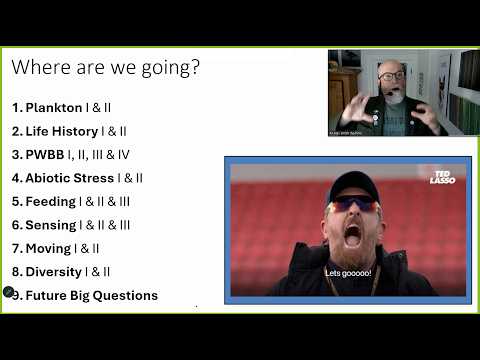
- The course begins with plankton, then covers life histories, problems with being big, abiotic stress, feeding, sensory biology, and locomotion.
- Later topics address invertebrate diversity estimates, possible insect declines, and opportunities to carry invertebrate research into students’ careers.
20:00
Strategies for Success and Phylogenetic Reasoning
- Smith recommends attending class and lab when possible, managing time deliberately, asking for help early, and forming study groups of two to four.
- Students should read lab worksheets before class and use Friday time to keep up with lecture and lab assessments.
- A central course idea is that most life is under a centimeter and weighs less than a gram, so human vision is a poor default for understanding how organisms sense the world.
- Although most species remain undescribed, the known invertebrate phylogeny can support predictions about ecological and physiological strategies across lineages.
25:00
Course Conduct, Marine Diversity, and AI Policy
- Smith asks students to treat classmates and instructors as colleagues: participate respectfully, keep an open mind, and give feedback when course practices work or fail.
- Species diversity is especially high in tropical terrestrial habitats because of insects, while marine environments contain the greatest diversity across phyla and deeper evolutionary lineages.
- The syllabus forbids submitting AI-generated text, images, audio, video, or other data as a student’s own work.
- Smith cites a study of nearly 30,000 students: AI users completed some homework faster but performed significantly worse on final exams.
30:00
Keeping AI Off the Learning Path
- Students describe using AI for concept explanations, practice questions, quizzes, and feedback, while others avoid it or worry about dependence.
- Smith argues that learning requires discomfort and synthesis; using AI to replace that process can reduce learning even when homework is completed more quickly.
- Citing Casey Dunn’s discussion of AI in research, Smith recommends keeping large language models off the data path: do not put data into a black box and outsource the science.
- AI may help generate R code, for example, but researchers must still collect, clean, analyze, and iteratively check the data themselves.
35:00
Missed Classes, Questions, and Evaluation Weights
- Recorded lectures, slides, captions, and transcripts can help students catch up; transcript search can locate a topic, though specialized biological terms may be misrecognized.
- Labs are not recorded, so students should contact Shayla Tuttle-Raycraft or the TAs about lab questions and Smith about lecture questions.
- The course includes two Invert R assignments worth 10% each, case studies worth 20% total, and a final exam worth 20%.
- There are 12 case studies with roughly 10 questions each; each question is low-stakes, and students have a 90-minute attempt within a 94-hour window.
40:00
Lab Reports, Peer Learning, and R Skills
- Labs include worksheets, group reports, and individual reports based on experiments students design, conduct, and analyze.
- Field work in the Dairy Bush and indoor work with mussels connect lab activities to the teaching team’s research expertise.
- Weekly case studies encourage steady practice rather than cramming, while lab reports model the process of doing and communicating science.
- Lab work and Invert R assignments build students’ R skills for analyzing and visualizing scientific data; peer collaboration also reduces the number of specimens collected.
45:00
Invert R Projects on Deep-Sea Mining and Next Steps
- Two Invert R assignments examine real data on deep-sea hydrothermal-vent communities facing pressure from mining development.
- Students analyze and visualize data in R, then present their findings in a three-minute video rather than a conventional written assignment.
- Smith stresses that limited biological knowledge of the deep sea leaves policymakers without enough information to assess potential mining harms.
- Assignment videos and PDFs are scheduled for release at noon; Smith encourages students to review course materials before next week’s plankton lectures and labs.
Summary, takeaways, and chapters were generated by AI from the video's transcript and may contain errors. The video belongs to its creator, Alex Smith.