01 - InvertR - Assignment 1 - Dispersal – Scenario
 Watch on YouTube →
Overview
Alex Smith frames the dispersal assignment around deep-sea hydrothermal vents: globally scattered habitats totaling about 50 km², with dense, specialized communities whose connectivity affects both biodiversity and vulnerability to mining. Students use public DNA sequences in R to compare two copepod species across vents and regions, estimating dispersal with phylogenetic branch lengths and isolation-by-distance analysis before presenting conclusions in an unedited three-minute video.
Key takeaways
- Deep-sea hydrothermal vents combine high biomass and specialized biodiversity with a global footprint estimated at only about 50 km², making disturbance a potentially concentrated conservation threat.
- Metapopulation theory is relevant to vents because fields are patchy and can disappear or re-form; dispersal between them may enable recolonization after local extinction.
- Larval life history predicts dispersal potential: feeding planktotrophic larvae can remain in the plankton far longer than yolk-supported lecithotrophic larvae, allowing much greater travel distances.
- Phylogenetic divergence and isolation-by-distance patterns provide indirect genetic evidence of connectivity when direct tracking of deep-sea larvae is impractical.
- The assignment uses DNA barcodes from two vent copepod species to test how dispersal differs across vents and regions, then links those results to the resilience of populations facing mining.
- Arvid Pardo’s principles for seabed governance—shared benefit, equity, and environmental protection—frame the conflict between mineral extraction and poorly documented deep-sea biodiversity.
Chapters
0:00
Assignment 1: Estimating Vent Connectivity from DNA
- The dispersal assignment uses real, publicly available DNA sequences and R to examine invertebrate connectivity at deep-sea hydrothermal vents.
- Students follow an existing analysis routine, interpret the results, and explain their conclusions in an unedited three-minute video rather than a written report.
- The broader course also considers how development pressures, especially seabed mining, could affect invertebrate biology.
3:00
Angus Reveals Dense Life at Hydrothermal Vents
- In 1977, Bob Ballard and Woods Hole Oceanographic Institution researchers explored near the Galápagos using Angus, a camera-and-temperature instrument lowered to the seafloor.
- The team found dense vent communities where earlier expectations had suggested little life could exist far below sunlight.
- Pompeii worms, giant metal-incorporating snails, and yeti crabs illustrate the specialized organisms and symbioses discovered at vents.
10:00
Patchy Vents, Endemic Species, and Population Boundaries
- Hydrothermal vent fields occur along features such as the Mid-Atlantic Ridge and East Pacific Rise; their combined area is estimated at only about 50 km².
- Vent communities can have high biomass and species richness, with many species restricted to vents or particular biogeographic regions.
- These patterns raise a population question: do vents function independently, or as connected local populations in a metapopulation?
13:00
Metapopulation Theory Explains Colonization and Local Extinction
- A metapopulation consists of local breeding populations in separate habitat patches, with dispersal allowing recolonization after local extinction.
- Presence–absence data can be represented as an incidence matrix, making colonization and extinction patterns relatively straightforward to model.
- Vent fields fit the framework because active sites are patchy and can open or close over decades or longer.
18:00
Larval Strategies Set Potential Dispersal Distances
- Because many adult marine invertebrates are sedentary, larval movement is central to estimating connectivity between vent patches.
- Planktotrophic larvae feed in the water column and may remain there for weeks, months, or years; lecithotrophic larvae rely on yolk and generally have shorter planktonic durations.
- Longer planktonic duration generally permits greater dispersal: planktotrophic larvae may travel thousands of kilometres, while lecithotrophic larvae may travel only tens of kilometres.
25:00
Phylogenies Use Genetic Variation as an Indirect Dispersal Measure
- Tracking individual larvae through the abyssal ocean is impractical, so the assignment infers connectivity indirectly from genetic data.
- Gene flow tends to homogenize genetic variation among sites; limited dispersal can allow populations to become more differentiated.
- Phylogenetic branch lengths quantify sequence divergence, with the displayed mitochondrial example linking roughly 0.9% divergence to about one or two million years.
30:00
Isolation by Distance Tests Genetic and Geographic Separation
- Isolation by distance correlates pairwise genetic differentiation with geographic distance; the pairwise observations are not independent, so ordinary regression is not appropriate.
- In Rocky Mountain blackflies, genetic differentiation increased with geographic separation, including across distances of only about 3–4 km.
- A positive trend suggests restricted dispersal, while a flat relationship is consistent with effective connectivity across the sampled sites.
33:00
Deep-Sea Mining Puts Vent Biodiversity and Governance in Focus
- Mining interest grew around polymetallic nodules in the Clarion-Clipperton Zone and mineral deposits associated with hydrothermal vents.
- Maltese delegate Arvid Pardo argued for international seabed governance based on benefits for all humanity, equitable distribution, and marine protection; the International Seabed Authority now regulates mining in international waters.
- Mining proposals and regulatory areas overlap with vent regions, while Canadian policy has not authorized seabed mining under its jurisdiction and The Metals Company has pursued seabed extraction.
- DNA barcoding from explored zones has revealed many species new to science; the assignment uses some publicly available sequences collected in this context.
43:00
Analyze Two Copepod Species and Present the Conservation Implications
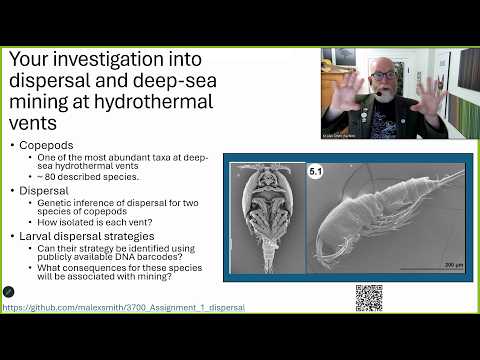
- Students analyze two copepod species across multiple vents in two regions, using R to estimate isolation and dispersal with phylogenies and isolation by distance.
- The analysis asks students to infer each species’ dispersal strategy and compare what the two genetic approaches indicate.
- The final deliverable is an unedited three-minute video answering four assignment questions, using physical materials to support the explanation.
- The R routine is transferable to other DNA datasets, taxa, courses, or future thesis projects.
Summary, takeaways, and chapters were generated by AI from the video's transcript and may contain errors. The video belongs to its creator, Alex Smith.