Wed Nov 4, 2026 Lecture (L28) Stewart Sections 4.6 Newton’s Method and 4.7 Antiderivatives (Part 1)
 Watch on YouTube →
Overview
The lecture develops Newton’s method from tangent-line geometry, deriving the iteration formula and applying it to approximate √3 from the initial guess 3. It then introduces antiderivatives as functions whose derivatives equal a given function, using x² to show why antiderivatives differ by an arbitrary constant; the material falls under Stewart Sections 4.6 and 4.7.
Key takeaways
- Newton’s method follows from a tangent-line step: xₙ₊₁ = xₙ − f(xₙ)/f′(xₙ), moving from the current estimate to where its tangent crosses the x-axis.
- For f(x) = x² − 3 starting at x₁ = 3, Newton’s method produces x₂ = 2, x₃ = 7/4, and x₄ = 97/56, a close approximation to √3.
- A Newton iteration is undefined when the derivative at the current estimate is zero, and some other starting values may fail to converge usefully.
- To verify that F is an antiderivative of f, differentiate F and check whether the result equals f; for example, the derivative of x³ is 3x², not x².
- Adding any constant to an antiderivative leaves its derivative unchanged, so the general antiderivative of x² is x³/3 + C.
Chapters
- The Friday quiz covers Sections 4.5 and 4.6, including Newton’s method.
- Section 4.7 begins here because antiderivatives need more class time, with rectilinear motion planned for Monday.
- The upcoming exam covers all of Chapter 4 plus Section 3.7 on L’Hôpital’s rule.
- Newton’s method estimates a root, an x-value where a function’s output is zero.
- For a tangent triangle at x₁, the vertical height is f(x₁) and the tangent slope is f′(x₁).
- Using rise over run gives a horizontal step of f(x₁)/f′(x₁), so the next estimate is x₂ = x₁ − f(x₁)/f′(x₁).
- Choose an initial estimate x₁, then repeatedly calculate xₙ₊₁ = xₙ − f(xₙ)/f′(xₙ).
- When the method converges, successive estimates move closer to the root.
- If f′(xₙ) = 0, the formula divides by zero and provides no next estimate; other starting points can also send an estimate too far away.
- The positive root of f(x) = x² − 3 is √3; the worked example begins with the deliberately rough estimate x₁ = 3.
- Since f(3) = 6 and f′(3) = 6, Newton’s formula gives x₂ = 3 − 6/6 = 2.
- At x₂ = 2, f(2) = 1 and f′(2) = 4, giving x₃ = 2 − 1/4 = 7/4, or 1.75.
- At x₃ = 7/4, the calculations give f(x₃) = 1/16 and f′(x₃) = 7/2.
- The next estimate is x₄ = 7/4 − (1/16)/(7/2) = 97/56; an initial arithmetic error is caught and corrected from 107/56.
- Squaring 97/56 gives 9409/3136 = 3 + 1/3136, confirming a close approximation to √3.
- Repeated Newton steps converge quickly, though they do not produce the exact irrational value √3 in a finite number of these calculations.
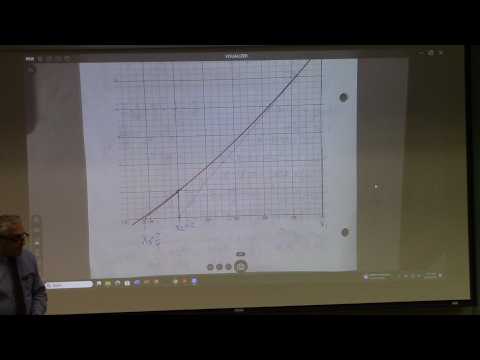
- For y = x² − 3, the positive x-intercept is √3, and the initial estimate x₁ = 3 lies well to its right.
- Moving along the tangent at x₁ reaches x₂ = 2; repeating the tangent construction reaches x₃ = 7/4.
- The resulting sawtooth path approaches the intercept, with later steps too small to distinguish clearly on the graph.
- Capital F is an antiderivative of lowercase f precisely when F′(x) = f(x).
- Testing the guess F(x) = x³ against f(x) = x² gives F′(x) = 3x², so x³ is not an antiderivative of x².
- Checking by differentiation directly tests a proposed antiderivative without first using a method for finding one.
- Dividing the guess x³ by 3 corrects the factor of 3: the derivative of x³/3 is x².
- Adding 17 does not change the derivative, because the derivative of a constant is zero; x³/3 + 17 is also an antiderivative of x².
- Every function x³/3 + C, where C is constant, is an antiderivative of x², and these are the only ones.
- A specified value of C gives a particular antiderivative; without choosing C, the expression describes the general antiderivative rather than one function.
Transcript excerpt
0:00 Morning, everybody. Uh happy Wednesday. This is Noah um lecture 28. We're going to be discussing two sections today. Uh I had originally just scheduled one, Newton's method, section 4.6. But looking at the calendar, I'll look at the calendar with you. [snorts] Well, we have uh quiz is coming Friday and the quiz will be on 4.5 and 4.6 stuff. But 4.7 is kind of a big deal. And [snorts] um we start discussing what are called antiderivatives and it takes uh it a lot of students have trouble making the transition from talking about derivatives to talking about antiderivatives. So, you know, Friday is a short day
0:46 because of the quiz. So, actually I'm going to start antiderivatives today, talk about them some more on Friday. And then on Monday we study what's called rectilinear motion, which is, you know, position, velocity, acceleration uh which is but from a standpoint of using antiderivatives. It's part of section 4.7. So, then then we're done with new material and then our our exam is a week from this coming Friday. And the exam covers all the sections of chapter four, but then also covers section 3.7. And remember that 3.7 was L'Hôpital's rule. And that was we we covered that in class just a couple of days before exam two. And so I told you at the time it would not be on exam two. It would be on exam on exam three. So, there it is.
1:34 That section and then the sections of uh chapter four [snorts] will be on that exam. So, so you'll have some time to digest the content of section 4.7, antiderivatives um before the exam. Okay. Well, uh let's talk about this handout. Anybody have a Oh, here we Look at that. Oh, very nice.
This is the start of the transcript. Save this video free for the whole transcript, searchable and time-coded.
In this course
Related notes
Summary, takeaways, and chapters were generated by AI from the video's transcript and may contain errors. The video belongs to its creator, Barsamian's Math Videos.